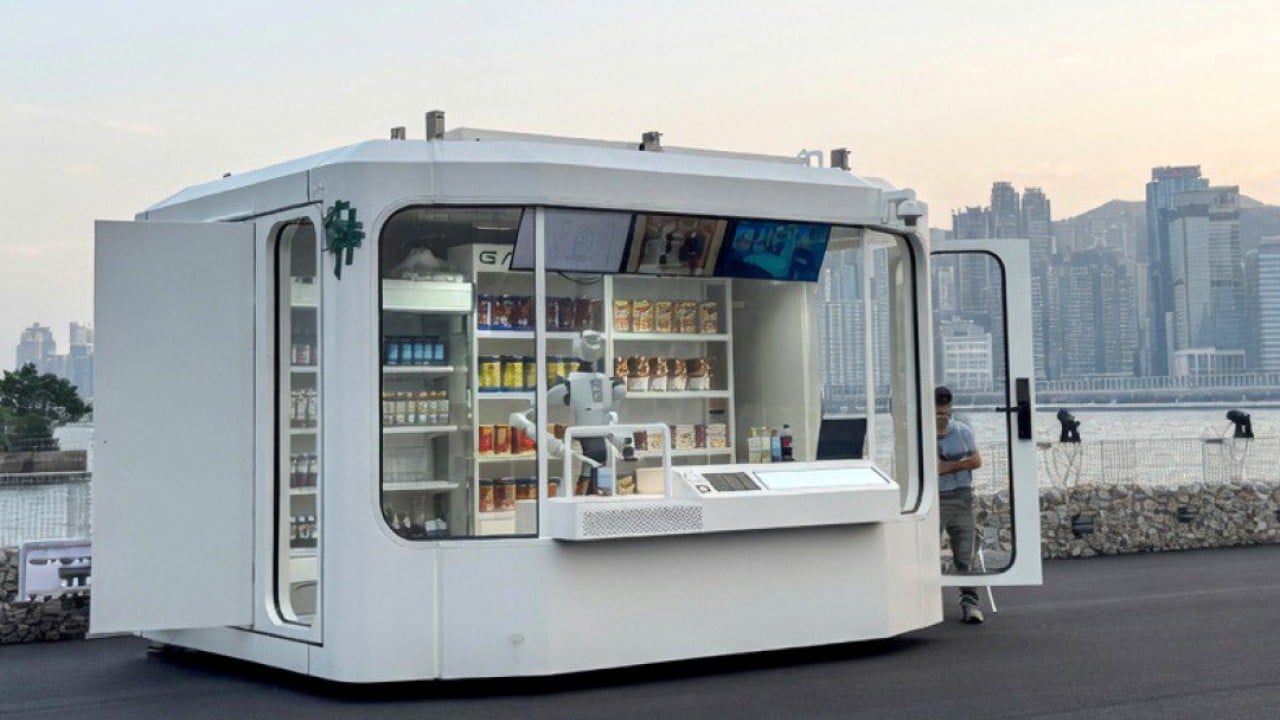
The tech press is currently swooning over the announcement that Hong Kong is launching its first convenience store operated by a humanoid robot. They are calling it a massive leap forward for retail automation. They are framing it as the inevitable answer to labor shortages.
They are completely wrong.
This is not the vanguard of retail. It is an incredibly expensive, wildly inefficient marketing stunt masquerading as innovation. I have spent fifteen years analyzing supply chains and automation deployments, and if there is one thing I have learned, it is that companies love to spend millions on highly visible novelty rather than solving invisible inefficiency.
Replacing a human cashier with a bipedal, multi-jointed robot to hand a customer a warm bottle of green tea is like buying a space shuttle to cross the street. It is a spectacular misallocation of capital that fundamentally misunderstands both the physics of robotics and the economics of convenience retail.
The Myth of the Automated Labor Solution
The prevailing narrative suggests that because Hong Kong faces a tightening labor market, stuffing a humanoid robot behind a counter solves the problem. This logic collapses under the slightest scrutiny.
Humanoid robots are mechanically fragile, computationally heavy, and agonizingly slow. A human convenience store worker does not just stand in one square meter and beep. They multitask with fluid efficiency. They unpack dense crates, spot a leaking milk carton before it ruins a shelf, judge the mood of an agitated customer, and clean up spilled coffee.
To make a humanoid robot perform these varied tasks in a cramped 7-Eleven or Circle K footprint requires astronomical engineering hours.
The Real Cost of "Cheap" Robot Labor
Let's break down the actual mechanics of this deployment versus traditional automation.
- The Humanoid Tax: A bipedal robot requires constant power, complex balance algorithms, and expensive actuators just to stand up and walk. You are paying a massive premium for form factor over function.
- The Speed Penalty: Watch any current humanoid robot pick up a bag of chips. The computer vision pipeline must scan the environment, calculate inverse kinematics, approach the object slowly to avoid crushing it, and place it down. A human teenager can do this ten times faster without thinking. In a high-density city like Hong Kong, where foot traffic velocity dictates survival, slowing down the transaction line is financial suicide.
- The Maintenance Tail: Who fixes the robot when a servo blows at 3:00 AM? Not a minimum-wage worker. You need a specialized robotics technician on call. Your labor costs did not disappear; they shifted from the retail ledger to a high-priced engineering contract.
We Solved Autonomous Retail A Decade Ago
The irony of this entire push is that the retail industry already perfected automated convenience stores years ago. They just do not look like C-3PO.
Vending machine clusters in Japan and automated micro-markets like Amazon Go proved that if you want to remove human labor from retail, you eliminate the counter entirely. You use weight-sensing shelves, ceiling-mounted camera arrays, and smart turnstiles.
[Customer Enters] -> [Takes Item Off Shelf] -> [Walks Out] = Efficient Automation
[Customer Enters] -> [Waits For Humanoid Robot To Mimic A Human Cashier] = Theater
By forcing a robot into a human shape to operate a store designed for humans, operators are making the job harder for the machine. It is a design failure. If a store does not need a human clerk, it does not need a counter. It needs a smart wall.
The Dark Reality of the Return on Investment
Let’s talk about the numbers that the press releases conveniently omit. I have seen enterprise tech pilots tank because executives fell in love with the PR metrics instead of the unit economics.
A viable humanoid robot chassis currently costs anywhere from $30,000 to over $150,000, depending on the manufacturer, and that excludes the proprietary software layer and ongoing maintenance. In contrast, the average retail worker in Hong Kong earns around HKD $60 to $80 per hour.
When you factor in the inevitable downtime, software bugs, and the fact that a robot cannot restock a heavy beverage cooler without blocking the entire aisle, the timeline for breaking even stretches into absurdity.
The downside to my skeptical view is obvious: automation technology does improve over time. Eventually, component costs will drop. But right now, deploying this in a live commercial environment is not about operational efficiency. It is a billboard. It is a way for a retail brand to signal that they are future-proof to shareholders who do not know any better.
Dismantling the Frequently Asked Questions
When people look at these initiatives, they tend to ask the wrong questions because they are hypnotized by the sci-fi aesthetic.
Will humanoid robots take all retail jobs next year?
No. They will not take them next decade either. Retailers will continue to automate via smart kiosks, RFID inventory tracking, and self-checkout apps. Humanoid robots will remain confined to flagship experiential stores where the goal is foot traffic and social media impressions, not pure profit margins.
Isn't any step toward AI integration a good step for a business?
This is the ultimate trap. Integrating AI into your logistics backend to predict inventory shrinkage or optimize your cold chain is a brilliant move that saves millions. Putting a physical AI puppet behind a register to mimic human hands is a waste of computational power. Do not confuse physical robotics with digital intelligence.
The Actionable Pivot for Retail Operators
If you are a retail executive watching the news out of Hong Kong and feeling a sudden wave of FOMO, breathe out and close the vendor brochures.
Stop looking at humanoids. Focus on friction.
Your customers do not want an AI entity to hand them a sandwich. They want to get their sandwich and leave the store in under thirty seconds. If you want to future-proof your business, invest your capital into unglamorous, invisible infrastructure.
Upgrade your inventory tracking so you never run out of stock. Implement seamless mobile payment ecosystems. Optimize your distribution centers with automated guided vehicles (AGVs) where the environment is controlled and the ROI is proven.
Leave the expensive puppet shows to your competitors. Let them burn their capital on novelty while you build a faster, leaner, genuinely automated supply chain that wins on price and speed.
The future of retail is completely invisible.