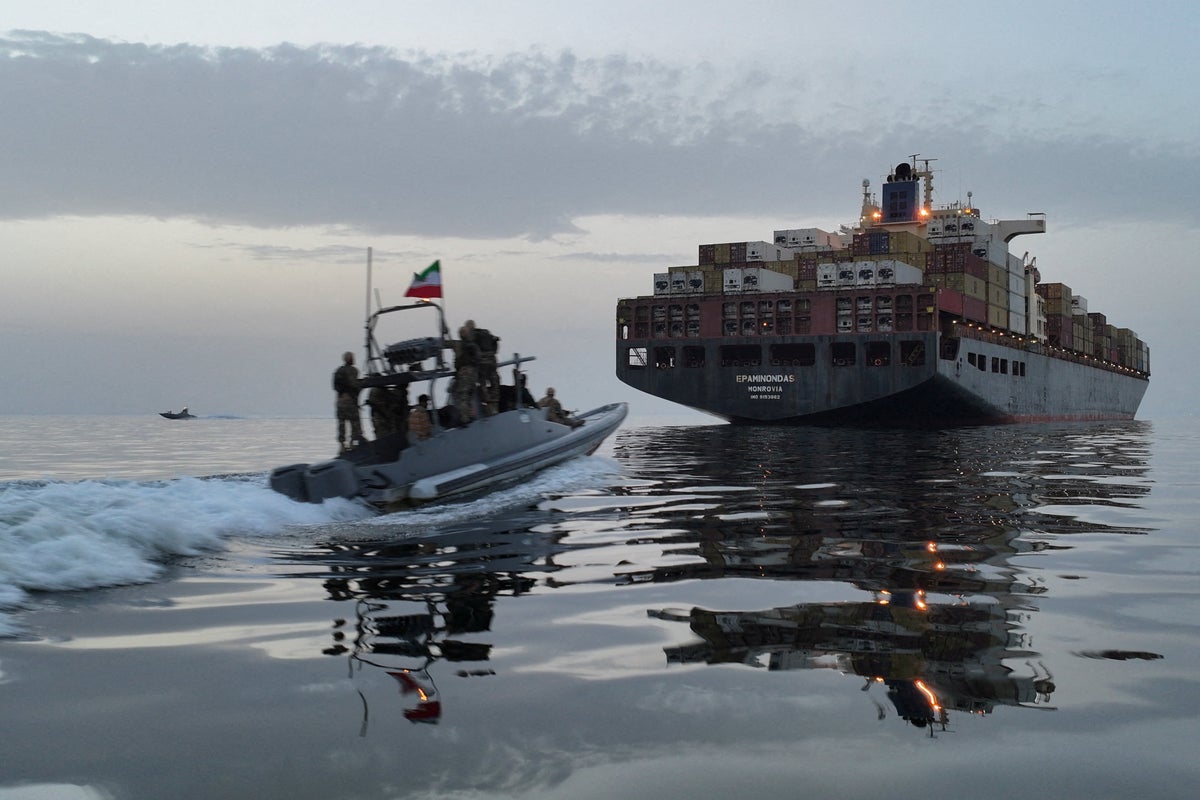
The Pentagon’s current obsession with "shooting and killing" Iran’s mosquito fleet—those swarms of Boghammar speedboats and armed dhows—is a masterclass in tactical vanity. We are watching a trillion-dollar military apparatus attempt to swat flies with a sledgehammer, while the flies are busy rewriting the rules of economic gravity. The prevailing narrative suggests that if the U.S. Navy simply increases its kinetic output and sinks enough small boats, the Strait of Hormuz will magically reopen, and the "blockade" will be broken.
This is a delusion. It ignores the fundamental reality of asymmetric littoral warfare: you cannot "defeat" a fleet that is designed to be deleted.
The Disposability Doctrine
Mainstream analysts love to count hulls. They see the destruction of Iranian conventional vessels—the Artesh frigates and corvettes—as a sign of success. I have seen military planners fall into this trap before, measuring progress by body counts and steel sunk. In the Strait of Hormuz, this metric is worse than useless; it is deceptive.
The Islamic Revolutionary Guard Corps Navy (IRGCN) does not operate on a platform-centric model. They operate on a systems-based denial model. Their speedboats are not "ships" in the traditional sense; they are low-cost, mass-produced munitions with outboard motors.
- Production Speed: Iran can manufacture these boats faster than the U.S. can cycle the legal and logistical hurdles to fire a $2 million RIM-116 Rolling Airframe Missile.
- Cost Asymmetry: A single Boghammar costs less than the fuel used by a Destroyer during a one-week patrol.
- Target Saturation: The IRGCN doesn't need to sink a U.S. warship to win. They only need to force the U.S. to expend high-value interceptors against low-value targets until the magazine is empty.
When President Trump orders the Navy to "shoot and kill" these boats, he is playing directly into a war of attrition where the math favors the underdog. Every "victory" for a U.S. Destroyer in a swarm engagement is an incremental drain on a finite supply of sophisticated ordnance that cannot be easily replenished in a theater thousands of miles from home.
Geography is the Supreme Commander
The "mosquito fleet" is not just about the boats; it is about the rocks they hide behind. The Strait of Hormuz is a 21-mile-wide chokepoint characterized by shallow waters and thousands of coastal inlets.
Large naval assets—the $13 billion Gerald R. Ford-class carriers—are effectively "boxed in" by the very geography they are meant to dominate. In these confined waters, radar clutter is a nightmare. A fleet of speedboats can blend into the background noise of thousands of civilian fishing vessels and dhows.
Imagine a scenario where a U.S. commander must decide, in seconds, whether a fast-approaching radar blip is a group of IRGC insurgents or a group of Omani fishermen. This is the Gray Zone at its most lethal. If you fire and hit civilians, you lose the information war. If you wait to confirm, you are already within the "kill zone" of a short-range anti-ship missile or a suicide drone launched from the deck of a $50,000 fiberglass hull.
The Invisible Blockade: Beyond the Boats
The biggest lie in the current reporting is that the "mosquito fleet" is the primary mechanism of the blockade. It isn't. The real blockade is psychological and insurance-based.
Iran does not need to physically block every mile of the Strait. They only need to make the cost of insurance for a VLCC (Very Large Crude Carrier) high enough that shipping companies refuse to enter. When a single "mosquito boat" fires a shot or drops a $10,000 Maham-2 mine, the maritime insurance premiums for the entire region spike.
- Market Sensitivity: Within 72 hours of a minor skirmish, oil prices can jump 20%.
- Supply Chain Multipliers: It isn't just about the oil. The blockade ripples through petrochemical feedstocks used in everything from medical supplies to semiconductor manufacturing.
- Strategic Reserves: Countries like India, which rely on the Strait for 80% of their oil, have only about 20 days of reserves.
The U.S. Navy can sink every boat it sees, but it cannot "sink" the risk profile. As long as the threat of an asymmetric strike exists, the blockade is effectively in place. The IRGC understands that persistence and ambiguity are more powerful than tonnage.
The Shadow Fleet Counter-Play
While the U.S. focuses on the "mosquitoes," they are missing the "ghosts." Iran’s primary tool for skirting the very blockade it imposes is its Shadow Fleet.
While the "mosquitoes" harass international shipping, a parallel fleet of aging, reflagged, and renamed tankers continues to move Iranian crude to markets in Asia, particularly China. They use "ship-to-ship" (STS) transfers in international waters, manipulate AIS (Automatic Identification System) transponders to "go dark," and employ layered beneficial ownership to mask the source of the oil.
The irony is thick: the U.S. is using its most advanced military technology to fight a swarm of speedboats, while the real economic war is being won by rusty tankers with fake paperwork and encrypted crypto-wallets.
The Failure of Kinetic Solutions
The "lazy consensus" suggests that more firepower is the answer. It isn't. In fact, increasing the kinetic intensity of the conflict only validates the IRGCN’s doctrine. They want the U.S. to engage. They want the footage of a billion-dollar ship being harassed by a boat that looks like a weekend pleasure craft.
To actually "break" the situation, the U.S. would need to move beyond the surface-level obsession with the mosquito fleet and address the structural vulnerabilities of the global energy market.
- Stop counting "kills": Sinking a Boghammar is not a victory; it is a tactical trade where you usually lose on the margin.
- Focus on Mine-Clearing, Not Swarm-Fighting: The most effective way to lower insurance premiums and reopen the Strait is to neutralize the "passive" threat of mines, which the mosquito fleet uses to exert control long after the boats have retreated to their "subterranean cities."
- Address the Shadow Market: If you want to hurt the IRGC, you don't shoot their boats; you seize their laundered assets and disrupt the digital payment rails that fund the production of those boats.
The mosquito fleet is a distraction—a highly effective, deadly, and cheap distraction. By focusing on the swarm, the U.S. is choosing to fight on the terrain where Iran is strongest. We are playing a game of checkers against an opponent that has already turned the board into a minefield.



