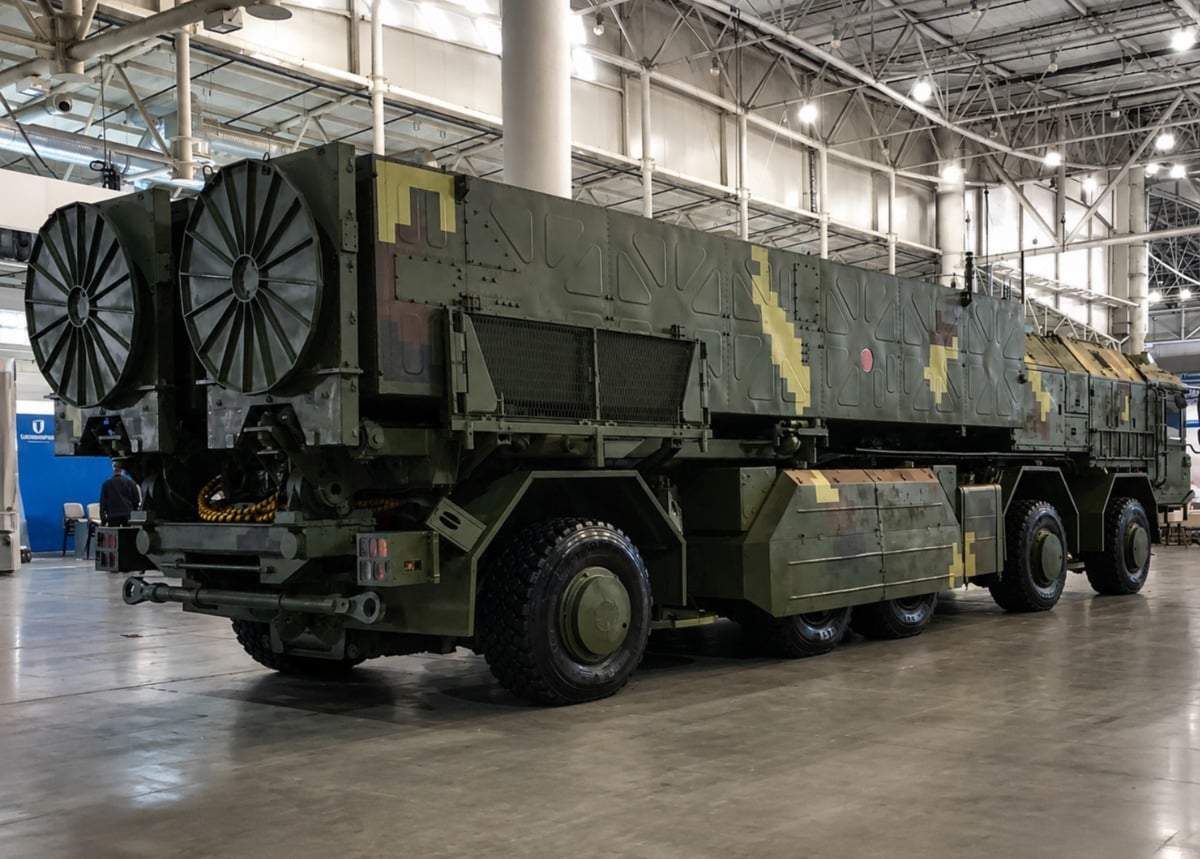
The mainstream defense press is currently having a collective meltdown over Ukraine’s domestic ballistic missile program. Headlines scream about "milestones" and "strategic self-reliance" after the recent test launches of a domestically developed ballistic system. The consensus is lazy, predictable, and fundamentally wrong. Commentators are treating the Sapsan (better known as the Hrim-2) as a geopolitical golden ticket—a weapon that will finally allow Kyiv to bypass Western red lines on deep strikes into Russian territory.
It is time to puncture this bubble.
I have spent years analyzing defense procurement and industrial scaling during active conflicts. I have watched governments burn through hundreds of millions of dollars chasing the prestige of domestic "sovereign" weapons while their frontline troops starved for basic, scalable attrition tools. The Hrim-2 is not the silver bullet the internet wants it to be. In fact, pouring precious wartime resources into high-end, capital-intensive ballistic missile production in the middle of an existential, GPS-denied, mass-attrition war is a profound strategic error.
The Myth of the Sovereign Deep Strike
The core argument for the Hrim-2 is simple: "We built it, so we can fire it wherever we want."
It is a seductive narrative. Since Western donors have consistently wrung their hands over the escalatory risks of letting Ukraine use ATACMS or Storm Shadows to hit airbases deep inside Russia, an indigenous 500-kilometer-range missile seems like the perfect legal loophole.
But this argument completely ignores the reality of modern defense industrial supply chains.
There is no such thing as a purely "indigenous" advanced ballistic missile in 2026. The Sapsan may be assembled in Ukraine, but where do you think the high-grade, radiation-hardened microchips for its inertial guidance systems come from? Where do the multi-axis CNC machines used to mill its solid-fuel rocket motor casings originate? What about the specialized chemical precursors required to mix stable, high-energy solid propellants at scale?
They come from Western supply chains. The moment those "indigenous" missiles start hitting strategic targets deep inside Russia, the very same Western allies who restrict their own weapons will quietly tighten the screws on the dual-use components Ukraine needs to build those missiles. A sovereign weapon built with non-sovereign components is a contradiction in terms.
The Brutal Math of Wartime Manufacturing
Let us do some basic, unvarnished math.
To build a short-range ballistic missile (SRBM) program that actually alters the course of a major theater war, you do not need five missiles. You do not need fifty. You need hundreds, delivered consistently, month after month.
Russia’s own Iskander-M—the system the Hrim-2 is frequently compared to—is produced by a state with a massive, intact, deeply integrated military-industrial complex operating on a 24/7 war footing. Even with all of Russia’s resources, their monthly production of Iskanders is estimated to be in the low dozens.
Now look at Ukraine’s industrial reality:
- Constant Bombardment: Every major assembly facility, from KB Pivdenne to Pivdenmash, has been repeatedly targeted by Russian cruise missiles and glide bombs.
- Decentralization Penalty: To survive, Ukraine must decentralize its manufacturing. This means shipping heavy, highly sensitive rocket motors and warheads across a fragmented network of hidden workshops. The logistical friction of building complex missiles under these conditions is staggering.
- Opportunity Cost: Every dollar, every skilled aerospace engineer, and every watt of electrical power allocated to hand-crafting a handful of Hrim-2 missiles is a resource diverted away from producing tens of thousands of cheap, highly effective long-range strike drones.
For the cost of a single Hrim-2 missile, Ukraine could manufacture a massive swarm of long-range attack drones. While a ballistic missile carries a heavier payload, a drone swarm does something far more valuable in a war of attrition: it drains the enemy’s expensive air defense interceptors and creates a continuous, distributed target saturation problem.
The Target-Rich, Asset-Poor Paradox
Even if we assume Ukraine overcomes the monumental hurdle of mass-producing the Sapsan, we run headfirst into a targeting bottleneck.
A ballistic missile is only as good as the intelligence directing it. To hit a moving target or a highly fortified bunker 500 kilometers away, you need real-time, high-fidelity targeting data. Ukraine does not possess a constellation of military-grade radar imaging satellites to provide constant, independent target acquisition.
Who provides that intelligence? The West.
If Ukraine attempts to use a domestic ballistic missile to strike a highly sensitive target inside Russia against the explicit wishes of Washington or Brussels, the intelligence pipeline can simply be turned off. Without active, high-resolution targeting coordinates, the Hrim-2 becomes a very expensive, highly inaccurate lawn dart.
The Path Forward: Scale the asymmetric, Leave the Prestige Behind
If domestic ballistic missiles are a high-cost, low-yield distraction, what should Ukraine do instead?
First, double down on the licensed production of proven, modular systems. The recent agreements to produce French SCALP cruise missiles, AASM guided bombs, and Aster 30 interceptors domestically by the end of 2026 are a step in the right direction. These are mature designs with established global supply chains. Ukraine should focus on assembling these systems rather than trying to reinvent the ballistic wheel from scratch.
Second, focus domestic missile development exclusively on interceptors rather than offensive ballistic missiles. The FREYJA project—Ukraine's initiative to develop a domestic anti-ballistic missile launcher and interceptor with Western radar integration—is a far more logical use of domestic talent. Protecting Ukrainian cities and infrastructure from Russian strikes is a defensive necessity that Western partners are actively willing to fund, supply, and support without fear of escalation.
Stop chasing the mirage of the sovereign ballistic missile. In a war of attrition, scale beats prestige every single time.