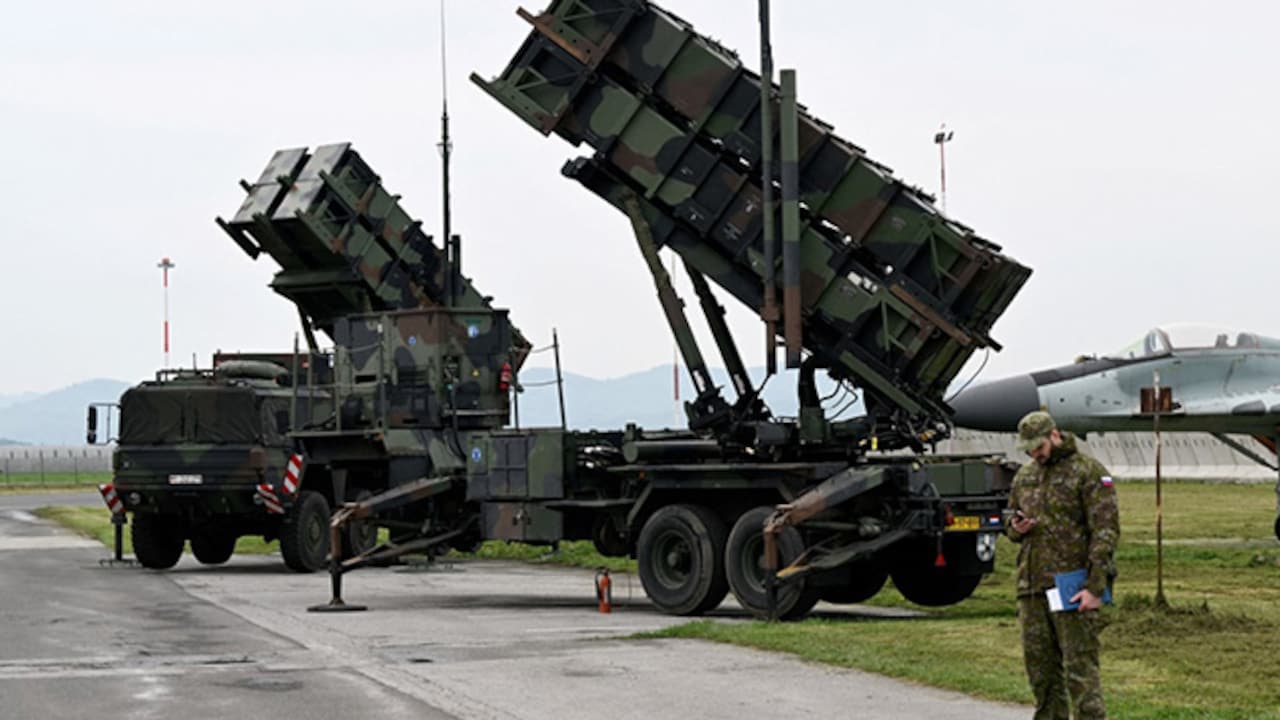
The announcement came with typical theatrical flair on the sidelines of the NATO summit in Ankara. Seated next to Ukrainian President Volodymyr Zelenskyy, President Donald Trump casually upended decades of closely guarded American defense industrial policy by declaring that the United States would grant Ukraine a license to manufacture its own Patriot missile interceptors. "This way, you can't complain that we're not giving 'em enough," Trump remarked. "I said, 'make them yourself.'"
Beneath the bravado lies a severe geopolitical reality. The United States has largely depleted its own tactical stockpiles of air defense munitions during recent military operations, leaving Washington with few physical batteries or interceptors left to spare. By offering Kyiv a production license for Lockheed Martin’s PAC-3 Missile Segment Enhancement (MSE) interceptors, the White House is attempting a clean handoff: shifting the immense logistical and financial burden of ballistic missile defense entirely onto Ukraine's domestic infrastructure.
Yet, any veteran defense analyst or industrial engineer knows that a technology transfer of this magnitude cannot be willed into existence by a political decree. The Patriot system is one of the most sophisticated pieces of military hardware on earth. Pretending that a war-torn country can simply spin up a supply chain to manufacture these interceptors overnight is a dangerous fantasy.
The Secret Supply Chain Bottlenecks That Political Pledges Ignore
A Patriot PAC-3 MSE interceptor is not a drone that can be assembled in a converted garage in Kyiv. It is an incredibly sophisticated flying computer packed with highly specialized components. The missile relies on a solid-rocket sustainer motor, an attitude control motor system featuring dozens of tiny, fast-acting rocket motors for terminal maneuvering, and a highly complex active radar seeker.
To build these components, you need a highly specialized chemical and industrial base that does not exist in Ukraine. The solid rocket propellants require precise chemical formulations that are tightly regulated. The advanced semiconductors used in the missile’s guidance systems are subject to strict International Traffic in Arms Regulations (ITAR) and require cleanroom manufacturing facilities that take years to build and certify.
Furthermore, the American defense industrial base itself is already choked by supply chain bottlenecks. Lockheed Martin and RTX Corporation have spent years trying to scale up PAC-3 production in the United States, hampered by shortages of rocket motors, thermal batteries, and specialized castings. If the primary manufacturers in Texas and Arkansas are struggling to meet production targets due to sub-tier supplier constraints, a foreign nation under daily bombardment will face an impossible uphill battle to source those same raw materials and microelectronics.
The Ultimate Target for Russian Ballistic Missiles
Even if Ukraine manages to source the machinery and components required to build an assembly line, the physical security of such a facility presents a catastrophic vulnerability.
The Kremlin has made the destruction of Ukraine’s defense industrial base a core priority. A factory capable of producing Patriot interceptors would instantly become the highest-priority target for Russia's long-range arsenal. Moscow would routinely deploy waves of Kinzhal and Iskander ballistic missiles to level any facility suspected of housing a Patriot assembly line.
To protect a Patriot factory, Ukraine would need to deploy its existing Patriot batteries around the manufacturing site. This creates a deeply ironic and self-defeating loop. Ukraine would be forced to pull its scarce, existing air defense assets away from defending major civilian centers, critical energy infrastructure, and frontline troops just to protect an unbuilt factory that will not produce a single usable missile for years.
Military analysts point out that industrial decentralization is the only viable path for Ukrainian survival. Kyiv has found success by scattering drone assembly across hundreds of hidden, basement-level workshops. But you cannot decentralize the production of a multi-million-dollar radar-guided interceptor. The machinery required, such as specialized autoclaves for composite materials and precision testing rigs, requires large, centralized, industrial footprints that are easily spotted by satellite reconnaissance.
Corporate Resistance and the Untapped Domestic Alternatives
The President casually admitted in Ankara that the administration had not even informed Lockheed Martin or RTX Corporation of the plan before announcing it to the world press. "I'm sure they'll be thrilled," Trump stated.
They likely are not. Defense contractors guard their intellectual property with extreme ferocity. A full technology transfer of the PAC-3 system involves handing over highly classified blueprints, software source codes, and manufacturing techniques that represent billions of dollars in research and development. American defense giants are notoriously reluctant to share these crown jewels, fearing long-term commercial competition and the severe risk of espionage. If Russian intelligence were to compromise a Ukrainian production facility, Moscow could gain access to the precise technical specifications of America’s premier air defense weapon, allowing them to develop effective electronic countermeasures.
Recognizing the long timelines and immense risks of the U.S. deal, Ukrainian arms manufacturers have already been quietly pursuing an alternative. An internal Ukrainian defense initiative known as Fire Point recently completed a flight test of a domestic surface-to-air missile called the FP-7. This home-grown interceptor is designed specifically to be cheaper and far less complex to build than Western systems. While it lacks the extreme altitude and range of a PAC-3, it represents a realistic, mass-producible solution tailored to Ukraine's actual industrial capacity.
The hard truth of the Ankara announcement is that it offers no immediate relief for a country facing relentless aerial bombardment today. It will take years to see if a single Ukrainian-made Patriot missile ever rolls off a production line. Until then, Kyiv remains dependent on an aging, depleted Western stockpile, left to bridge the gap with its own industrial ingenuity while staring down a sky filled with Russian steel.