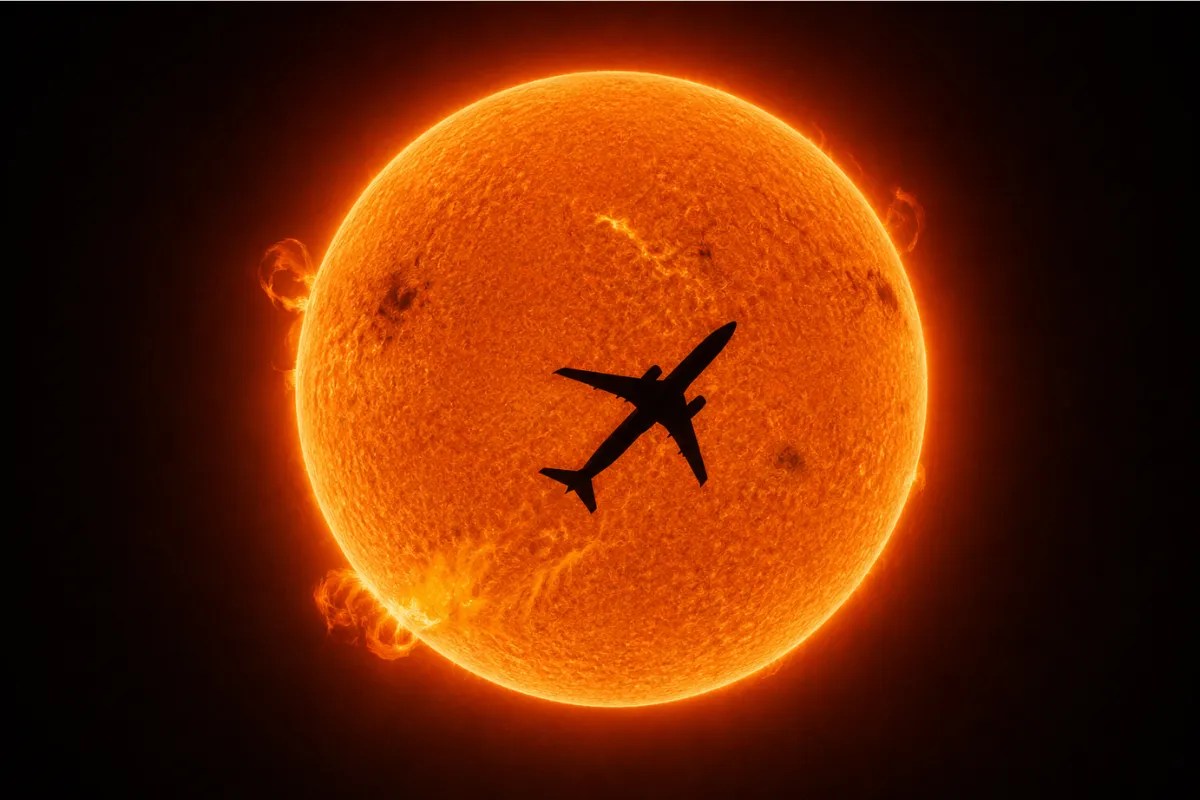
Soumyadeep Mukherjee didn't just stumble upon a miracle. He hunted it. Most people think photography is about clicking a button when something pretty happens, but the reality behind the "Transit of an Airplane Across the Sun" is a grueling exercise in math and stubbornness. Imagine standing under a blistering sky for nearly a week, praying for a metal tube moving at 500 miles per hour to cross a specific point in space. It's madness.
This isn't your average sunset photo. Mukherjee, an astrophotographer from Kolkata, captured an image that looks like a precision-engineered CGI render. A plane, perfectly centered, bisecting the massive, fiery disk of the sun. But the story isn't the photo itself. It's the 1.7 million frames he had to burn through to find that one perfect moment. In other updates, read about: Why That Fleet of Empty Waymos in Atlanta is Actually a Masterclass in Infrastructure Logistics.
Why This Shot Is a Mathematical Nightmare
You can't just point a camera at the sun and hope for the best. If you try that, you'll fry your sensor and your retinas. You need specialized solar filters, but more importantly, you need luck that borders on the supernatural. The sun is small in our sky—roughly the size of a pea held at arm's length. A plane flying at 30,000 feet is a tiny speck. The odds of their paths crossing at the exact millisecond you're recording are astronomical.
Mukherjee spent six days in October 2024 tracking solar transits. Think about that timeframe. That's 144 hours of monitoring flight paths, checking weather satellites, and hoping the smog doesn't ruin the clarity. He wasn't just taking photos; he was recording high-speed video to ensure he didn't miss the fraction of a second the plane spent in front of the solar disk. CNET has analyzed this fascinating issue in extensive detail.
When you're dealing with 1.7 million images, you're not looking at a memory card. You're looking at a data management crisis. Most hobbyists give up after a few hundred shots. To go into the millions requires a level of obsession that separates "pretty good" photographers from the ones who win awards.
The Equipment That Makes the Magic Possible
You don't need a NASA budget, but you do need the right glass. Mukherjee used a Nikon Z9, a beast of a camera known for its insane frame rates. When you're trying to catch a jet traveling at near-sonic speeds, 20 or 30 frames per second isn't enough. You need more. You're basically filming a movie and then picking the best still frame.
The lens setup usually involves a massive focal length—somewhere in the 600mm to 1000mm range. At that magnification, every vibration matters. A slight breeze or a heavy footstep nearby can turn a crisp airplane silhouette into a blurry mess.
- Solar Filters: Essential to block 99.99% of sunlight.
- High-Speed Storage: You can't write 1.7 million images to a cheap SD card.
- Patience: This is the part most people fail at.
The sun doesn't sit still, and neither does the Earth. To keep the sun centered, you need a tracking mount that compensates for the Earth's rotation. If your alignment is off by even a fraction of a degree, the sun drifts out of frame, and your chance at the plane vanishes.
Dealing With the Data Avalanche
Sorting through 1.7 million images is a nightmare. Honestly, it sounds like a special type of hell. You can't manually look at every frame. You use software to detect changes in brightness or shape within the solar disk.
Mukherjee had to wait six days because the first five were likely "near misses." Maybe the plane was too high. Maybe it was too low. Maybe it just clipped the edge of the sun. For the "Goldilocks" shot—the one where the plane is dead center—everything has to align. The distance of the plane from the camera affects its size relative to the sun. If the plane is too close, it's too big. Too far, and it's a tiny dot. This specific shot hit the sweet spot where the plane fits perfectly within the solar circle.
What Most People Miss About Astrophotography
People see the final result and say, "Wow, what a lucky shot." That's an insult. Luck is when a bird poops on you. This photo is a result of calculated persistence.
It's about understanding atmospheric refraction. It's about knowing exactly how the heat from the ground will distort the air (heat shimmer) and ruin the sharpness of the plane's wings. Mukherjee chose his timing and location to minimize these factors. He wasn't just lucky; he was prepared for the moment luck showed up.
The sun in this photo shows sunspots. Those dark patches are cooler regions of the sun's surface with intense magnetic activity. Seeing those spots alongside a modern feat of engineering like a commercial jet creates a jarring, beautiful contrast. It's the ancient, massive power of a star versus a tiny human machine.
How You Can Capture a Transit
Don't go out and shoot 1.7 million photos tomorrow. You'll just break your camera. Start small.
First, get an app like FlightRadar24 and combine it with an astronomy app like Stellarium. You need to find the "corridor" where a flight path intersects with the sun's position from your specific GPS coordinates. This corridor is often only a few hundred meters wide on the ground. If you're standing in the wrong backyard, you miss it.
Second, get a dedicated solar filter. Don't use sunglasses. Don't use ND filters. Use a certified white-light solar filter or a Hydrogen-alpha telescope if you're serious.
Third, practice on the moon. Lunar transits are easier because the moon isn't trying to melt your equipment. Once you've mastered tracking the moon and catching a plane there, move up to the sun.
Mukherjee's feat proves that the best photos aren't "taken"—they're built through days of failure. If you want a shot that goes viral, you have to be willing to sit in the sun for six days and look at a million photos that didn't work. Most people won't do that. That's why his photo is famous and yours isn't. Get a tracking mount, find a flight path, and start recording. Just don't expect it to happen on day one.


