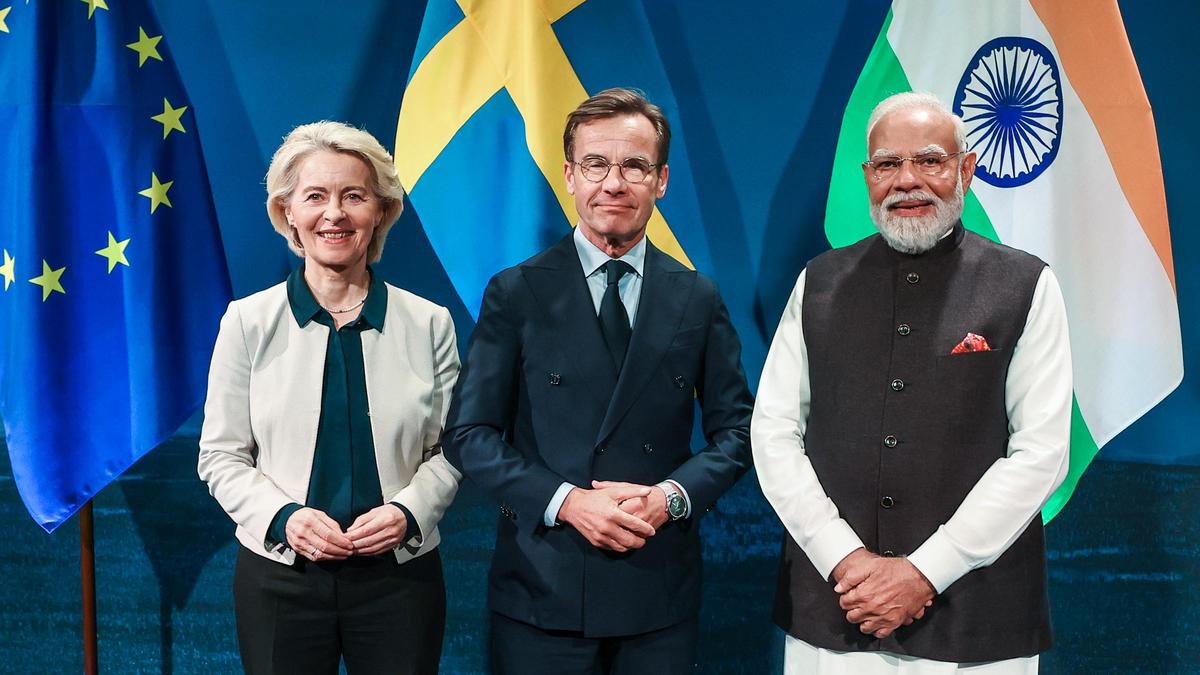
Brussels loves a grand narrative, and nothing satisfies European bureaucrats quite like calling a stagnant trade negotiation a "missing puzzle piece." When European Commission President Ursula von der Leyen pitches a sweeping Bilateral Trade and Investment Agreement (BTIA) with India, the financial press nods along in predictable harmony. The established consensus is simple: Europe needs to diversify away from China, India is the world's fastest-growing major economy, and a comprehensive deal is a win-win waiting to happen.
It is a beautiful theory utterly detached from economic reality.
The idea that the EU and India are on the cusp of an economic marriage of convenience ignores two decades of structural incompatibility. This is not a puzzle missing a final piece. It is two entirely different puzzles mixed up in the same box. The political photo-ops in New Delhi mask a fundamental truth that trade diplomats whisper behind closed doors: the core economic priorities of Brussels and New Delhi are diametrically opposed.
The Geopolitical Mirage of Diversification
The driving force behind the renewed push for an EU-India deal is not sudden economic synergy. It is geopolitical panic. Western capitals are desperate to "de-risk" supply chains. They view India as the ultimate counterweight to Beijing.
This strategy misunderstands the nature of global supply networks and India’s domestic economic philosophy. India is not looking to become Europe’s compliant, low-cost factory floor. Under the banner of Atmanirbhar Bharat (Self-Reliant India), New Delhi has consistently leaned into protectionist policies designed to nurture domestic champions, not open its gates to foreign competition.
Consider the raw data. While the EU champions open markets and regulatory alignment, India has been raising tariffs. Since 2014, India’s average applied tariff rate has crept upward, defying the global trend toward liberalization. The country pulled out of the Regional Comprehensive Economic Partnership (RCEP) at the eleventh hour precisely because it feared a flood of cheap imports would devastate its domestic manufacturing and agricultural sectors. To think New Delhi will suddenly dismantle these defenses for European automakers and dairy farmers is wishful thinking.
The Unbridgeable Chasm: Data, Agriculture, and Labor
To understand why this agreement has dragged on since 2007 without cross-the-finish-line success, look at the specific deal-breakers that both sides treat as existential. These are not minor technical hurdles to be ironed out by civil servants; they are core tenets of national sovereignty.
1. The Carbon Border Tax Collision
The EU’s Carbon Border Adjustment Mechanism (CBAM) is designed to penalize imports from countries with less stringent environmental regulations. Brussels views this as a progressive climate policy. New Delhi views it as a nakedly protectionist trade barrier wrapped in a green flag. India’s industrial sector relies heavily on coal. Imposing a carbon tax at the European border effectively guts the competitiveness of Indian steel, aluminum, and cement. India is already preparing to challenge CBAM at the World Trade Organization. You cannot sign a free trade agreement with a partner while simultaneously prepping a legal war against their flagship economic policy.
2. Data Sovereignty vs. GDPR Norms
Europe treats data privacy through the strict lens of the General Data Protection Regulation (GDPR). It demands that trading partners adopt equivalent, stringent privacy frameworks before allowing seamless data flows. India, conversely, is fiercely protective of its digital borders. New Delhi’s Digital Personal Data Protection Act emphasizes data localization, requiring certain classes of critical data to be stored and processed within Indian borders. For India’s massive IT and business processing sectors, European rigidity is a major roadblock. For European tech firms, India's localization mandates are non-starters.
3. The Mobility Matrix
Every time India sits down at a trade table, its primary demand is "Mode 4" liberalization—the temporary movement of professionals across borders. India wants easier visas for its software engineers, doctors, and accountants to work in Europe. This is where European rhetoric on global partnership hits the wall of domestic migration politics. With nationalist parties gaining ground across the Eurozone, no European leader is going to sign a deal that makes it easier for foreign professionals to compete for domestic white-collar jobs.
The Myth of the Untapped Middle Class
European multinationals drool over India’s 1.4 billion population, envisioning an insatiable market for European luxury goods, machinery, and consumer products. This enthusiasm overlooks the stark reality of Indian consumer demographics.
The "Indian Middle Class" is an elastic term frequently manipulated by consulting firms to sell optimistic investment decks. If you define the middle class by Western standards—disposable income available for premium foreign goods—the actual target market is a thin sliver of the population, numbering perhaps 50 million to 100 million people. The vast majority of the population remains highly price-sensitive.
European firms consistently lose out to agile domestic competitors or East Asian rivals who understand how to manufacture at ultra-low price points. A reduction in tariffs on German cars or French wines will certainly please wealthy elites in Mumbai and Delhi, but it will not move the needle for the Eurozone’s sputtering export economies.
Stop Chasing the Mega-Deal: A Pragmatic Alternative
The obsession with a single, comprehensive "mega-deal" is an outdated relic of 1990s globalization. It forces negotiators into an all-or-nothing framework where a dispute over Scotch whisky or dairy tariffs can stall progress on critical technology collaboration for half a decade.
If European and Indian leaders genuinely want to deepen economic ties, they must abandon the BTIA ghost and pivot to a fragmented, transactional approach.
- Sector-Specific Mini-Deals: Forget a comprehensive treaty. Focus exclusively on critical raw materials, clean energy technology, and defense procurement. These are areas where strategic alignment outweighs domestic protectionist impulses.
- The Trade and Technology Council (TTC): Utilize the existing TTC framework to synchronize standards on artificial intelligence, semiconductor supply chains, and telecommunications before regulatory paths diverge completely.
- M&A Over Trade Agreements: Instead of waiting for tariff walls to fall, European corporations must deploy capital directly into the Indian ecosystem via joint ventures and acquisitions, embedding themselves within the protectionist framework rather than fighting it from the outside.
Admitting the downside of this fragmented approach is necessary: it will not deliver the historic, headline-grabbing signing ceremonies that politicians crave. It will be messy, slow, and transactional. But it has the distinct advantage of being viable.
The Cost of Bureaucratic Stubbornness
I have spent years watching corporate boards and trade ministries burn millions of dollars planning for regulatory environments that never materialize. They buy into the optimistic press releases issued after every G20 summit, assuming that political goodwill translates into regulatory alignment. It rarely does.
The European Union's insistence on exporting its regulatory values alongside its goods is its greatest diplomatic liability when dealing with the Global South. India is a proud, rising superpower that will not accept European standards as the default global template.
Continuing to demand a comprehensive investment agreement under the current parameters is an exercise in bureaucratic inertia. It wastes diplomatic capital that could be used on achievable, targeted economic alliances. von der Leyen's missing puzzle piece does not exist because the two economic blocs are building entirely different pictures. The sooner Brussels accepts that reality, the sooner it can build a strategy based on the world as it is, rather than the world it wishes to regulate.