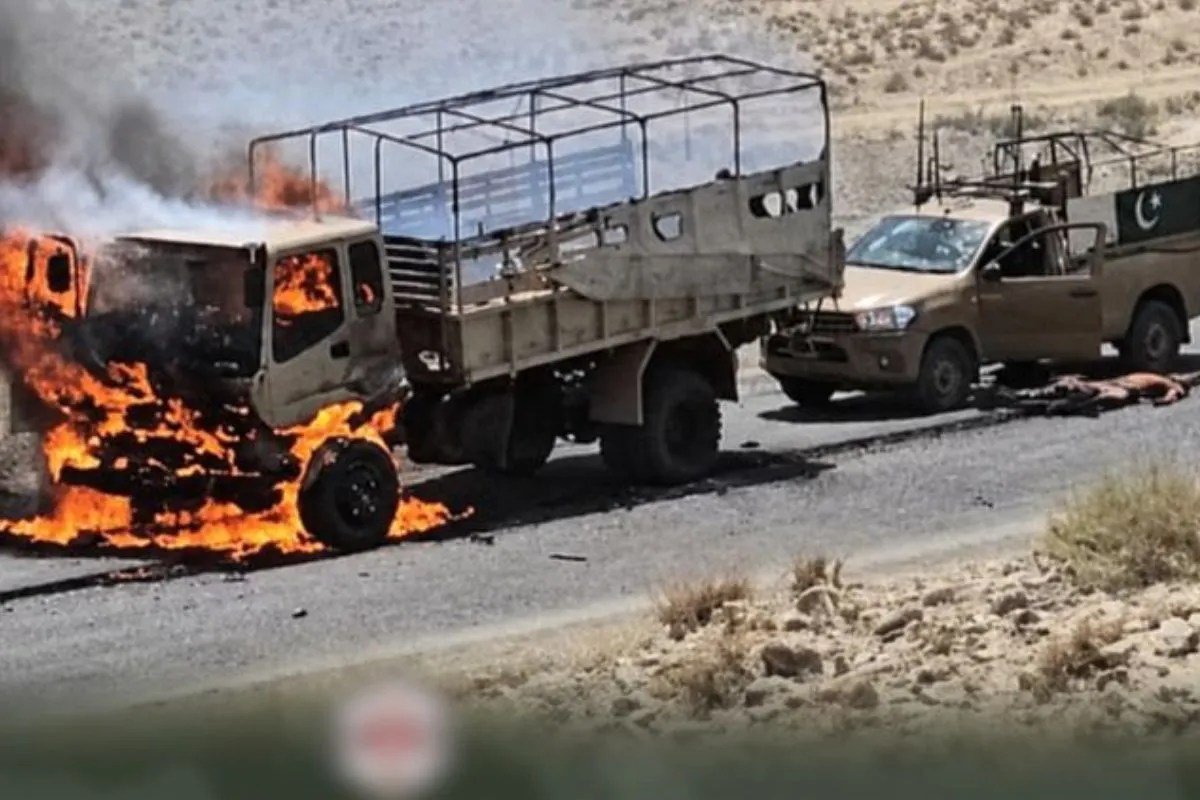
The smoke rising from the charred chassis of military trucks at Ziarat Cross tells a story far more complex than standard dispatch reports suggest. When the Balochistan Liberation Army asserted responsibility for simultaneous assaults that reportedly left twenty-five Pakistani service members dead, the incident exposed vulnerabilities that extend well beyond a routine skirmish in a restive border province.
For decades, the official narrative emanating from Islamabad has characterized unrest in Pakistan's largest and most resource-rich province as a manageable security disturbance driven by foreign-backed elements. Yet, the tactical precision and synchronized nature of recent operations reveal a structural evolution within insurgent command structures. This is not the hit-and-run banditry of the past. It is a calculated campaign designed to challenge state authority over critical trade corridors and energy infrastructure. Recently making news lately: Why JD Vance Says All Options Remain on the Table With Iran.
The Anatomy of an Escalation
Understanding why these dual strikes—the ambush at Ziarat Cross and the remote-detonated vehicle strike in the Surab district—matters requires looking closely at methodology. Insurgent factions have increasingly relied on specialized units, such as the Special Tactical Operations Squad and dedicated tactical cells, shifting away from loose militias toward disciplined, asymmetric units.
Military analysts tracking the region note a distinct shift in operational capabilities. When a convoy can be successfully ambushed, vehicles destroyed, and proprietary visual evidence broadcasted within hours via dedicated media channels like Hakkal, the psychological impact outweighs the physical loss of hardware. It challenges the state monopoly on force in real-time, feeding an information ecosystem where insurgent credibility grows with every unacknowledged casualty. Additional details regarding the matter are explored by TIME.
Security doctrines in Islamabad have historically favored heavy kinetic responses. Troops are deployed, cordons are established, and temporary curfews are enforced. However, this heavy-handed posture often deepens local alienation.
The Economic Battlefield
Resource extraction sits at the core of the grievance. Balochistan holds vast reserves of natural gas, gold, and copper, alongside the strategic deep-water port of Gwadar, which anchors multi-billion-dollar transnational economic corridors. Local populations argue that wealth flows outward toward the capital while poverty deepens locally.
Insurgent strategies have adapted to this economic reality. Rather than merely engaging military checkpoints, factions have instituted targeted blockades and economic interdictions. Convoys carrying logistics, fuel, and construction materials for state-backed projects are treated as legitimate military targets.
Consider a hypothetical logistics supply chain running from central depots to a remote extraction site in the province. Under normal security conditions, routine patrols keep commercial traffic flowing. Under current conditions, every supply truck requires armed escort, turning commercial transit into an armed military venture that drains state resources over prolonged periods.
This creates a slow-bleed attrition model. Pakistan's military apparatus, already stretched thin across multiple disputed borders and internal security challenges, finds itself bogged down in counter-insurgency operations that lack a clear political resolution.
The Information War
Modern insurgencies fight as much for the lens as they do for the territory. The rapid release of curated video trailers following the Ziarat incident demonstrates an acute understanding of media optics. By showcasing captured weaponry and the smoking wreckage of military transport, the leadership aims to sustain domestic recruitment and project an aura of unstoppable momentum.
State authorities frequently respond with information blackouts or restricted internet access in troubled districts, attempting to stanch the flow of unverified reports. Yet, in an era of decentralized digital communication, suppression often fuels speculation, driving local populations toward alternative information sources that lean heavily toward insurgent propaganda.
The silence from high-ranking defense officials immediately following such high-casualty claims reflects a deeper institutional dilemma. Acknowledging the scale of losses undermines public confidence in military readiness, while complete denial strains credibility when visual evidence circulates widely across regional networks.
Beyond the Immediate Horizon
The structural deadlock in Balochistan points toward a prolonged cycle of violence. Political outreach has repeatedly stalled, undermined by mutual distrust, disappearances, and a refusal on both sides to compromise on foundational demands. As long as economic projects are perceived by locals as instruments of colonial extraction rather than regional development, security forces will remain trapped in an unsustainable defensive posture.
The burning wreckage at Ziarat Cross is unlikely to be an isolated checkpoint tragedy. It serves as a stark indicator of a deeper, unresolved fracture at the heart of the state, where military dominance fails to translate into political stability or enduring peace.