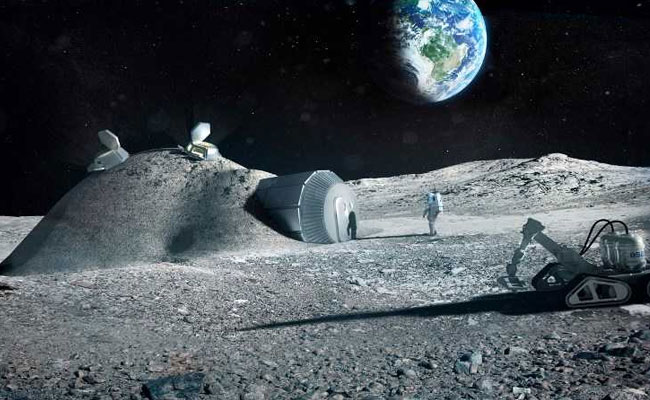
The official phrasing carried that familiar, bureaucratic chill. When the China Manned Space Agency announced that the ambitious Chang'e-7 lunar mission failed to meet launch conditions and would miss its window entirely for the year, observers across global space agencies leaned in. Officially, meteorological stress stemming from a brewing tropical system near Hainan Island's Wenchang spaceport forced a halt. Underneath the polite diplomatic and technical statements, however, lies a far more unforgiving reality about the modern scramble for the lunar south pole.
Deadlines in deep-space exploration are notoriously unforgiving, but deadlines tied to geopolitical prestige amplify every operational hiccup into a systemic crisis. Don't miss our previous article on this related article.
The Physics of a Missed Window
Orbital mechanics do not care about national pride or five-year plans. When a planetary launch window closes, it closes because the geometry of Earth, the Moon, and the targeted landing site no longer aligns to permit safe transit and orbital insertion with available fuel reserves.
For Chang'e-7—an extraordinarily complex robotic precursor designed to hunt for water ice inside permanently shadowed craters at the lunar south pole—the stakes were exceptionally high. This was not a routine communications satellite hop to geostationary orbit. It was a technological pathfinder meant to pave the way for human landings before the decade ends. To read more about the history here, Engadget provides an excellent breakdown.
When Tropical Depression Narra swirled into the Gulf of Tonkin, it created immediate surface-level hazards at Wenchang. High winds and torrential rain threaten delicate ground support infrastructure and make rolling back heavy rocket stacks mandatory. Yet weather is merely the visible friction point. The deeper issue with missing a strict lunar launch window is the cascading effect it has on a tightly choreographed long-term roadmap.
The 2030 Human Landing Pressure
Beijing has set a hard target to land taikonauts on the lunar surface by 2030, locking itself into a high-stakes cadence that mirrors NASA's Artemis schedule. To achieve this, every precursor mission must function as a flawless stepping stone.
Chang'e-7 was scheduled to map resources, test environmental sensors, and probe landing hazards that future human crews will face directly. Losing the 2026 window compresses the timeline for subsequent hardware tests. The heavy-lift Long March 10 rockets, the Mengzhou crew capsules, and the Lanyue lunar landers all rely on data gathered by robotic precursors to validate guidance and navigation systems.
When one domino stalls, the entire architectural sequence shudders.
This environment breeds a distinct type of institutional tension. Space programs operating under intense political spotlight face a constant tug-of-war between safety culture and schedule adherence. By publicly standing down and invoking the principles of reliability and absolute mission success, mission controllers chose long-term engineering prudence over short-term PR momentum. That choice carries weight. History shows that rushing complex space hardware past red flags usually ends in catastrophe rather than triumph.
The Margin for Error Narrows
Every major spacefaring nation is currently discovering that lunar exploration is far more punishing than low-Earth orbit operations. Whether dealing with volatile weather at equatorial launch sites, thermal extremes on the lunar surface, or the relentless communications latency of deep space, the margin for error remains razor-thin.
For international watchers, the delay serves as a reminder that the race to the Moon is not a clean sprint. It is an endurance trial riddled with sudden stops, orbital realities, and engineering limits that cannot be negotiated away by decree. As engineers roll the Chang'e hardware back into storage to re-evaluate trajectories for future windows, the clock keeps ticking down toward 2030, and the pressure on every subsequent countdown multiplies.