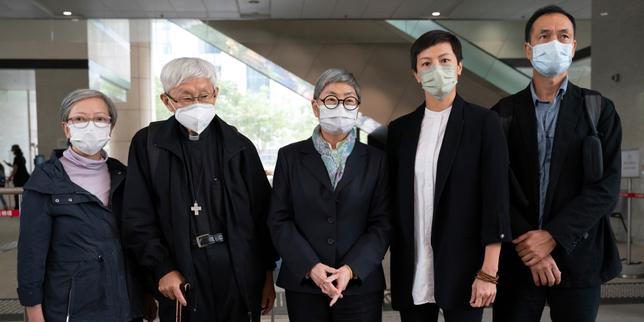
A Hong Kong appellate court has officially dismissed the appeals of five prominent pro-democracy figures, upholding their criminal convictions for failing to register a defunct humanitarian relief fund under a colonial-era statute. The ruling marks a definitive turning point for civic administration in the territory, ensuring that informal groups, ad-hoc committees, and emergency coalitions face strict legal liabilities for administrative omissions.
The high-profile defendants include retired Roman Catholic Cardinal Joseph Zen, singer and activist Denise Ho, cultural studies scholar Hui Po Keung, and former legislative councilors Margaret Ng and Cyd Ho. Operating as trustees of the 612 Humanitarian Relief Fund, these figures managed financial donations intended to cover medical, legal, and living expenses for individuals arrested during the tumultuous anti-government demonstrations of 2019.
When the fund ceased operations in October 2021, its creators likely assumed their exposure had ended. Instead, the legal machinery shifted focus from the sweeping mandates of national security legislation down to the granular details of civil registration compliance. The recent decision by appellate judges Jeremy Poon, Aarif Barma, and Derek Pang clarifies how local jurisprudence handles cooperative financial entities, turning a bureaucratic infraction into a major precedent.
The Mechanics of the Verdict
At the core of the legal battle lay a fundamental disagreement over what constitutes a "society" under Hong Kong's Societies Ordinance. Defense counsels argued that the 612 Humanitarian Relief Fund was merely a collection of monetary assets managed through a trust framework rather than an organized association of people. Under this theory, a pool of money held for charitable purposes should not trigger mandatory organizational registration with the police.
The three-judge appellate panel dismantled this defense completely. They ruled that the expansive statutory definition of a society captures any club, company, partnership, or association of ten or more persons regardless of its nature. The judges emphasized that the five trustees acted as a governing body intended to solicit, collect, and disburse public donations.
Consequently, the court determined that the fund missed its mandatory one-month window to register or apply for formal exemption after its inception. Although the financial penalty remained relatively modest at 4,000 Hong Kong dollars per person, the symbolic and structural weight of the decision extends far beyond monetary fines.
Every informal mutual-aid network, charity drive, and ad-hoc legal defense group in the region now operates under a different legal reality. The threshold for criminal liability has dropped straight into the paperwork.
A Century-Old Statute in a Modern Era
Enacted initially in 1901, the Societies Ordinance was designed during a different century to monitor secret societies and political subversion against colonial authorities. The ordinance underwent cycles of repeal and revival, eventually being reinstated by mainland authorities following the 1997 handover to guard against emerging security risks.
Critics argue that deploying a 20th-century ordinance to police modern humanitarian aid reflects an intentional strategy to shrink the civic sphere. Yet, the appellate court maintained that the registration scheme strikes a fair constitutional balance. The panel reasoned that freedom of association is not absolute and may be curtailed in the interest of public safety, order, and national security.
For years, observers watched to see whether the initial arrests—which temporarily involved suspicion of foreign collusion under the sweeping National Security Law—would lead to heavy indictments. When those severe national security charges failed to materialize during the trial phase, attention pivoted to the Societies Ordinance violations. This pivot demonstrated an administrative efficiency: prosecutors can secure convictions through regulatory infractions without needing to prove direct intent to subvert the state.
The Broader Fallout for Humanitarian Aid
The implications for civil society organizations are severe. Historically, crisis situations breed spontaneous solidarity. When thousands of individuals face sudden arrest or injury, formal bureaucratic registration rarely precedes immediate financial relief.
By criminalizing the failure to register an emergency fund, the ruling signals that informal humanitarian efforts carry inherent criminal risks. Legal experts note that future groups providing medical or legal aid must now navigate a landscape where bureaucratic omission is treated as a substantive offense.
Margaret Ng announced outside the courtroom that the defense team intends to challenge the verdict at the Court of Final Appeal. The ultimate question for the territory's highest court will be whether ordinary citizens organizing mutual support must treat every cooperative civic action as a formally registered entity.
The line between grassroots philanthropy and illegal association has grown razor-thin. As the final legal appeal takes shape, the space for independent civil action contracts further into the shadows of regulatory compliance.