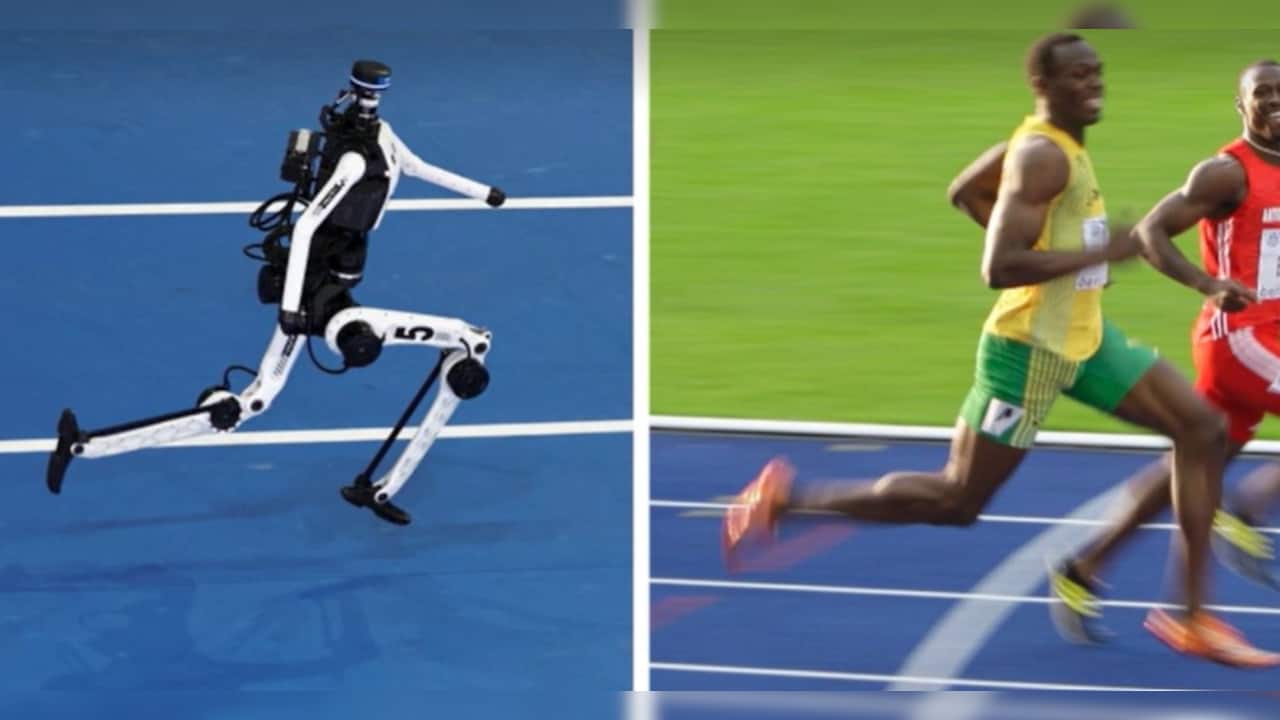
A battery-powered bipedal machine called Tiangong Ultra crossed a 100-metre track in Beijing in 9.39 seconds, shaving fractions off a biological benchmark that has stood since Usain Bolt ran 9.58 seconds in Berlin. Another contender named Lightning posted a 9.47-second heat, and unofficial trials clocked even faster splits. The mainstream media treated this as an athletic novelty. It is not an athletic novelty. It is an engineering stress-test masquerading as a track meet, designed to expose the violent mechanical realities of high-speed humanoid locomotion.
Public fascination fixates on the comparison against flesh and bone. That comparison is fundamentally unserious. Bolt used skeletal muscles, chemical energy stored in glycogen, and billions of years of evolutionary trial and error to propel himself across a rubberized surface. The machines in Beijing relied on customized electric actuators, high-density lithium packs, and thousands of lines of real-time control code processing inertial measurement units at millisecond intervals.
Yet the moment the stopwatch stopped, the illusion of athletic grace evaporated. Both machines failed to decelerate effectively, slamming directly into safety barriers. One staggered off toward the spectators, while the other suffered catastrophic structural failure and required removal on a stretcher. This lack of graceful stopping power highlights the core limitation of contemporary robotics. Generating explosive forward momentum is an engineering solved problem. Stopping a hundred-kilogram metal frame traveling at over fourteen meters per second without shearing its own joints is an entirely different domain of difficulty.
The Real Physics of Mechanical Speed
Why do engineers force bipedal robots to sprint? The answer requires looking past the spectacle and examining the control theory behind dynamic balance.
A wheeled robot is easy. Four wheels provide a broad stability polygon, keeping the center of gravity safely within a permanent footprint. A bipedal humanoid is an inverted pendulum perpetually falling forward. To move fast, the machine must lean into the fall, timing each footfall to catch its own weight before gravity causes a total structural collapse.
When Tiangong Ultra cut its time down from an embarrassing 21.50 seconds at the previous year's exhibition to a blistering 9.39 seconds, the change did not come from a magical new motor. It came from massive iterations in feedback loops. Engineers had to tune the joint stiffness, alter the torque distribution, and rewrite the predictive algorithms that calculate ground reaction forces.
Consider a hypothetical manufacturing floor where a humanoid robot must carry a heavy transmission casing across an oily surface. If the machine loses traction, its internal computer must execute the exact same recovery calculations required during a high-speed sprint crash. The sprint is simply an accelerated torture test for the balance controller. If the machine can survive the violent accelerations of a 100-metre dash, it can theoretically handle the unpredictable physical perturbations of a chaotic warehouse or a disaster zone.
The Capital Flood and the Manufacturing Reality
Behind the hardware in Beijing lies a massive realignment of global venture capital and state-backed industrial policy. Market response to these public demonstrations has been immediate and aggressive. Venture valuations for domestic robotics firms have skyrocketed, with public market debuts seeing single-week valuations multiply several times over.
This financial exuberance mirrors historical tech bubbles, but with a critical distinction. The hardware actually works. Factories across the Pearl River Delta are already integrating bipedal and quadrupedal units into assembly lines, not for publicity stunts, but to offset shrinking domestic labor pools.
However, a massive chasm exists between running a straight line on a predictable indoor track and operating autonomously in an unstructured environment. The machines competing in Beijing were optimized for one specific task: maximal linear acceleration over a short distance. Their programmers hard-coded or heavily optimized the gait profile for that exact track length and surface friction.
Put these same record-setting machines on a gravel path with a five-degree incline and a patch of spilled oil, and the control algorithms will likely fault out within meters. Industrial deployment requires reliability measured in thousands of operating hours between failures. A machine that needs a stretcher after a fast run is a spectacular laboratory prototype, not yet a factory workhorse.
The Structural Vulnerability of Rigid Actuators
The stretcher incident reveals an inherent materials science bottleneck. Human muscle is compliant. It absorbs shock naturally through viscoelastic tissue properties, tendons, and multi-joint articulation. When a human sprinter crosses the finish line, the deceleration is distributed across the entire kinetic chain.
Robots use rigid gearboxes, harmonic drives, and stiff metal frames. When kinetic energy must be dissipated instantly, rigid systems have nowhere to send the shockwaves except back into the structural components. Without massive, heavy dampening systems—which add dead weight and ruin efficiency—high speeds inevitably lead to mechanical self-destruction.
To overcome this, next-generation research focuses on quasi-direct drive actuators and series elastic elements that mimic human tendons. Yet adding compliance to a joint makes precise position control infinitely harder. Engineers are caught in an endless engineering compromise between mechanical durability and computational responsiveness. Every gram added to absorb shock slows down the motor response, dropping the top speed back down toward earth.
Moving Past the Anthropomorphic Fallacy
The obsession with building machines that mimic human anatomy down to the last tendon is largely driven by marketing departments rather than industrial utility. Human environments—stairs, doorways, tools—were built for human dimensions, which justifies the bipedal form factor. But forcing a robot to run a 100-metre dash is an anthropomorphic vanity project.
A delivery drone does not need to jog. A warehouse logistics platform does not need to sprint like Usain Bolt. The true value of these trials is the brutal stress they place on onboard sensors and power distribution systems.
When a machine is drawing maximum current from its battery packs to sustain peak torque across twenty distinct joints simultaneously, thermal management becomes an acute crisis. Several test units during the Beijing trials suffered from extreme thermal throttling before even reaching the finals. Solving how to dump kilowatts of waste heat from a sealed, human-sized torso without liquid cooling lines dangling off the chassis is a far greater engineering hurdle than beating a human running record.
The stopwatch in Beijing captured a headline-grabbing milestone, but the smoke rising from fried actuators and the crumpled frames hauled off on medical stretchers told the real story. The machine age is advancing rapidly, yet the physical laws governing momentum, friction, and thermal fatigue remain entirely indifferent to human benchmarks.