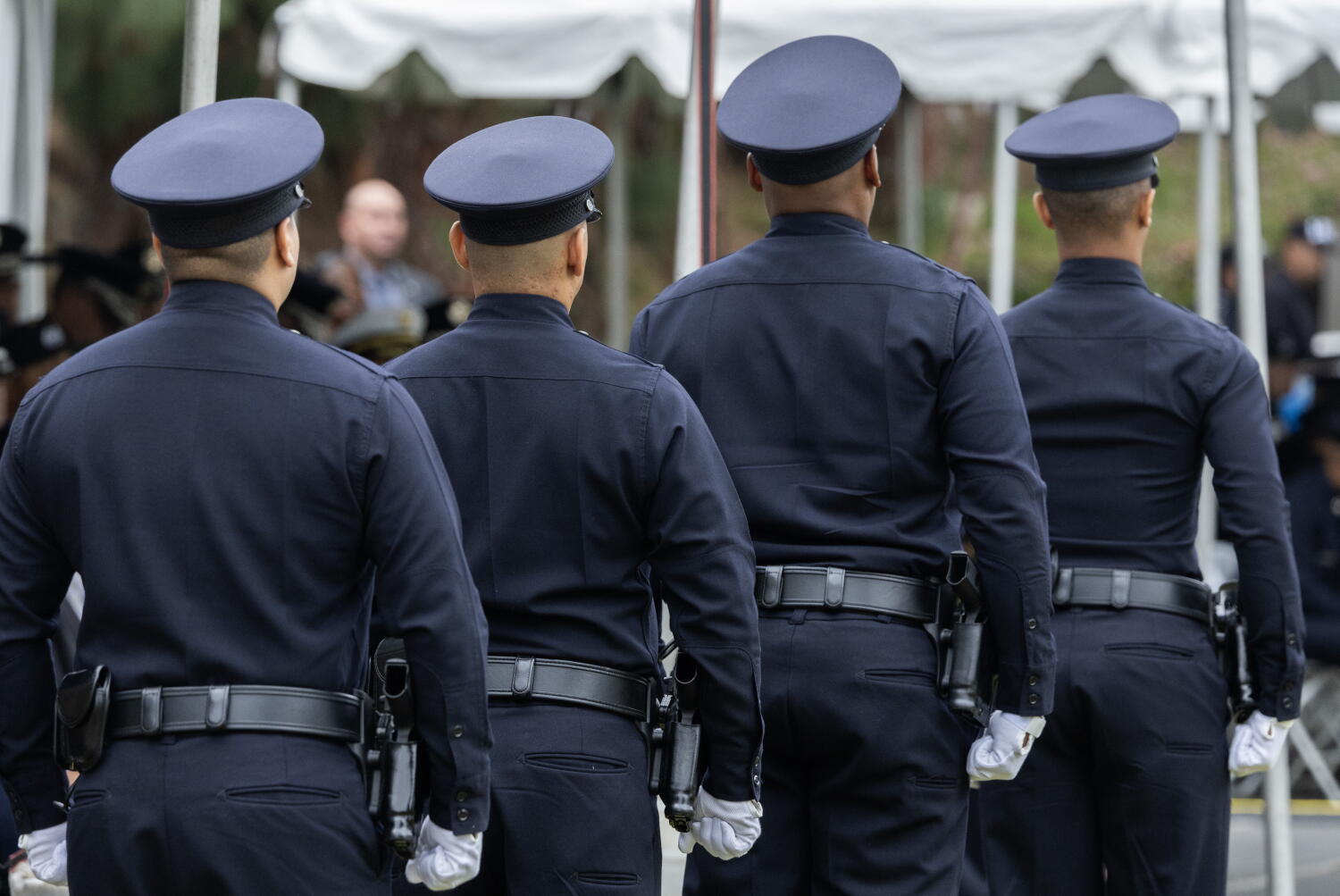
When a law enforcement agency tasked with vetting future police officers becomes an incubator for bigotry, the institutional rot runs deeper than a few bad apples. Los Angeles Police Department officer Daniel Flores walked into internal affairs with roughly ninety secret audio files, hoping to expose a culture of unchecked racism, misogyny, and homophobia embedded directly within the department's recruitment division. Instead of sparking a swift housecleaning of the guilty, the maneuver triggered an extraordinary legal counter-offensive. Prosecutors turned their sights on the person who brought the audio to light.
The resulting criminal charges against Flores lay bare a profound systemic failure. They expose a terrifying dilemma for municipal employees across the country. Do you stay silent and protect your pension, or do you document workplace corruption and risk spending up to thirteen years in a state prison?
The Anatomy of a Contaminated Bureaucracy
The recordings captured inside the LAPD Recruitment and Employment Division during 2024 paint a grim portrait of institutional dysfunction. Officers responsible for evaluating who gets a badge and a gun were recorded casually hurling racial slurs, mocking marginalized groups, and trivializing the deaths of public figures. These were not whispers in dark alleys. This was daylight banter among colleagues charged with filtering out biased applicants to protect the public trust.
Yet, when the audio leaked via an anonymous flash drive delivered to the inspector general, the machinery of the state ground into motion not to purge the bigots, but to punish the recorder. Los Angeles County District Attorney Nathan J. Hochman authorized multiple felony counts of illegal eavesdropping under the California Invasion of Privacy Act.
The legal theory from the prosecution is straightforward on paper. California is a two-party consent state. Secretly recording confidential workplace conversations violates state statute regardless of the moral justification. Prosecutors argued in court filings that Flores was motivated less by civic virtue and more by a desire to avoid a transfer to patrol and cash in on what some colleagues allegedly referred to as the "LAPD lottery"—a colloquialism for lucrative civil rights lawsuits against the city.
The Whistleblower Paradox
Defense attorneys and civil rights advocates look at the exact same set of facts and see an Orwellian perversion of justice. If an officer discovers systemic corruption, bigotry, and civil rights violations inside an internal department, traditional reporting channels frequently lead to professional ostracization, retaliation, or administrative stonewalling.
When internal affairs divisions function primarily as damage control for institutional reputation, the incentive structure collapses. Flores chose to gather tangible proof rather than rely on he-said-she-said internal complaints that traditionally vanish into filing cabinets. His defense team maintains that he acted within the scope of investigating workplace misconduct.
Even political leadership caught crosswinds in this debacle. Los Angeles Mayor Karen Bass publicly noted the chilling effect of the prosecution. Charging a whistleblower sends an unmistakable signal to every municipal employee in the region. If you hear slurs, look at the floor, keep your mouth shut, and go home.
Beyond the Audio Files
The legal war lines up a fascinating collision between privacy protections and public accountability. On one side stands the sanctity of private communication laws designed to stop corporate espionage and malicious wiretapping. On the other stands the constitutional right of citizens to be free from discriminatory state actors who weaponize police powers.
By focusing heavily on Flores's personal motives—alleging he manipulated conversations, omitted his own participation, and dreamed of a financial payout—the district attorney's office attempted to strip away his moral high ground. But shifting the spotlight onto the messenger does little to cleanse the department of the sixteen officers caught on tape spewing venom. While those officers faced internal discipline, the public remains largely in the dark regarding the true extent of their accountability, overshadowed entirely by the spectacle of a felony trial against a cop who hit record.
Institutions do not reform themselves voluntarily. They require external shocks or internal breaches to force a reckoning with their own internal decay. When the legal system punishes the breach more harshly than the decay itself, the message to the public is unmistakable. The preservation of administrative comfort outweighs the pursuit of systemic truth.
The trial will ultimately decide whether recording bigotry is a felony under state wiretap statutes. But the verdict on the moral integrity of the department has already been rendered by the raw audio files themselves.
The system protected its own, and the tape keeps running.