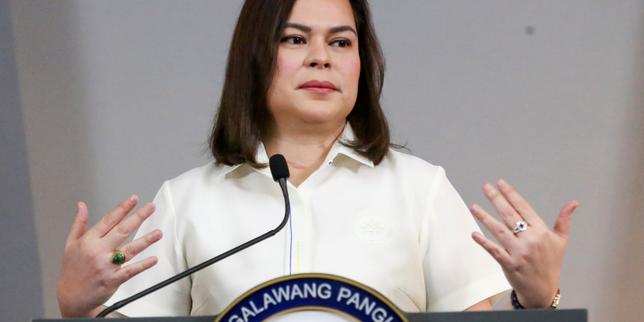
A Quezon City regional trial court has issued an arrest warrant for Philippine Vice President Sara Duterte, charging her with three counts of grave threats tied to explicit remarks she made against President Ferdinand Marcos Jr. The legal escalation breaks the remaining veneer of stability in an alliance that once swept the executive branch in 2022. Set against the backdrop of an ongoing Senate impeachment trial and the fallout from her father's removal, this courtroom move represents an institutional chess match engineered to permanently neutralize the most formidable political dynasty in modern Philippine history.
The formal charges stem from a volatile late-night press briefing held in November 2024. During that appearance, Duterte stated publicly that she had spoken to an assassin, instructing him to target President Marcos, First Lady Liza Araneta-Marcos, and former House Speaker Martin Romualdez if she herself were killed. While her defense team has insisted the remarks were rhetorical hyperbole and that she denies any genuine threat, the National Bureau of Investigation treated them as a direct penal violation. The Department of Justice signed off on the indictments, moving from political rhetoric to statutory crime.
Bail has been fixed at 120,000 pesos for each of the three counts. Legal analysts note that an actual incarceration of the sitting vice president remains unlikely in the immediate term, as her lawyers are positioned to post bond swiftly. Yet the warrant itself carries a psychological and tactical weight that transcends physical detention. It validates the state's aggressive posture and creates a parallel criminal track that runs concurrently with her high-stakes Senate impeachment proceedings.
The Anatomy of a Fractured Pact
The Marcos-Duterte "Uniteam" alliance was always a marriage of convenience forged to recapture the palace. It brought together two titanic political brands: the heirs of the martial law-era dictatorship and the populist machine of the outgoing Davao patriarch, Rodrigo Duterte. That marriage survived the 2022 ballot box by landslide margins, but it began to fray almost the moment the ballots were counted.
Disagreements over foreign policy, particularly regarding the South China Sea and ties with Washington, opened early ideological fault lines. But the real friction was structural. Power in Manila is zero-sum. As President Marcos consolidated his cabinet, purged Duterte loyalists from key legislative committees, and allowed inquiries into the bloody anti-narcotics campaign of the previous administration to move forward, the writing on the wall became unmistakable.
The November 2024 assassination remarks did not create this rift; they weaponized it. For an administration seeking legal avenues to check a fiercely independent vice president who routinely out-polls members of the president's own circle, those recorded comments served as an administrative gift.
The Impeachment Machine and Parallel Trials
Sara Duterte's legal jeopardy is no longer confined to a single courtroom. The House of Representatives voted to impeach her in mid-2025 on a cocktail of charges spanning graft, unexplained misuse of public funds during her tenure as education secretary and vice president, and the explosive security threats. Now, she sits before a Senate acting as an impeachment court.
Her defense has leaned heavily on the argument of executive immunity and procedural redundancy. Legal counsel argues that a sitting official cannot be criminally prosecuted for matters currently subsumed under an active impeachment trial.
The state's prosecutors and independent constitutional scholars see it differently. Impeachment is a political process designed to remove an official from public trust, whereas criminal prosecution determines penal liability under the Revised Penal Code. Because the standards of proof and the ultimate remedies differ, courts have cleared the path for both mechanisms to grind forward at the same time. If the Senate votes to convict, she faces permanent disqualification from holding public office. If the criminal courts secure a conviction on the grave threats charges, she faces potential imprisonment ranging from months to statutory limits depending on application.
The 2028 Horizon
Behind the technical legal briefs and bail bonds lies the ultimate prize: the 2028 presidential race. Sara Duterte has long been framed as the presumptive frontrunner to succeed Marcos, carrying the mantle of her father's enduring populist base.
Every subpoena, every hearing day in the Senate, and every signature on an arrest warrant is calibrated to erode that viability. By boxing her into multiple legal fronts, the administration aims to drain her campaign war chest, exhaust her public messaging, and create an aura of systemic corruption that sticks with undecided suburban voters.
Yet writing off a Duterte in Philippine politics ignores decades of historical precedent. The family's base in Mindanao and among the urban working class views these legal maneuvers not as justice, but as elite retribution from the capital. When political figures are cornered by the establishment in Manila, the resulting backlash often transforms prosecution into martyrdom.
The court order issued in Quezon City is only the latest escalation in a war of attrition that will define the trajectory of the nation's democracy long before voters return to the polls.