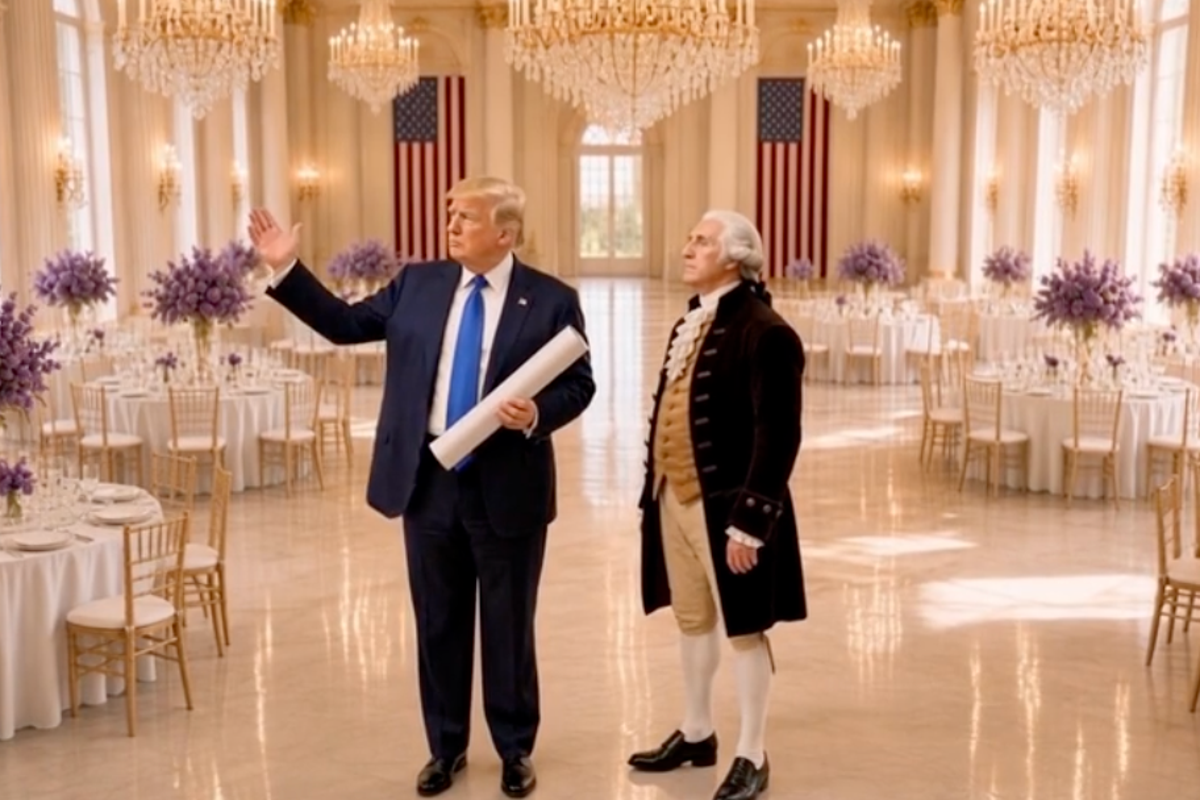
President Donald Trump recently shared an artificial intelligence-generated video on social media depicting himself giving America's first president, George Washington, a personal tour of a heavily disputed, unbuilt White House ballroom. This digital stunt arrived precisely as the administration appealed to the Supreme Court to rescue the $400 million construction project from federal court injunctions. While viral AI clips featuring historical figures offer easy fodder for online amusement, the underlying policy battle reveals a high-stakes clash over executive authority, congressional oversight, and the physical boundaries of the executive mansion.
The online post featured a short video clip of Trump and Washington walking through an expansive, gilded hall, alongside images of the two figures writing with quill pens and riding horses together. Trump captioned the video with a public note thanking Washington for his supposed architectural advice regarding the "Military Complex/Ballroom". Beyond the obvious historical irony—Washington selected the site for the executive mansion but never actually lived in it, leaving office years before construction finished—the digital artifacts mask a very real legal crisis playing out across federal courts.
The Architectural Pivot From Hospitality to Defense
When the administration first floated the grand ballroom concept, public justifications centered on hospitality. Officials argued that hosting foreign dignitaries and large national gatherings under temporary tents on the South Lawn fell below the dignity of the United States. State dinners and large-scale summits required a permanent, opulent structure capable of projecting American power and elegance.
Yet, as preservationists and legal opponents pushed back, the rationale shifted. Federal appeals court panels intervened, ruling that aboveground construction could not move forward without explicit congressional approval. In response, the administration's legal strategy pivoted sharply. The ballroom was increasingly framed as an inseparable component of an underground military complex vital to national security and presidential protection.
Courts have maintained a bifurcated stance, allowing underground structural work to proceed while halting the aboveground entertainment spaces. By rebranding the initiative as a security asset rather than a hospitality upgrade, the executive branch attempts to bypass traditional legislative budget controls. This legal maneuvering underscores a broader historical pattern where executive ambitions run directly into the constitutional separation of powers.
The Supreme Court Showdown
The administration's emergency appeal to the Supreme Court frames the judicial halt as an immediate threat to presidential safety. Legal filings argue that every square foot of the ongoing project functions as an integrated whole designed to remedy severe security vulnerabilities. Stopping work mid-stream, according to administration lawyers, leaves the executive branch exposed.
Opponents, including preservation groups that triggered the initial injunctions, view the project through an entirely different lens. They argue that bypassing Congress to erect a massive structure bearing gold-colored presidential seals violates basic statutory constraints on public lands and historic properties. The dispute highlights the limits of executive authority over federal real estate, turning a routine capital improvement project into a constitutional referendum.
Legacy Building in the Digital Era
The deployment of artificial intelligence to enlist George Washington as an architectural consultant fits neatly into a broader pattern of online communication. Modern political discourse increasingly relies on synthetic media to construct visual narratives that defy historical or physical reality. By placing himself alongside foundational figures, the president anchors his contemporary policy fights within a curated mythological timeline.
These digital creations serve a dual purpose. They mobilize a loyal digital base through shareable, lighthearted content while simultaneously signaling defiance against judicial roadblocks. When courts issue injunctions stopping physical steel and concrete, digital pixels offer an unrestrictive canvas where construction never stops and historical figures offer enthusiastic endorsements.
As the Supreme Court weighs whether to lift the lower court restrictions, the physical fate of the White House lawn remains frozen. The digital ghosts of the eighteenth century may stroll freely through generated halls, but the real-world concrete mixers await a final word from the judicial branch.