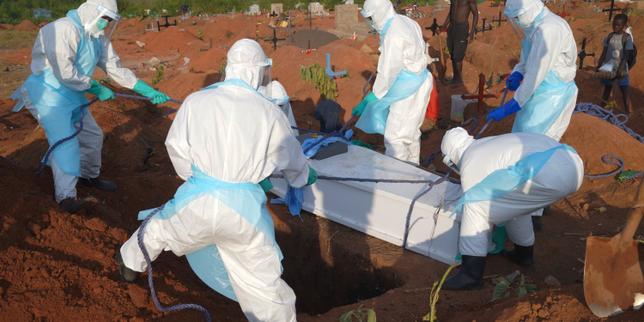
The rain in the Democratic Republic of Congo does not just fall; it heavy-drops from the sky, drumming against the canopy until the earth turns to a thick, red paste. In the North Kivu province, this mud is a physical barrier. It swallows motorcycle tires. It slows ambulances to a crawl. But while the mud stalls human movement, something else moves through the dense green topography with terrifying, silent speed.
It starts with a headache. A minor fatigue. The kind of exhaustion a farmer might dismiss after a grueling day clearing fields. Then the fever spikes, sharp and sudden, like a hot needle.
When the World Health Organization elevated the global risk assessment for the Ebola outbreak in the DRC, the announcement arrived in the form of a sterile press release. It used phrases like "rapid expansion" and "increased transmission vectors." But statistics are fundamentally bloodless. They cannot capture the sudden, choking panic of a mother watching her child grow burning hot to the touch, or the agonizing calculus of a doctor deciding whether a cough is a common cold or the beginning of a community’s collapse.
To understand why this microscopic killer is outrunning our best defenses, we have to look past the data. We have to look at the dirt, the borders, and the profound fragility of human trust.
The Friction of Distance
Consider a hypothetical healthcare worker named Alphonse. He is real in every sense that matters, a composite of the dozens of local researchers and nurses currently standing on the front lines in Beni and Butembo. Alphonse does not wear a crisp white lab coat. He wears a yellow, rubberized biohazard suit that transforms the humid equatorial air inside it into a suffocating sauna within ten minutes.
His job is contact tracing. When a patient tests positive for Ebola, Alphonse must retrace every single human interaction that person had over the past twenty-one days.
Think about your own last three weeks. Every cashier you handed cash to. Every passenger who brushed against your shoulder on a crowded bus. Every family member you embraced. Now, imagine trying to map that network in a region where there are no paved roads, where electricity is a luxury, and where decades of armed conflict have left the population deeply, understandably suspicious of outsiders.
The virus exploits this friction. While a surveillance team spends twelve hours navigating twenty miles of broken road to reach a remote village, the virus travels effortlessly. It hitches a ride in the bloodstream of a trader heading to a bustling market town. It moves via a grieving relative who traveled across the province to attend a traditional burial, where touching the deceased is an act of deep respect—and a lethal mistake.
The World Health Organization did not upgrade the risk level because the virus itself had mutated into a more virulent form. The pathogen remains the same brutal, thread-like entity it has always been. The risk changed because the virus found the perfect highway: human movement through a broken infrastructure.
The Sound of a Broken Promise
There is a common misconception that containing an epidemic is purely a medical challenge. Bring enough vaccine doses, deploy enough isolation tents, and the problem solves itself.
It is never that simple. The ultimate barrier to stopping Ebola is not a lack of science; it is a profound deficit of trust.
For generations, the people of eastern DRC have lived under the shadow of violence from various militia groups. They have seen international organizations arrive with armored vehicles, promise aid, and leave when the political winds shift. Suddenly, when an outbreak occurs, the world floods the region with millions of dollars, high-tech isolation pods, and armed escorts.
The local population looks at this sudden influx and asks a rational question: Why do you care so much about a fever that kills us today, when you ignored the violence that killed our children yesterday?
When medical teams arrive in full protective gear, looking less like doctors and more like astronauts, it creates terror. Rumors spread through the markets like wildfire. Some believe the isolation centers are places where people are taken to die, or worse, that the foreigners brought the disease themselves to eliminate the population.
When trust breaks down, the epidemic accelerates. People hide their sick relatives in bedrooms. They bury their dead secretly at night beneath the banana trees. The official numbers published in Geneva clinics represent only a fraction of reality. Every hidden case is a new spark thrown into a dry forest.
The Geometry of an Outbreak
Mathematically, epidemics are problems of exponential geometry. A single case produces two; two produce four; four become sixteen. In the early stages, the line on the chart crawls along the bottom, seemingly flat, inducing a false sense of security.
Then comes the inflection point.
Once an outbreak hits a major urban hub, the geometry changes. In a rural village, a virus can run out of hosts if the community isolates itself. In a city of hundreds of thousands, like Goma or Butembo, the web of human contact is too dense, too chaotic to map. The virus enters the informal transit networks—the motorcycle taxis, the crowded wooden boats crossing Lake Kivu, the footpaths crossing international borders into Uganda and Rwanda.
This is the reality behind the phrase "spreading rapidly." It means the containment lines have broken. It means the virus is no longer contained within a predictable geographic pocket. It has entered the wild, fluid stream of daily commerce and survival.
The Weight of the Yellow Suit
Working inside an Ebola treatment center changes a person. The sensory memory lingers. The smell of chlorine water sprayed on boots. The constant, rhythmic hiss of oxygen concentrators. The absolute silence of a patient in the final stages of the disease, when the virus has systematically dismantled their internal systems.
Medical professionals face a unique psychological horror here. In standard medicine, compassion is expressed through touch—a hand held, a reassuring pat on the shoulder. Inside the red zone of an Ebola center, touch is regulated by layers of nitrile gloves. It is clinical. It is cold. To accidentally tear a glove on a piece of medical equipment is to stare your own mortality in the face.
Yet, despite the terror, the local nurses and cleaners keep showing up. They are the true shield holding back a global catastrophe. They work shifts until their boots are filled with sweat, earning meager wages, often facing stigma from their own neighbors who fear they will bring the virus home with them.
Their bravery is not the absence of fear. It is the recognition that if they drop the line, there is no one else to hold it.
The Global Echo
It is easy for someone sitting thousands of miles away to look at a map of central Africa and view this crisis as a distant, localized tragedy. A headline to be glanced at and forgotten.
That view is a dangerous illusion.
In an interconnected world, there is no such thing as a local outbreak. A virus that begins in a forest clearing in Congo can be in London, Tokyo, or New York within thirty-six hours. The international borders we draw on maps, the passport controls, the visa requirements—none of these mean anything to a strand of ribonucleic acid.
The upgrade of the global risk assessment by health authorities is a siren. It is an acknowledgment that the window for containing this event at its source is closing. It demands that the international community stop viewing global health funding as an act of charity, and start viewing it for what it truly is: a critical investment in collective survival.
Defeating the fever in the forest requires more than just shipping boxes of experimental vaccines or deploying elite epidemiologists. It requires rebuilding the broken bridge of trust with the communities on the ground. It means listening to the village elders, respecting local traditions while gently adapting them for safety, and treating the population not as statistics to be managed, but as partners in a shared struggle.
The rain continues to fall in North Kivu, turning the roads to clay, hiding the footprints of those who travel from village to village, carrying the invisible weight of the fever with them. The clock is ticking, and the earth is growing softer by the hour.