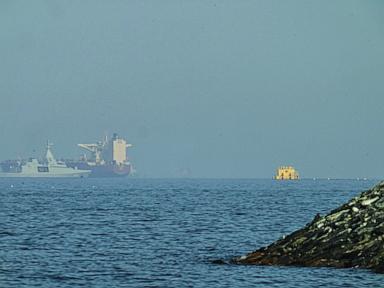
The sea is never as empty as it looks on a map. On a digital screen, the Strait of Hormuz is a thin blue neck of water, a mere thirty-mile-wide pinch point between the jagged coast of Oman and the heavy shadow of Iran. But for a captain standing on the bridge of a 300,000-ton Aframax tanker, that blue space is a crowded, high-stakes gauntlet.
Steel hulls thrum with the vibration of massive engines. The air smells of salt, heavy fuel oil, and the persistent humidity of the Persian Gulf. Every hour, millions of barrels of crude oil slide through this passage. It is the jugular of global energy. Yet, lately, the cost of transit is no longer just measured in fuel and time. It is being measured in the legal survival of the companies that own the ships.
The United States government has issued a quiet but devastating warning to the global shipping industry. The message is simple: if you pay the toll to pass through these waters, you might be funding a sanctioned regime—and the U.S. Treasury is watching.
The Ledger in the Dark
Imagine a shipping executive named Elias. He sits in a glass-walled office in Athens or Singapore, staring at a spreadsheet. One of his vessels is nearing the Strait. To ensure a smooth passage, to avoid "administrative delays" or the sudden appearance of fast-moving patrol boats, there are fees to be paid. Traditionally, maritime tolls are a boring, bureaucratic necessity of the trade.
But these are not traditional times.
The U.S. State and Treasury Departments have signaled that certain payments made to Iranian entities for "maritime services" or "transit fees" are not just business expenses. They are violations of international sanctions. For Elias, this is a nightmare. If he pays, his company could be blacklisted, its bank accounts frozen, its ability to trade in U.S. dollars evaporated overnight. If he doesn't pay, his ship—and the forty crew members aboard—becomes a target for harassment in one of the most volatile waterways on earth.
This isn't a hypothetical tension. This is the friction that keeps global insurance premiums at record highs. The U.S. government’s stance is that Iran uses these "tolls" to circumvent the strangling effect of economic sanctions. They see it as a backdoor revenue stream for the Islamic Revolutionary Guard Corps (IRGC). By forcing shipping companies to pay for the "privilege" of not being seized, the regime effectively turns the Strait into a private toll road.
The Mechanics of the Squeeze
The problem for the shipping industry is that the law is often clearer than the reality on the water. The U.S. warning specifically targets payments made to the Iranian Ports and Maritime Organization (PMO). Washington contends that the PMO is an arm of the state used to funnel money into destabilizing activities across the Middle East.
Consider the sheer scale of the risk. A single tanker might be carrying $100 million worth of cargo. The toll to pass might be a few thousand dollars—a rounding error in the grand scheme of the voyage. However, that small payment acts as a digital tripwire.
Modern finance is an interconnected web. Most shipping transactions are cleared through Western banks. The moment a payment hits a sanctioned entity, an alert pings in a basement office in Washington D.C. The "invisible chokepoint" isn't just the physical Strait of Hormuz; it is the financial infrastructure that allows a ship to exist in the global market.
Business leaders are now caught in a pincer movement. On one side, the threat of physical seizure by regional actors. On the other, the "financial death penalty" from the U.S. Treasury. There is no middle ground. There is no "oops" in the world of high-level sanctions.
The Human Cost of High Policy
While politicians and lawyers argue over the definition of a "service fee," the people actually on the water feel the weight of these decisions differently.
When a ship is caught in this geopolitical crossfire, it isn't just a corporate asset. It is a home. There are cooks in the galley, engineers in the belly of the beast, and young deckhands looking at the horizon. When a vessel is delayed or seized due to a dispute over "illegal payments" or "non-compliance," these people become pawns.
The U.S. warning is designed to prevent the normalization of "protection money." By telling firms they cannot pay, the U.S. is attempting to dry up the liquid cash flow that sustains the IRGC's maritime operations. It is a long-game strategy. But in the short term, it creates a vacuum of uncertainty.
Shipping companies are now being forced to do the job of intelligence agencies. They must vet every vendor, every tugboat operator, and every port agent with obsessive detail. They have to ask: who owns the company that owns the company that is refueling my ship?
The Ghost Fleet and the Law-Abiding
The tragedy of this situation is the divide it creates in the industry. There is a "dark fleet"—a collection of aging, uninsured tankers that operate entirely outside the law. They change their names, flip their transponders off, and fly flags of convenience. They don't care about U.S. sanctions because they have already opted out of the legitimate world.
The companies being hurt by these new warnings are the ones trying to play by the rules. The reputable firms, the ones that carry the world’s essential energy and goods, are the ones now looking at the Strait of Hormuz with a sense of dread. They are being told to stand firm against a regime that holds the keys to the gate, even as that regime stands on their doorstep.
The logic of the U.S. position is sound from a security perspective: you cannot defeat an adversary while simultaneously paying them for passage. But for the merchant mariner, the logic is colder. It is the logic of a man caught between a shark and a whirlpool.
The Strait remains. The water continues to churn. And somewhere, right now, a captain is looking at his radar, wondering if the next ship he sees is a friend, a foe, or a bill he isn't allowed to pay. The cost of doing business has never been higher, and the price of a mistake has never been more absolute.
The map shows a narrow blue line. The reality is a vast, grey expanse where every decision is a gamble.