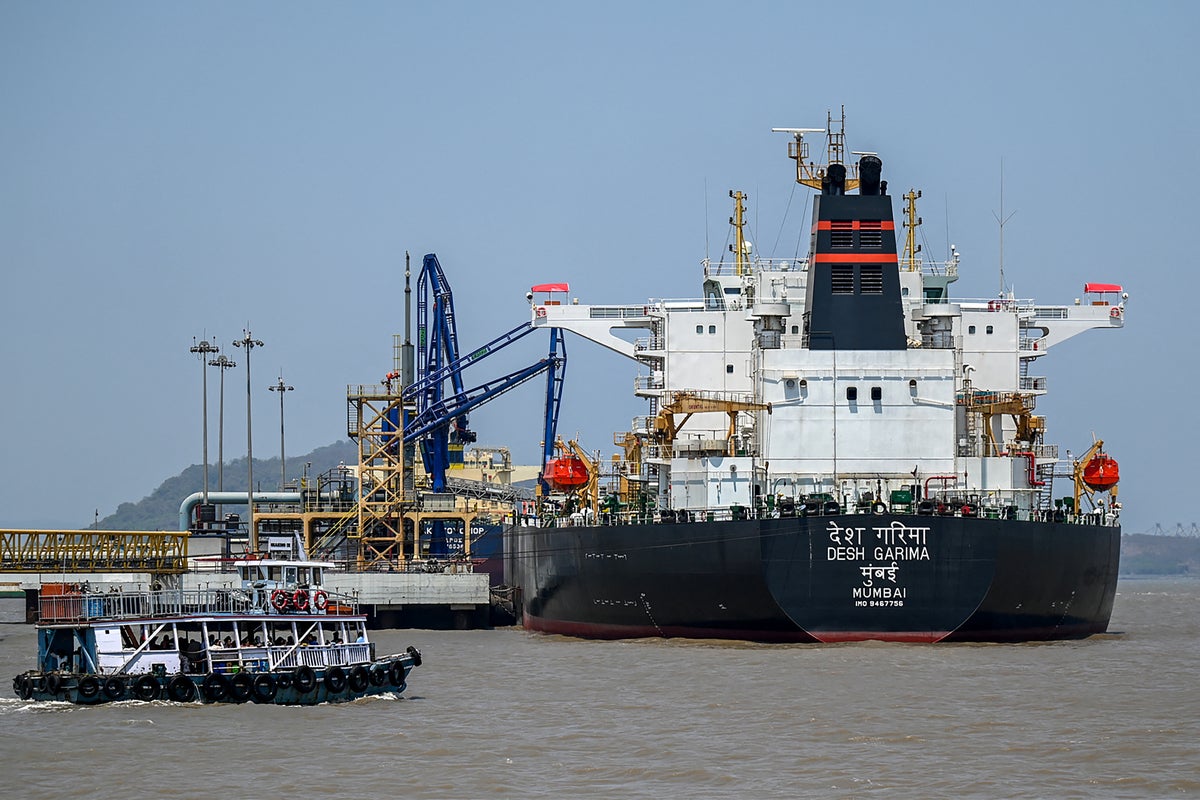
The steel hulls of dozens of Very Large Crude Carriers (VLCCs) are currently sitting low in the warm waters of the Persian Gulf, acting as the world’s most expensive storage units. This isn't a temporary bottleneck. It is a desperate logistical workaround. For months, Tehran has been forced to park millions of barrels of crude oil at sea because the traditional avenues of global trade have been systematically choked off by a tightening web of international sanctions and a relentless U.S. blockade.
While the surface-level narrative suggests a simple standoff between Washington and Tehran, the reality is a high-stakes shell game involving "ghost" transshipments, aging tankers with disabled transponders, and a domestic economy screaming for liquidity. Iran is producing more oil than it can legally sell, creating a massive inventory overhang that threatens to gum up its entire industrial infrastructure. When storage tanks on land hit their limits, the only place left to go is the water.
The Logistics of a Floating Warehouse
Land-based storage in places like Kharg Island has reached near-total capacity. When a nation cannot turn off the taps at the wellhead without risking permanent damage to the geological pressure of its oil fields, it must keep pumping. This creates a relentless flow of crude that has nowhere to go. To prevent a total shutdown of production, the National Iranian Oil Company (NIOC) has repurposed its own fleet—and a collection of third-party vessels—into stationary warehouses.
This is not a cheap solution. Maintaining a VLCC costs tens of thousands of dollars per day in charter rates, fuel for generators, and crew wages. Beyond the immediate financial drain, the crude oil itself begins to degrade. Over time, heavier components settle at the bottom of the tanks, forming a sludge that is difficult and costly to remove. Iran is essentially watching its most valuable resource lose value while paying a premium to keep it from spilling.
The Ghost Fleet and the AIS Blackout
To move any of this oil, Iran relies on a "shadow fleet" of vessels that operate outside the norms of international maritime law. These ships frequently engage in "going dark," a practice where they turn off their Automatic Identification System (AIS) transponders to hide their locations. They appear on satellite imagery as metallic ghosts, drifting near the coast of the United Arab Emirates or hiding in the vastness of the South China Sea.
The process of offloading this oil often involves dangerous ship-to-ship (STS) transfers in the middle of the ocean. By pumping oil from an Iranian-flagged vessel to a neutral one, traders attempt to "launder" the origin of the crude. They mask the paper trail, re-labeling the product as "Malaysian" or "Omani" blend before it makes its final journey to independent refineries in China, often referred to as "teapots." These refineries are the primary lifeline for Iranian exports, but they demand massive discounts—sometimes as much as $20 a barrel below the global benchmark—to compensate for the risk of secondary sanctions.
The False Promise of Domestic Refining
Tehran has repeatedly claimed that it will pivot toward refining more of its own crude into gasoline and petrochemicals to bypass the need for raw exports. This is largely political theater. Building a modern refinery takes a decade and billions of dollars in foreign capital—two things Iran currently lacks. While they have made strides in condensate splitting at the Persian Gulf Star refinery, the sheer volume of heavy crude being produced far outstrips their internal processing capacity.
This leaves the country in a "production trap." If they stop pumping, they lose the ability to restart quickly when sanctions eventually lift. If they keep pumping, they sink deeper into the logistical nightmare of maritime storage. The current stockpile is estimated to be north of 60 million barrels, a staggering amount of idle wealth that could be funding infrastructure or stabilizing the rial, but is instead rusting in the sun.
The Environmental Time Bomb
There is a darker side to this blockade that the diplomatic community rarely discusses. The vessels being used for long-term storage and shadow-fleet operations are often well past their prime. Most reputable shipping companies scrap their tankers after 20 years. The ships currently holding Iranian crude are frequently older, with questionable maintenance records and insurance policies that aren't worth the paper they are printed on.
A single collision or structural failure in the Strait of Hormuz would not just be a localized disaster. It would be an ecological catastrophe that could shut down the world’s most vital energy transit point. The U.S. blockade has inadvertently created a situation where the safety of the global oil supply is tethered to the integrity of aging, overworked hulls that are being pushed far beyond their design life.
The China Connection and the Limits of Loyalty
China remains the only major buyer willing to thumb its nose at Washington, but even that relationship has its limits. Beijing is a pragmatic actor. They are happy to take Iranian oil at a steep discount, but they are not interested in a total confrontation with the U.S. Treasury Department over it. When the heat from Washington increases, Chinese banks often tighten their compliance, leaving Iranian tankers idling off the coast of Qingdao for weeks, waiting for a clearance that may never come.
This creates a "just-in-time" crisis for Tehran. They cannot plan a budget because they don't know when their floating inventory will actually convert to cash. The unpredictability of these sales means the Iranian central bank is constantly operating in a state of emergency. They are trading their sovereign resources for a fraction of their worth just to keep the lights on in Tehran.
The Infrastructure Decay
While the focus remains on the tankers, the land-based infrastructure is quietly rotting. Without access to Western spare parts and engineering expertise, Iranian pumping stations and pipelines are being held together with "jury-rigged" solutions and Chinese-made components that aren't always a perfect fit. The longer the blockade lasts, the more the physical capacity to export oil—even if sanctions were lifted tomorrow—diminishes.
This isn't just about ships sitting in the water. It’s about the slow-motion de-industrialization of a founding member of OPEC. The oil industry is a high-tech game that requires constant reinvestment. By forcing Iran to spend its meager revenues on tanker rentals and shadow-fleet premiums, the blockade is effectively eating the seed corn of the country's future energy sector.
The Strategy of Attrition
The U.S. calculation is that eventually, the cost of the blockade will become unbearable, forcing a return to the negotiating table. However, this ignores the entrenched nature of the "resistance economy." The elite layers of the Iranian government have become experts at skimming profits from the very shadow networks used to bypass sanctions. For those in power, the blockade has created a lucrative black market that provides a perverse incentive to maintain the status quo, even as the broader population suffers from rampant inflation.
The floating storage is a physical manifestation of a geopolitical stalemate. It represents a nation that has been effectively removed from the global grid but refuses to unplug. Every barrel of oil that sits in a tanker in the Persian Gulf is a testament to the failure of diplomacy and the sheer, stubborn endurance of a regime that has learned to live in the shadows.
The standoff has moved from the halls of the UN to the deckplates of VLCCs. There are no easy exits from this situation. As long as the blockade continues, the "invisible fleet" will continue to grow, a ticking clock of steel and crude oil that the world ignores at its own peril. The pressure inside those tanks is rising, and it isn't just the vapor.
It is the weight of a nation with no way out.