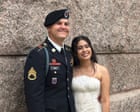
The metal of a military ID card feels heavy when you’re a spouse. It is a small, rectangular piece of plastic that acts as a skeleton key to a very specific, very insular world. It says you belong. It says your family is an asset to the United States government. It says that while your partner is trained to hold a perimeter in a desert thousands of miles away, you are safe within the gates of the home front.
But for one family at Fort Carson, that plastic key didn’t work. The gate didn't just stay closed; it became a trap.
The Quiet Morning at the Gate
Imagine the routine. It’s early. The sun is just starting to hit the peaks of the Rockies, casting long, jagged shadows across the asphalt of the base entrance. A soldier’s wife—let’s call her Maria, though the headlines have used her real name—is driving toward the checkpoint. She has done this a thousand times. She has her papers. She has her life packed into the passenger seat. She has a husband who wears the flag on his shoulder.
She hands over her identification. The guard looks at the screen. The air in the car changes.
In that moment, the "total force" concept of the US military, which claims to support the family as much as the soldier, evaporated. Maria wasn’t seen as a military spouse or a mother. She was a red flag in a database. Immigration and Customs Enforcement (ICE) agents were called. Within hours, a woman whose daily life was dedicated to supporting the American infantry was in the back of a federal vehicle, headed for a detention center.
The logic is cold. It is binary. You are either documented or you are not. But the military doesn’t operate on binary logic; it operates on morale, on the unspoken contract that the state protects those who protect the state. When that contract is shredded at the front gate of an Army post, the ripple effect moves through the barracks like a cold front.
The Geography of Fear
For a long time, military bases were considered "sensitive locations." This wasn't a formal law, but a memorandum of understanding—a gentleman’s agreement between agencies. The idea was simple: you don’t conduct immigration raids at churches, hospitals, or military installations. Why? Because the chaos of a deportation arrest in a place of sanctuary or service creates a net loss for the community.
But policies shift like sand.
When Maria was detained at Fort Carson, it signaled a departure from the "don't ask, don't tell" era of military family status. Suddenly, the wire fences that were supposed to keep the enemy out were being used to keep a mother in. This isn't just about one woman in Colorado. It’s about the estimated 11,000 undocumented family members of active-duty service members currently serving in the US Armed Forces.
Think about that number. Eleven thousand.
That is more than two full combat brigades. Imagine a soldier in a foxhole in a high-tension zone, his rifle cleaned, his eyes on the horizon, while his mind is stuck at a domestic checkpoint. He is wondering if a routine trip to the commissary will result in his wife being put on a plane to a country she hasn't seen in a decade.
How do you maintain a "ready force" when the force is terrified of its own employer?
The Hidden Complexity of Parole in Place
There is a legal mechanism designed to prevent exactly this kind of nightmare. It’s called "Parole in Place." It sounds like something out of a spy novel, but it’s actually a vital piece of bureaucratic mercy. It allows undocumented family members of soldiers to stay in the US and apply for a green card without having to leave the country—a journey that often triggers a ten-year ban on reentry.
It exists because the Pentagon knows that a distracted soldier is a dead soldier.
But the system is a labyrinth. It requires lawyers, hundreds of dollars in fees, and a mountain of evidence to prove that the family’s separation would cause "extreme hardship." In the case at Fort Carson, the paperwork was in motion. The intent to comply was there. But the enforcement arm of the government moved faster than the administrative arm.
One hand was reaching out to help; the other was reaching for the handcuffs.
The disconnect is staggering. You have the Department of Defense on one side, spending millions to recruit and retain talent, and the Department of Homeland Security on the other, creating a vacuum of trust. When Maria was arrested, the Army initially stayed silent. It was a "law enforcement matter." But to the soldiers watching, it felt like a betrayal of the highest order.
The Release and the Aftermath
After a firestorm of local activism, frantic calls from congressional offices, and a surge of media attention, Maria was released. She was allowed to go back to her husband and her children. The immediate crisis ended.
But the damage to the "military family" brand is permanent.
Trust is a resource. Like fuel or ammunition, it can be depleted. Every time an incident like this happens, the military loses a little more of that resource. It becomes harder to convince a young man or woman to sign a contract that gives the government total control over their life when the government won't provide basic security for their loved ones.
We often talk about "supporting the troops" in the abstract. We put the yellow ribbons on the cars. We say "thank you for your service" in the grocery store line. But the true test of support isn't found in a slogan; it’s found in the policy at the gate. If a soldier is willing to die for a country, that country should at least be willing to let his wife finish her errands.
The arrest at Fort Carson wasn't a win for national security. It didn't make the base safer. It didn't strengthen the border. It just reminded 11,000 families that their sacrifice is conditional. It told them that the uniform their loved ones wear is not a shield for the people they love most.
The sun sets over the mountains again. The guards at the gate rotate. The plastic ID cards are swiped, one after another, a digital heartbeat of a community under stress. Somewhere on that base, a soldier is looking at his wife, wondering if tomorrow is the day the gate closes for good.
He checks his gear. He prepares for the mission. But his eyes are no longer just on the horizon; they are on the rearview mirror.