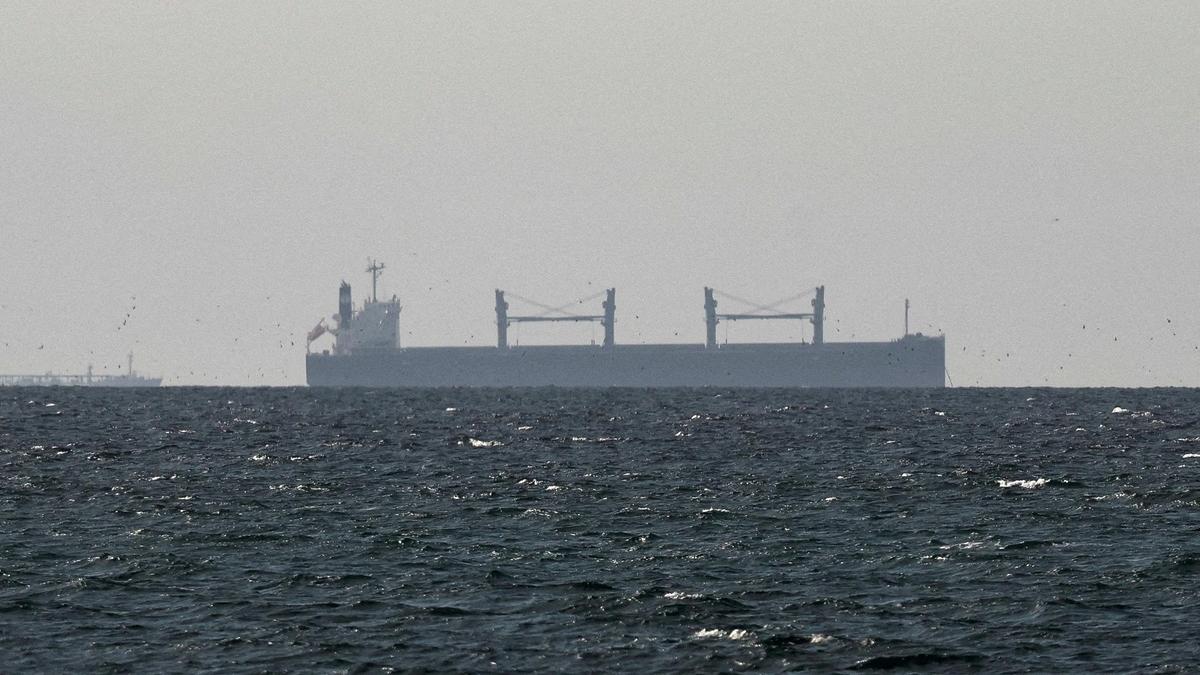
The sea is never really empty. Even in the deepest reaches of the Gulf, where the horizon dissolves into a hazy, shimmering heat, the water is crowded with intent. Somewhere beneath the surface of a blue-black wave, a sensor pings. Miles above, a satellite catches that pulse and relays it to a dim room in Bahrain or Virginia.
This is the blockade. It is not a wall of stone or a fence of wire. It is a living, breathing grid of steel and software.
For a merchant sailor on the deck of a rusted tanker, the geopolitics of the Middle East are rarely about speeches or press releases. They are about the sudden, jarring silhouette of a grey hull appearing against the sunrise. They are about the crackle of a radio frequency and the cold realization that the path ahead is no longer yours to choose. The U.S. military has made it clear: the blockade of Iran is not a suggestion. It is a physical reality that shapes every gallon of oil and every crate of grain moving through these waters.
But while the steel is real, the atmosphere is changing. There is a scent of diplomacy in the salt air.
The Mathematics of Thirst
Consider a hypothetical captain named Elias. He has spent thirty years navigating the chokepoints of the world. He knows that the Strait of Hormuz is only twenty-one miles wide at its narrowest point. To a politician, that is a statistic. To Elias, it is a throat.
If that throat closes, the world gasps.
The blockade is designed to keep the pressure high enough to hurt, but not so high that the system shatters. It is a delicate, agonizing balance. For years, the story has been one of pure friction—seized ships, drone strikes, and the quiet, high-stakes game of cat and mouse played by "ghost armadas" trying to slip past the sensors.
The military calls it "maritime security operations." The Iranians call it "economic terrorism." The rest of us call it the price of gas. But beneath the shouting, something else is happening. The very fact that the U.S. is loudly asserting the blockade’s strength is, paradoxically, a signal that they are ready to talk. In the world of power, you only brag about your grip when you are thinking about loosening it—for the right price.
The Ghost in the Machine
Modern blockades are fought in the electromagnetic spectrum as much as they are on the waves. This isn't the 1940s; there are no lines of battleships firing broadsides. Instead, there is the "dark fleet."
Imagine a ship that simply disappears.
One moment, a tanker is broadcasting its position via AIS (Automatic Identification System), a digital breadcrumb trail that tells the world its name, speed, and destination. Then, with the flip of a switch, the signal vanishes. The ship becomes a ghost. It drifts into a "ship-to-ship" transfer, huddling against another vessel in the dead of night to swap cargo like a back-alley handoff.
The U.S. military’s current insistence that the blockade is "in force" is a direct response to these ghosts. They are saying: We see you.
They are using synthetic aperture radar that can peer through clouds and darkness. They are using AI-driven behavioral analysis to predict where a ship will go based on its weight and drift, even when its transponder is silent. It is a technological siege. It is exhausting. It is expensive.
And it might finally be working toward an end.
The Weight of a Handshake
Why do we care about a few more destroyers in the Gulf? Because tension is a spring. You can only wind it so tight before the metal fatigues.
Talks of a "thaw" are often greeted with cynicism, and rightly so. We have been here before. We have seen the handshakes turn into fistfights. But the human cost of the current stalemate is becoming an anchor that neither side can carry forever.
Inside Iran, the blockade means more than just empty government coffers. It means a surgeon in Tehran struggling to find specialized medical equipment. It means a father watching the price of bread double in a single month. It is the slow, grinding erosion of daily life.
On the other side, for the U.S. and its allies, the blockade is a massive drain on resources and a constant risk of an accidental spark leading to a wildfire. A single nervous sailor on a fast-attack boat, a single miscalculated drone flight, and the "talks" disappear in a flash of cordite.
The hope for renewed talks isn't born out of sudden friendship. It is born out of exhaustion.
The Signal Through the Noise
Diplomacy is often described as a chess match, but that’s too clean. Chess has rules. This is more like wrestling in the dark. You feel for a limb, you test the weight of your opponent, and you wait for a moment of stillness.
The U.S. military’s announcement serves as that stillness. By affirming the blockade, they are setting the boundaries of the room. They are telling the Iranian negotiators that the pressure will not lift until the ink is dry on a new deal. It is the "stick" that makes the "carrot" of sanctions relief look appetizing.
What does this look like on the ground? It looks like a flurry of back-channel messages through Swiss intermediaries. It looks like diplomats in Vienna or Doha drinking too much coffee in hotel lobbies, waiting for a phone call that might never come.
It is a game of whispers backed by the roar of jet engines.
The Blue Frontier
We often forget that 90 percent of everything we own—the clothes on our backs, the phones in our pockets, the fuel in our cars—comes to us by sea. We treat the ocean as a void, a blank space between Point A and Point B.
But for the men and women stationed on the USS Bataan or the Iranian frigates watching them back through binoculars, that space is anything but empty. It is a high-tension wire.
The blockade is a reminder that our modern, digital, frictionless world still relies on the movement of heavy things through dangerous places. It is a reminder that peace is not the absence of conflict, but the management of it.
If the talks resume, it won't be because anyone "won." It will be because the cost of the blockade has finally outweighed the cost of compromise.
The next few weeks will be defined by a strange duality. We will see photos of grey ships and hear talk of "maximum pressure." At the same time, we will hear rumors of "understandings" and "frameworks."
One is the reality of the water; the other is the reality of the room.
The sailor on the deck of the tanker doesn't care about the framework. He cares about the horizon. He looks for the silhouette of the destroyer, wondering if today is the day the radio stays silent, if today is the day the path finally opens, and if he can finally stop being a pawn in a game played by people who will never feel the spray of salt on their faces.
The line in the water is still there. It is firm, it is cold, and it is guarded by the most sophisticated weapons ever built. But for the first time in a long time, there is a sense that someone is looking for the eraser.