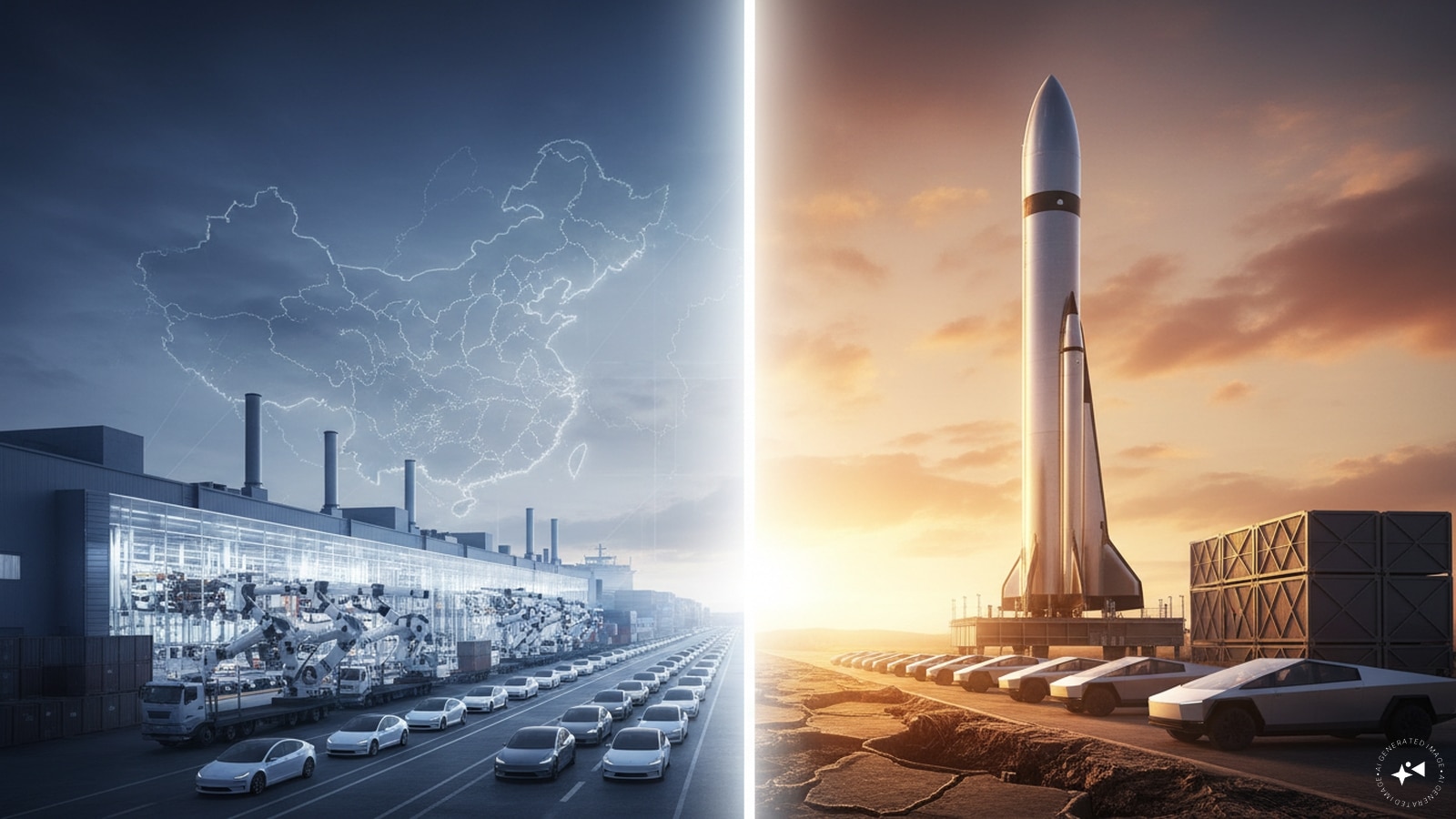
The factory floor in Shanghai never truly sleeps. At two in the morning, the air smells faintly of hot rubber, ozone, and industrial coffee. Robots hum in synchronized violence, welding chassis together with sparks that flash like miniature lightning storms. Every forty seconds, a completed Model 3 or Model Y rolls off the line. This single sprawling campus breathes life into half of Tesla’s global production. It is the beating heart of an automotive empire.
And someone wants to cut it loose.
When the quiet rumor surfaced about splitting off the massive Chinese operations to fuse them directly into SpaceX, Wall Street blinked. It sounded like science fiction. A car company untangling its most efficient manufacturing engine and handing it over to a private aerospace contractor aiming for Mars. Yet, beneath the initial absurdity lies a stark geopolitical reality. In modern boardrooms, geography is destiny.
Consider what happens next: two distinct corporate gravitational pulls fighting over the same master architect.
I remember standing outside a manufacturing plant a few years back, watching raw steel roll in on flatbeds and watching finished vehicles drive out into the sun. The logistics are staggering. Every single bolt has a pedigree. Every supply chain link is a tightrope walk over regulatory abysses. When you build half your vehicles inside a foreign superpower while your other venture is building rockets funded largely by government defense contracts, the tension becomes radioactive.
Washington watches every move. Beijing watches every move.
To understand why this separation is even whispered about, you have to look at the geometry of risk. Elon Musk has spent two decades proving that traditional manufacturing wisdom is mostly garbage. He built Gigafactory Shanghai with unprecedented speed, proving that Chinese engineering velocity could outpace Western bureaucracy by a factor of ten. But that efficiency came with a heavy mortgage. The plant sits on foreign soil, subject to shifting political tides, export controls, and the delicate dance of international diplomacy.
If geopolitical friction spikes tomorrow, that half-million-car lifeline could freeze overnight.
Enter SpaceX.
SpaceX is not just a rocket company; it is an infrastructure monopoly wrapped in an adventure novel. Starship is designed to lift the tonnage required to build a permanent human settlement on Mars. But getting there requires capital on a planetary scale. It requires manufacturing discipline that can turn custom, hand-built aerospace marvels into mass-produced commodities.
What if you take the hyper-efficient automated assembly lines of Shanghai and point them upward?
That is the hidden thesis behind the division. By severing the Chinese manufacturing arm from the American corporate parent, Tesla might shield its domestic assets from foreign entanglement, while simultaneously feeding SpaceX the cash-generating industrial beast it needs to colonize the stars.
Of course, this is not simple administrative paperwork. It is open-heart surgery on a multi-hundred-billion-dollar enterprise.
Think about the patents. Think about the software architecture. Autopilot and Full Self-Driving algorithms are trained on petabytes of data gathered from millions of cars driving down Chinese highways. Under strict data sovereignty laws, that information cannot simply be shipped to Texas to train orbital rockets. The firewall between jurisdictions is real, thick, and heavily guarded.
When a company gets too big for a single planet, it fractures.
We have seen this movie before in the history of industrial titans. Standard Oil had to be broken apart because its shadow grew too long for the economy to bear. General Motors spun out units to survive changing markets. But this is different. This is not about antitrust penalties or poor quarterly earnings. This is about survival in an era where software, hardware, and statecraft have fused into a single volatile mixture.
The factory floor in Shanghai keeps humming. The robots do not care about corporate reorganizations or orbital mechanics. They only weld, paint, and repeat.
Yet the people standing on that floor can feel the shift. They know that the cars they build are no longer just vehicles to get commuters to grocery stores. They are economic chits in a high-stakes game played between superpowers.
If the split happens, the automotive world will never look the same. Tesla will transform from a car company that builds rockets into something much harder to define—a decentralized network of planetary logistics, caught between the gravity of the earth and the pull of the stars.
The sparks will keep flying in Shanghai. Whether they light a fire on Mars or start a blaze much closer to home is the only question that matters now.