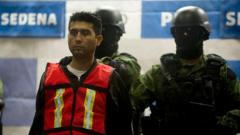
The guilty plea of Arnulfo Gonzalez-Valencia, better known by the moniker "El Cuini," represents a tectonic shift in the war against the Jalisco New Generation Cartel (CJNG). For years, federal investigators viewed him not as a mere foot soldier, but as the financial mastermind who transformed a regional gang into a global criminal conglomerate. By pleading guilty in a U.S. federal court, Gonzalez-Valencia has effectively decapitated the economic brain of the organization, potentially exposing a web of international shell companies and money-laundering routes that span from Asia to South America.
This is not a story about a simple drug runner. This is about the collapse of a sophisticated corporate structure. Gonzalez-Valencia was the leader of "Los Cuinis," the hyper-wealthy financial arm of the CJNG. While the cartel’s public face, Nemesio "El Mencho" Oseguera Cervantes, handled the violence and the territory, the Gonzalez-Valencia family managed the ledgers. They treated the drug trade like a venture capital firm, reinvesting profits into legitimate real estate, luxury resorts, and international trade.
The Financial Engine Behind the Violence
The CJNG rose to power faster than any other criminal group in Mexican history. Their ascent was fueled by a unique partnership between the brute force of the Jalisco gunmen and the financial acumen of Los Cuinis. While other cartels were focused on moving kilos across the border, Arnulfo Gonzalez-Valencia was focused on the global supply chain.
He understood that moving money is harder than moving drugs. Under his direction, the organization moved beyond simple cash smuggling. They utilized a "black market peso exchange" and complex trade-based money laundering schemes. By the time the Department of the Treasury's Office of Foreign Assets Control (OFAC) began freezing their assets, the group had already integrated itself into the fabric of the legal economy.
The plea deal suggests a catastrophic failure in the cartel's internal security. When a high-ranking financial officer flips—or even admits guilt without a full cooperation agreement—it creates a "run on the bank" mentality within the criminal underworld. Every business partner, every corrupt politician, and every banker who ever took a bribe from Los Cuinis is now looking over their shoulder.
The Myth of the Untouchable Financier
For a decade, Gonzalez-Valencia operated under the assumption that his distance from the front lines would protect him. He didn't carry an AK-47; he carried a smartphone and a portfolio. This "white-collar" approach to narco-trafficking made Los Cuinis arguably more dangerous than the gunmen. They provided the liquidity that allowed the CJNG to purchase high-grade military weaponry, including rocket-propelled grenades used to shoot down a Mexican army helicopter in 2015.
The U.S. justice system's focus on Gonzalez-Valencia highlights a strategic pivot. Law enforcement has realized that seizing shipments is a temporary fix. To dismantle the CJNG, they have to go after the people who make the money "clean." The guilty plea confirms that the evidence against the Cuinis' financial network was overwhelming, likely involving intercepted communications and forensic accounting that mapped out their global footprint.
Why This Plea Matters More Than a Capture
Capturing a cartel leader often leads to a "kingpin effect," where the organization splinters into smaller, more violent factions. However, the removal of a financial architect creates a different kind of vacuum. It creates a liquidity crisis. Without Arnulfo’s expertise, the CJNG faces a bottleneck in how it launders and distributes its massive profits.
We are seeing the end of the "Board of Directors" era for the Jalisco cartel. The Gonzalez-Valencia family provided the CJNG with a level of stability that other Mexican cartels lacked. They were a bloodline organization, bound by family ties that were supposed to be unbreakable. Arnulfo’s admission of guilt in a foreign court is a signal that those ties are fraying under the weight of life sentences and total asset forfeiture.
Global Reach and Local Impact
The reach of Los Cuinis extended far beyond the borders of Jalisco. They established significant operations in Europe and Australia, where the price of cocaine is significantly higher than in the United States. This diversification made them resilient. Even if the DEA squeezed their U.S. routes, the European markets kept the cash flowing.
Arnulfo was the gatekeeper of these markets. His guilty plea is a roadmap for international investigators. It validates the theory that the modern cartel is less like a gang and more like a multinational corporation with a private army. The legal pressure on him likely stems from a multi-year effort to track wire transfers and shell company registrations in tax havens like Panama and the Cayman Islands.
The Fragility of the Jalisco Empire
Despite their fearsome reputation, the CJNG is now more vulnerable than it appears. The organization is fighting a multi-front war: against the Mexican government, rival cartels like the Sinaloa federation, and now, the loss of its chief financial officer. When the money stops moving smoothly, loyalty in the lower ranks begins to dissolve. Hitmen don't work for free, and corrupt officials don't take risks without a guaranteed payout.
The prosecution of Arnulfo Gonzalez-Valencia is a reminder that the most effective weapon against organized crime isn't a bullet; it's a subpoena. By stripping away the veneer of legitimacy that Los Cuinis worked so hard to build, the U.S. government has forced the CJNG back into the shadows. They are no longer a sophisticated business; they are once again a hunted gang.
The real impact will be felt in the coming months as the CJNG tries to reorganize its financial pipelines. If they cannot find a replacement for Arnulfo's technical expertise, we will see a decline in their ability to conduct large-scale operations. The "New Generation" is getting old, and its founders are finding that no amount of money can buy a way out of a federal indictment.
The guilty plea of El Cuini isn't just a legal victory. It is the sound of the cartel's vault slamming shut.