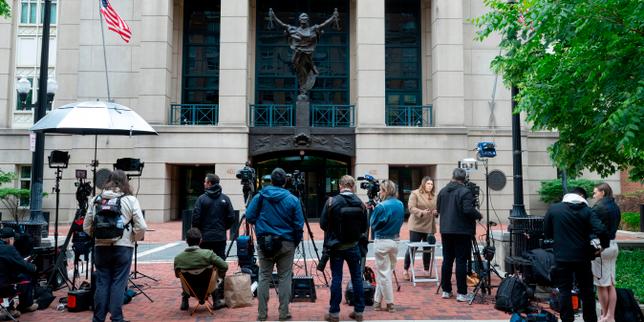
The headlines are vibrating with the same tired script. James Comey, the former FBI Director now facing the teeth of a Justice Department indictment, stands before the cameras and declares he is "still not afraid." The media laps it up. They frame it as a profile in courage or a tragic fall from grace.
They are both wrong. Don't miss our recent article on this related article.
This isn't a story about bravery. It is a story about the terminal failure of institutional ego. For decades, the upper echelon of the intelligence community has operated under the delusion that "process" is a shield and "intent" is a get-out-of-jail-free card. The indictment of a former FBI Director isn't just a legal maneuver; it is a brutal correction of a system that forgot it was supposed to be accountable to the public, not to its own sense of moral superiority.
The Martyrdom Complex is a Policy Failure
The "not afraid" narrative is a calculated branding move. When a high-ranking official leans into the role of the defiant martyr, they are usually trying to distract you from the granular reality of the charges. In the world of high-stakes federal investigations, fear is a survival mechanism. Abandoning it isn't a sign of strength; it’s a sign of a total disconnect from the consequences of one's actions. To read more about the context of this, The New York Times provides an in-depth breakdown.
I have spent years watching how these agencies operate from the inside out. I have seen mid-level analysts lose their careers over a fraction of the procedural "shortcuts" that directors take as a matter of course. When the person at the top claims they aren't afraid of a DOJ indictment, they are really saying they believe they are fundamentally different from the citizens they once policed.
The competitor's coverage treats this like a personal drama. It isn't. It is a structural crisis.
Why the Rule of Law is Not a Vibes-Based System
The lazy consensus suggests that these indictments are purely political. That's a convenient exit ramp for anyone who doesn't want to look at the evidence. We’ve entered an era where we prioritize "the spirit of the law" when it benefits our team and "the letter of the law" when it doesn't.
Comey’s defense—and the defense of those like him—rests on the idea that if your heart is in the right place, the rules are merely suggestions. But the law doesn't care about your "why." It cares about your "what."
- Fact: Handling classified information is a binary state. You either followed the protocol, or you didn't.
- Fact: Memos written on government time about government business are government property.
- Fact: Leaking those memos to the press to trigger a special counsel is, at best, a massive ethical breach and, at worst, a criminal violation of the Privacy Act.
When we allow officials to bypass these rules because they feel they are "saving the country," we aren't protecting democracy. We are building a high-tech autocracy where the only thing that matters is who holds the badge.
The Data of Discretion
Let’s look at the numbers the mainstream press ignores. The FBI's own manual (the DIOG) is thousands of pages of rigid instructions. If a street-level agent violated even 5% of those protocols during a sensitive investigation, they wouldn't be doing a book tour. They would be in a deposition.
The "nuance" the media misses is the massive disparity in how the DOJ treats its own.
| Position | Typical Outcome for Procedural Breach | Outcome for "Elite" Bureaucrats |
|---|---|---|
| Field Agent | Immediate suspension, loss of clearance, possible prosecution. | Reassignment or quiet resignation. |
| Department Head | Professional reprimand, "lessons learned" memo. | Six-figure book deals, CNN contributorships, "No Fear" branding. |
| James Comey | A decade of public debate and hero-worship. | Formal indictment (a decade too late). |
The indictment isn't an attack on the FBI. It is a long-overdue attempt to bring the FBI back into the same reality as the rest of us.
The Technological Narcissism of the Modern State
We need to talk about the tools. Comey’s era saw the FBI lean heavily into digital surveillance and the weaponization of "leaks" as a primary tool of governance. This is where the technology crossover happens. The intelligence community now views information not as a public trust, but as a currency to be traded for political outcomes.
The "I'm not afraid" stance is a product of this digital arrogance. When you control the flow of information, you feel invincible. You believe that you can always manufacture a narrative that makes your crimes look like virtues.
Imagine a scenario where a CEO of a Fortune 500 company leaked trade secrets to a competitor to force a board member to resign, then claimed they did it for the "soul of the company." They would be sued into the Stone Age. Yet, when a government official does it with national security secrets, we debate whether it was "bold."
Stop falling for the theater.
Dismantling the "People Also Ask" Nonsense
People often ask: "Is this indictment a threat to the FBI's independence?"
That is the wrong question. The real question is: "When did we decide that 'independence' meant 'lack of oversight'?"
Independence means the FBI shouldn't be a political weapon for the President. It does not mean the FBI is a fourth branch of government that gets to decide which laws apply to its leadership. If the DOJ cannot indict a former FBI Director for clear violations of the law, then the FBI isn't independent—it's sovereign.
Another common query: "Doesn't this discourage future whistleblowers?"
No. Whistleblowing has a specific legal definition. It involves going to an Inspector General or a Congressional committee through protected channels. It does not involve leaking memos to the New York Times because you’re mad you got fired. Confusing the two is an insult to real whistleblowers who actually risk their lives to expose corruption.
The High Cost of the "Not Afraid" Attitude
There is a downside to this contrarian view: it makes people uncomfortable. It forces us to acknowledge that our institutions are led by fallible, often ego-driven humans who are just as capable of breaking the law as anyone else.
But the alternative is worse. If we continue to buy into the "hero bureaucrat" myth, we lose the ability to govern ourselves. We become spectators in a war between different factions of the unelected elite.
James Comey says he isn't afraid. That is exactly the problem. He should be. Not of a jail cell, but of the fact that he has done more to damage the credibility of the FBI than any "enemy of the state" ever could. He turned the highest law enforcement office in the land into a platform for personal grievance and self-aggrandizement.
The indictment isn't the tragedy. The tragedy is that it took this long for the system to stop being intimidated by the man's height and his haircut.
The era of the "Untouchable Bureaucrat" is ending. If you’re still clinging to the idea that these people are the guardians of our democracy, you aren't paying attention to the data. You're just a fan of the show.
Get off the bleachers. The rules apply to everyone, or they apply to no one. Pick one.