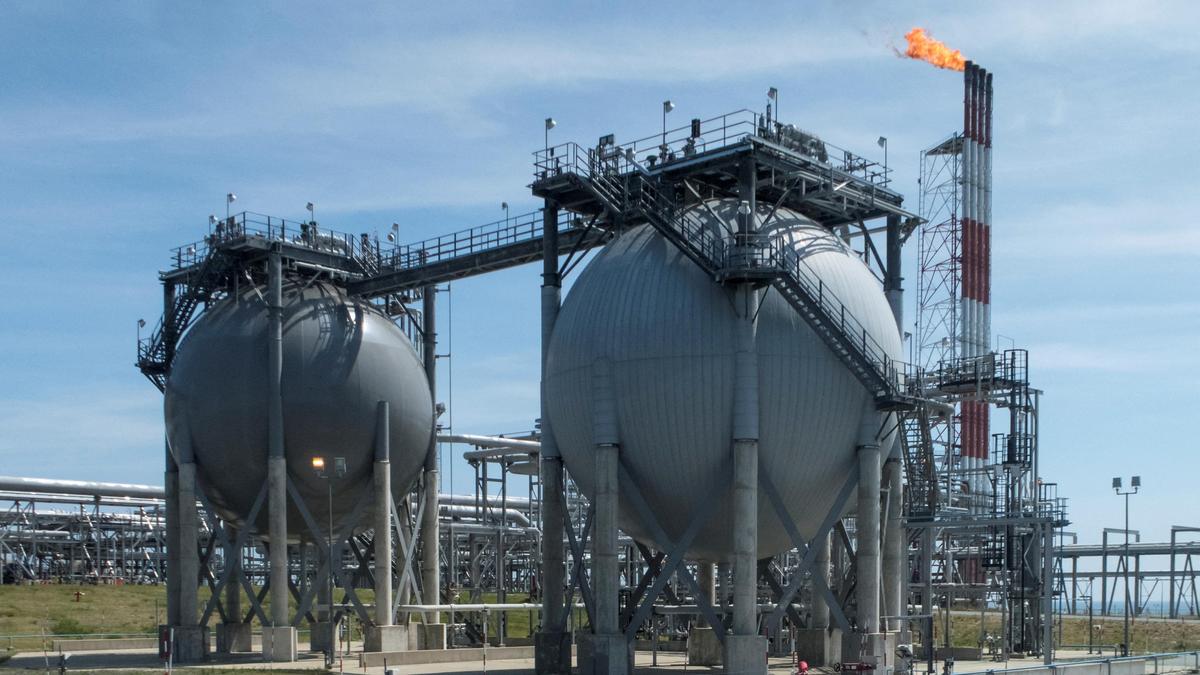
Japan has officially ended its long-standing drought of Russian crude oil, receiving its first shipment since the escalation of regional conflicts in the Middle East disrupted global supply chains. The Taiyo Oil shipment, which arrived at the Kikuma refinery, marks a pragmatic—if politically sensitive—pivot for Tokyo. While the G7 remains publicly committed to squeezing Moscow’s revenues, Japan’s status as a resource-poor island nation has forced a quiet reconciliation with the reality of its energy security. This isn't just about a single tanker; it is about the fragility of the "Western front" in the face of a direct threat to domestic fuel prices.
The Middle East Chokepoint and the Russian Pivot
For years, Japan leaned heavily on Middle Eastern crude, with over 90% of its supply flowing through the Strait of Hormuz. When the threat of a wider Iran war began to loom, the vulnerability of that single-source dependency became impossible for the Kishida administration to ignore. The math is simple and brutal. If the Strait closes, Japan’s economy stalls within weeks. Learn more on a connected issue: this related article.
To mitigate this, Tokyo has begun utilizing its "Sakhalin-2" exemptions. While most of the world shifted toward Atlantic or African grades to replace Russian Urals, the logistical cost for Japan to do the same is astronomical. Shipping oil from the North Sea or the Gulf Coast to East Asia takes forty days or more. Shipping from Russia’s Far East takes less than three.
Why Price Caps Failed to Stop This Move
The G7 price cap on Russian oil was designed to keep the oil flowing while limiting the Kremlin’s profit. However, Japan negotiated a specific carve-out for oil produced from the Sakhalin-2 project. They argued that without this oil, their long-term liquefied natural gas (LNG) contracts—which are bundled with oil production at the site—would be endangered. Further reporting by Business Insider highlights similar views on the subject.
The reality is that the "price cap" has become a sieve. By importing this oil, Japan is signaling that domestic stability outweighs the symbolic unity of the sanctions regime. It is a calculated gamble. They are betting that Washington will look the other way because a crippled Japanese economy would be a far greater liability to the Indo-Pacific alliance than a few million barrels of Russian crude.
The Logistics of Necessity
Refineries are not universal machines. They are calibrated for specific "diets" of crude oil. Many Japanese refineries were built to handle the low-sulfur, light grades that come out of Russia’s Eastern Siberia-Pacific Ocean (ESPO) pipeline.
When Japan attempted to "go cold turkey" on Russian oil, they forced their refineries to adapt to more expensive, distant alternatives. This increased the "crack spread"—the difference between the price of crude and the price of the finished gasoline or diesel. The result was a steady creep in prices at the pump for Japanese citizens, further eroding the popularity of a government already struggling with inflation.
The arrival of the recent tanker is a relief valve. It allows Taiyo Oil and other refiners to blend cheaper, closer feedstock, immediately improving the margins of the refinery and, theoretically, stabilizing prices for the end-user.
The Hidden Hand of the Sakhalin Projects
We have to look at the equity stakes to understand why this won't be the last shipment. Japanese trading houses Mitsubishi and Mitsui retained their stakes in Sakhalin-2 even after Shell exited the project at a massive loss. This was not a fluke or a mistake. It was a strategic directive from the Ministry of Economy, Trade and Industry (METI).
If Japan walked away, China or India would have stepped in to buy those shares at a discount. By staying, Japan maintains a seat at the table and a legal claim to the output. The recent shipment is the physical manifestation of that policy. It is Japan asserting its right to the energy it helped develop, regardless of the geopolitical optics in Brussels or Washington.
A Fractured Sanctions Landscape
The return of Russian oil to Japanese ports highlights a growing divide between the rhetoric of global sanctions and the survival instincts of individual nations. India and China have already demonstrated that they will buy Russian energy as long as it is discounted. Now, a core G7 member is doing the same, albeit through a more regulated and "exempted" pathway.
This creates a secondary market where "political" oil and "market" oil exist at two different price points. Japan is trying to bridge that gap. They are using the Iran war as a convenient, and legitimate, justification to diversify back toward a supplier that is geographically unavoidable.
The Environmental Tradeoff
There is also a carbon cost to this geopolitical maneuvering. When Japan sources oil from the Middle East or the U.S., the carbon footprint of the transport alone is massive. By sourcing from Sakhalin, the transit time is cut by 90%. In a world obsessed with ESG (Environmental, Social, and Governance) metrics, the "S" and the "G" are currently in a head-on collision with the "E." Tokyo has decided that the social stability of affordable energy and the governance of a secure supply chain are currently more important than the optics of where the barrels originated.
The Future of the East Asian Energy Mix
Expect more of this. The precedent has been set. As long as the Middle East remains a powderkeg, Japan will continue to use its exemptions to pull oil from the Russian Far East. They have realized that in a multipolar world, being a "loyal ally" does not keep the lights on in Tokyo.
The industry is watching the "Sakhalin-1" project next. If imports begin to flow from there as well, the sanctions on Russian energy will effectively be dead in the water in Asia. Japan is not leading a rebellion; they are simply leading a return to cold, hard realism.
The era of choosing values over volume is ending for the world’s third-largest economy. They tried the alternative, looked at the balance sheets, and decided that the risk of a dark winter was worse than the sting of a diplomat's letter. Watch the port of Kikuma. The tankers arriving there are the truest indicators of where the world’s power actually lies.
Direct your attention to the shipping manifests of the next three months. If the frequency of these deliveries increases, it confirms that the Sakhalin exemption is no longer a temporary safety net, but a permanent pillar of Japanese energy policy.