The internet loves a cute animal story. Every six months, the digital ecosystem selects a new furry avatar to worship, and right now, the spotlight belongs to Jimothy the raccoon. Media outlets are churning out standard, soft-focus profile pieces explaining "how Jimothy captured our hearts" with warm references to organic virality, spontaneous wholesome content, and the innate joy of internet culture.
It is a comforting narrative. It is also completely wrong.
Jimothy did not break the internet because he is uniquely charming or inherently special. He blew up because his handlers stumbled into an algorithmic exploit that social media platforms are desperate to keep quiet. What audiences perceive as a spontaneous explosion of human affection is actually the logical end-result of engagement engineering, short-form video optimization, and a collective psychological coping mechanism.
If you want to understand how culture actually spreads today, you need to stop cooing over a masked scavenger and start looking at the mechanics under the hood.
The Myth of Organic Virality
The standard media playbook tells us that virality is an act of digital serendipity. A user uploads a funny clip, people share it because it brightens their day, and suddenly a star is born.
That narrative is dead. It died the moment short-form video algorithms pivoted from social graphs to interest-based recommendation engines.
In the old days of the web, content spread through explicit human curation. You saw a video, you liked it, and you manually sent it to five friends. Today, human agency plays a distant second fiddle to machine learning models designed to optimize for one metric above all else: watch time retention.
Jimothy’s content machine succeeded because raccoons possess a specific physical architecture that breaks content moderation classifiers and forces human eyes to pause:
- High-contrast facial features: Dark eye masks against light fur create immediate visual focal points in a fast-scrolling feed.
- Anthropomorphic dexterity: Paws that mimic human hand movements trigger a cognitive double-take, inflating watch time by critical fractions of a second.
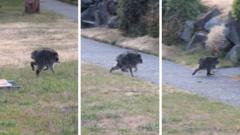
- Unpredictable motion vectors: Erratic, twitchy movements trick the human startle response, forcing the viewer to rewatch a three-second loop to process what happened.
I have watched digital marketing agencies throw millions of dollars at polished, high-production influencer campaigns only to get completely outpaced by a 1080p clip of a raccoon knocking over a trash can. Why? Because the agencies were trying to appeal to human taste, while Jimothy's handlers inadvertently appealed to the cold logic of the feed.
When a viewer stops scrolling for 1.2 seconds instead of 0.4 seconds, the algorithm registers a high-signal positive feedback loop. It does not care that the subject is a raccoon. It cares that the visual pattern holds attention.
Parasocial Exploitation in the Feed
Let us address the "wholesomeness" angle that every mainstream commentary leans on. The prevailing argument claims that in a chaotic, stress-inducing world, animals like Jimothy offer an innocent escape.
That is a surface-level diagnosis. The reality is far more transactional.
Jimothy is a product of manufactured parasocial intimacy. By placing a wild animal in mundane human environments—wearing tiny hats, sitting at dinner tables, interacting with smartphones—the content deliberately blurs the line between wildlife and domestic companionship. It creates a false sense of accessible joy.
Thought Experiment: Imagine replacing Jimothy with an equally intelligent, highly charismatic rat performing the exact same actions in the exact same lighting. The viral quotient drops by 80%. Why? Because the audience isn't responding to the animal's behavior; they are responding to a curated aesthetic that validates their desire for effortless, low-stakes comfort.
This isn't organic joy. It's micro-dosed serotonin engineered for maximum repeat consumption.
The problem with elevating wild animals to meme status goes beyond media critique. It creates an unsustainable flywheel. Viewers demand increasingly bizarre, escalating scenarios to get the same hit of novelty. To maintain the engagement curve, content creators are forced to push their pets into increasingly unnatural settings. What starts as a candid moment evolves into a full-time production schedule where a wild animal becomes an unpaid laborer in the attention economy.
Why People Ask the Wrong Questions About Internet Fame
Whenever a character like Jimothy takes over the timeline, the mainstream discussion devolves into predictable "People Also Ask" style queries. Understanding why these questions are fundamentally flawed reveals just how badly the average consumer misunderstands modern media.
"Why do people love Jimothy so much?"
This question assumes the audience actively chose to love Jimothy out of an array of options. They didn't. The recommendation engine chose Jimothy for them and served him repeatedly until familiarity bred affection. You don't love the animal; you love the frictionless delivery of a low-effort distraction that requires zero emotional processing power.
"How can I make my pet viral like Jimothy?"
This is the classic mistake of treating an outlier event as a reproducible strategy. Attempting to replicate an algorithmic anomaly by copying the surface-level details—buying tiny props, playing trending audio tracks—is a race to the bottom. For every pet account that hits critical mass, ten thousand rot in zero-view obscurity because they missed the exact temporal window where the algorithm prioritized that specific visual syntax.
"Is Jimothy good for animal awareness?"
No. It actively commodifies wildlife. Converting a raccoon into a digital plush toy sanitizes the reality of wildlife management, exotic pet trade risks, and urban pest dynamics. It substitutes genuine ecological awareness with passive, commodified entertainment.
The Hidden Cost of Content Commodification
There is an inherent downside to dissecting cultural phenomena through this hyper-analytical lens. When you pull back the curtain on algorithmic distribution, you ruin the magic trick. You lose the ability to simply laugh at a ridiculous video of an animal doing a backflip.
I admit that viewing the digital landscape through purely mechanical terms can feel cynical. There is value in uncritical enjoyment, and not every viewer needs to dissect the retention curves of a fifteen-second clip.
However, remaining blissfully ignorant of these systems leaves us vulnerable to manipulation. Today, the algorithm uses these mechanics to force a raccoon onto your screen. Tomorrow, it uses the exact same optical triggers, emotional pacing, and retention tricks to push polarizing political narratives or speculative financial bubbles.
Jimothy is not an isolated piece of harmless pop culture. He is a lightweight proof-of-concept for how easily human attention can be captured, retained, and monetized by automated distribution networks.
Stop Looking at the Raccoon
The obsession with Jimothy will fade. It always does. In a few months, the feed will discard him for a bizarre cat, an articulate parrot, or a capybara with a distinct habit. The subject is entirely disposable.
The underlying infrastructure, however, is permanent.
The next time a hyper-viral animal dominates your feed, stop asking what makes the creature so special. Stop sharing the heartwarming profiles that treat algorithmic distribution like a miracle. Start analyzing why your brain was manipulated into stopping its scroll, who profits from those extra two seconds of your life, and what is being quietly optimized behind the curtain while you stare at the screen.
Stop feeding the content machine your unthinking attention. Close the tab. Put down the phone. Walk away.