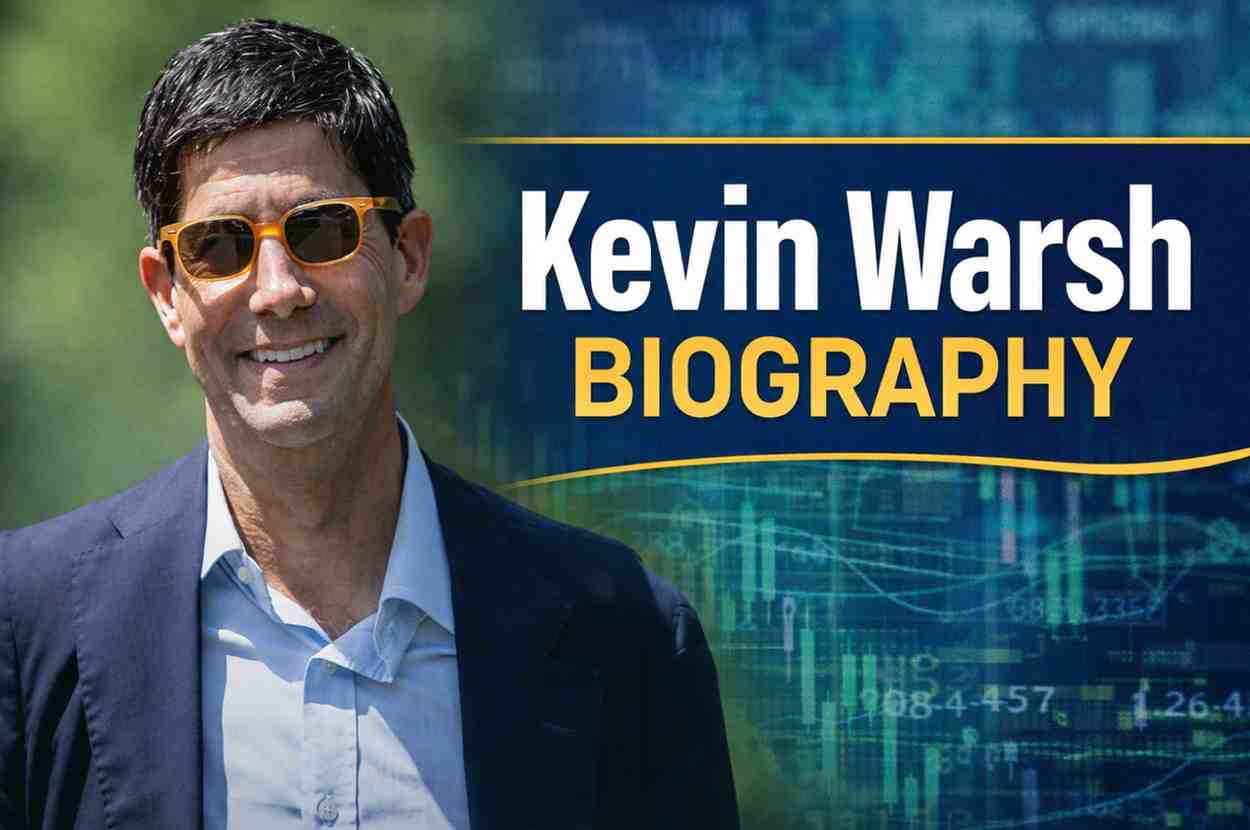
Donald Trump has spent years searching for a central banker who doubles as a loyalist, and in Kevin Warsh, he believes he has finally found his man. By nominating Warsh to succeed Jerome Powell as Chair of the Federal Reserve this May, the President isn't just picking a policy wonk; he is installing a shock absorber. Warsh is the ultimate insider-outsider—a former Fed governor with deep Wall Street ties who has spent the last decade throwing stones at the very institution he is now tapped to lead.
But the narrative that Warsh is merely a "yes-man" misses the institutional trap being set in Washington. Trump wants lower interest rates to fuel a high-growth, high-tariff economy, and Warsh has signaled he is willing to provide them by betting on an unproven theory: that Artificial Intelligence will boost productivity so sharply that the Fed can slash rates without triggering a localized inflationary firestorm. It is a massive gamble. If the AI miracle fails to materialize and inflation spikes, Warsh will not be the hero of a new economic era. He will be the high-profile fall guy for an administration that demands the impossible from the laws of economics.
The Greenspan Shadow
To understand Kevin Warsh, you have to understand his obsession with Alan Greenspan. Warsh has recently revived the myth of "the Maestro," arguing that the Fed should rely less on "stale" lagging data and more on forward-looking intuition. He calls data dependence one of the most dangerous phrases in monetary policy.
This is music to the ears of a White House that views the current Fed’s cautious, numbers-heavy approach as a personal affront. Warsh is essentially promising a return to a "conviction-based" policy. In this framework, the Chair doesn't wait for a report from the Bureau of Labor Statistics to tell him the economy is changing; he senses it in the market and moves first.
The danger here is obvious. When Greenspan operated on intuition in the 1990s, he was hailed as a genius because he was right about the internet productivity boom. When he used that same intuition in the early 2000s, he helped inflate the housing bubble that nearly destroyed the global financial system. Warsh is betting his entire legacy on the idea that AI is the new internet. If he’s wrong, there is no safety net.
The Balance Sheet Bloodbath
While Warsh is sounding like a dove on interest rates to please the Oval Office, he remains a dedicated hawk on the Fed's balance sheet. He has long criticized the "bloated" multi-trillion-dollar portfolio of Treasurys and mortgage-backed securities, calling it a distortion of free markets.
This creates a brutal internal contradiction for his upcoming term.
- The Rate Cut Goal: Trump wants the federal funds rate pushed down to stimulate borrowing and spending.
- The Balance Sheet Reality: Warsh wants to aggressively shrink the Fed’s holdings.
Aggressively offloading bonds is a form of quantitative tightening. It puts upward pressure on long-term interest rates—the very rates that dictate mortgages and corporate debt. Warsh may find himself in a position where he is cutting short-term rates to satisfy the President while his balance sheet policies are simultaneously driving up the cost of a 30-year mortgage. This is not a recipe for stability. It is a recipe for a market seizure.
The Ghost of Jerome Powell
Warsh isn't just entering a hostile economic environment; he is entering a hostile building. Jerome Powell’s term as Chair ends in May, but his term as a Governor technically lasts until 2028. There is a very real possibility that Powell remains on the board, acting as a shadow Chair and a rallying point for the "old guard" of career economists who view Warsh’s appointment as a political takeover.
No Fed Chair in the modern era has had to lead while their predecessor sat across the table, potentially voting against them. If Warsh tries to force through radical rate cuts based on "intuition" while the rest of the board demands data, the resulting internal friction will leak into the markets. Investors hate uncertainty. A fractured Fed is a weak Fed, and a weak Fed leads to a volatile dollar.
The Institutional Suicide Pact
The ultimate risk for Warsh isn't that he fails to please Trump, but that he succeeds.
If Warsh successfully bends the Fed to the White House's will, he destroys the very independence that gives the U.S. dollar its status as the world’s reserve currency. Foreign central banks and global investors buy U.S. debt because they trust the Fed to protect the value of the dollar, even if it means defying a President. If that trust evaporates, the "exorbitant privilege" of the American economy goes with it.
Warsh is highly intelligent and understands these risks better than almost anyone. He knows that he is being brought in to execute a "regime change" at the central bank. The question is whether he truly believes his AI-productivity theory will save him, or if he is simply willing to take the fall when the bill for "conviction-based" policy finally comes due.
Trump has a long history of discarding the people he once praised as "the best." If the markets tank or inflation returns to 1970s levels, the President won't blame his own tariffs or his demand for cheap money. He will blame the man he put in charge of the printing press. Kevin Warsh is walking into a trap designed by his own ambition.
Markets are already flinching. Gold and silver tumbled on the news of his nomination, while the dollar saw a temporary, nervous spike. These aren't signs of confidence; they are the tremors of a system bracing for impact. Warsh has spent years arguing that the Fed needs a revolution. He is about to find out that revolutions usually end with the architects being led to the guillotine.
The Senate confirmation will be a formality. The real trial begins in May, when the "Maestro" 2.0 has to prove that his intuition is worth more than the hard, cold data he so publicly despises.
Focus on the spread between short-term and long-term yields as May approaches. That is where the truth will hide.