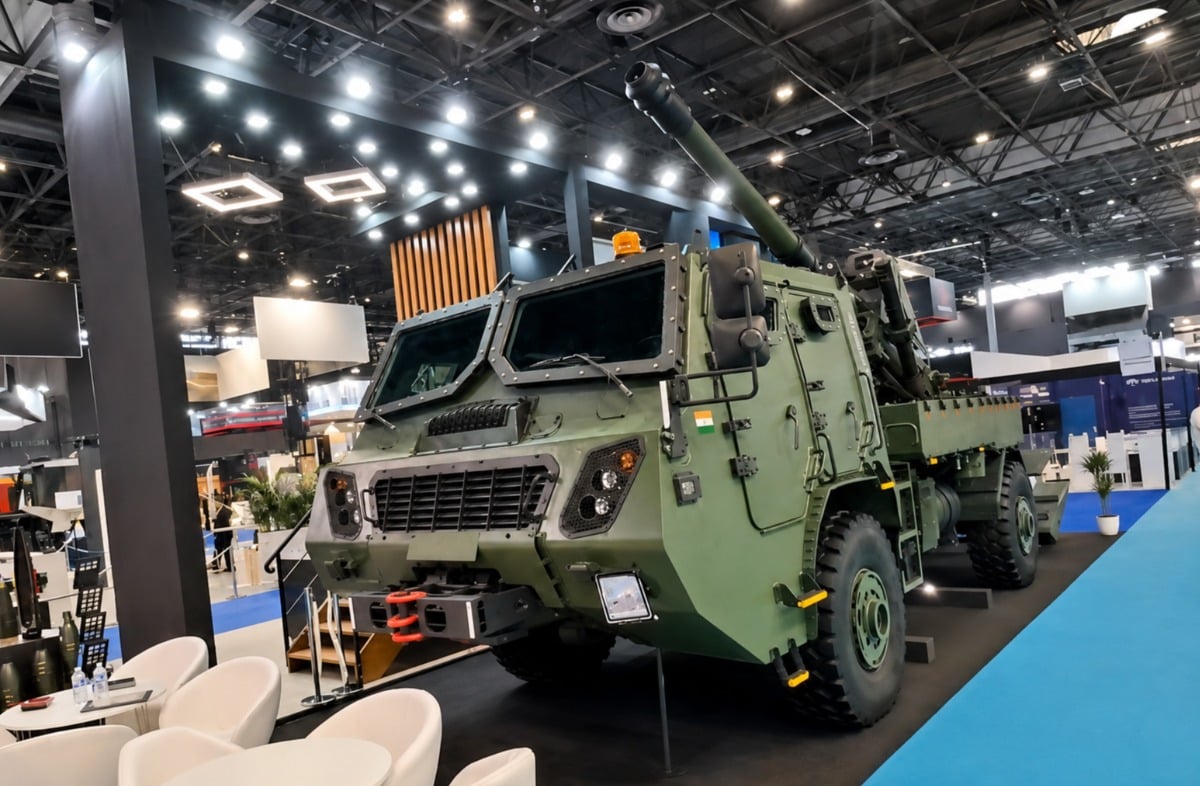
Modern land warfare has exposed a fundamental vulnerability in towed and heavy tracked artillery systems: the compression of the kill chain through drone-based target acquisition and automated counter-battery fire. In response, the United States Army has initiated the Mobile Tactical Cannon (MTC) program to procure a highly transportable, rapid-deployment 155mm weapon system. The joint proposal by India’s Kalyani Strategic Systems Limited (KSSL) and America’s AM General to enter a variant of the Mounted Artillery Gun (MArG) into this race shifts the evaluation metrics of mobile fires from raw armor protection to structural physics and dispatch logistics.
To understand the strategic implications of the MArG 52-calibre 155mm platform entering the Western defense ecosystem, the architecture must be evaluated across three engineering and operational pillars: force mitigation physics, strategic deployability equations, and supply chain integration.
The Physics of Recoil: Soft Recoil Technology vs. Mass Accumulation
Traditional self-propelled howitzers absorb the massive mechanical energy of a 155mm detonation by utilizing massive hydraulic recoil mechanisms housed within heavy, armored chassis. This traditional model relies on brute mass to stabilize the platform during firing. The MArG platform disrupts this engineering convention by implementing a patented Soft Recoil Technology (SRT) mitigation system.
The mechanism operates on a forward-recoil principle. Prior to detonation, the gun barrel is accelerated forward by a high-pressure hydraulic system. The propellant charge ignites precisely at the moment the barrel reaches its optimal forward velocity. The rearward force generated by the expanding gases must first arrest the forward momentum of the barrel before it can compress the primary recoil dampeners.
$$F_{\text{net}} = F_{\text{recoil}} - F_{\text{forward}}$$
By indexing the ignition timing to the kinematics of the forward stroke, the peak recoil forces transmitted to the vehicle chassis are reduced by up to 50% compared to conventional static-start artillery systems. This reduction in peak structural stress changes the vehicle host requirements. Instead of requiring a heavy 6x6 or 8x8 armored truck bed or a tracked chassis, a full 52-calibre 155mm system can be integrated onto a highly agile, light-weight 4x4 platform. This lowers the gross vehicle weight rating (GVWR) to approximately 22 tonnes for its standard configurations.
The Survivability Function: Quantifying Shoot-and-Scoot
The modern artillery survival metric is a function of time. In active theaters, counter-battery radar systems can calculate an incoming shell's trajectory and project the firing source point within 30 seconds of detonation.
The MArG architecture reduces the platform’s dwell time at any given firing position through an automated load-assist mechanism and an integrated all-weather digital fire control suite. The operational sequence is divided into three distinct chronological phases:
- Emplacement Phase: Upon halting, the vehicle uses automated hydraulic stabilizers to ground the platform. The digital fire control system, tied directly into network-centric battlefield management software, computes the firing solution within seconds of stopping.
- Engagement Phase: The automated load-assist rams the 155mm projectile and modular propellant charges into the breech, enabling a sustained burst rate of fire. The system maintains capability for both high-angle indirect fire and direct emergency fire up to and exceeding a 40-kilometer range using standard high-explosive or precision-guided munitions.
- Displacement Phase: Immediately following the final round's departure, the automated stabilizers retract as the crew moves the vehicle.
Because the vehicle's lightweight 4x4 or compact configuration utilizes a purpose-built powerpack and heavy-duty suspension system, its off-road acceleration and cross-terrain tactical mobility exceed those of traditional 30-to-40-tonne tracked artillery. The platform can achieve displacement and move outside the blast radius of typical counter-battery artillery before the enemy's retaliatory shells impact the initial firing coordinates.
Strategic Transportability and Global Logistics Footprint
The logistical constraint of traditional artillery lies in strategic airlift. Moving heavy tracked howitzers requires large strategic transports, which limits the number of units deliverable per sortie and restricts operations to runways capable of supporting high wheel-load classifications.
The MArG system alters this deployment equation. Its lower gross vehicle weight allows it to fit within the payload envelopes of standard tactical cargo aircraft. The operational implications for rapid reaction forces are clear:
- Sortie Efficiency: A single strategic transport aircraft can ferry multiple truck-mounted artillery systems simultaneously, doubling or tripling the immediate firepower delivery per deployment wave.
- Austere Airfield Access: Lower aircraft landing weights open up smaller, unimproved dirt runways closer to the forward edge of the battle area, shortening the transit time from airhead to firing line.
- Maintenance Lifecycle Decoupling: By utilizing a truck-chassis baseline co-developed and supported by AM General, the mechanical maintenance footprint mirrors that of tactical wheeled vehicle fleets rather than specialized, low-density tracked vehicle supply lines. This standardizes common parts like tires, hoses, and engine components, reducing the total ownership cost over the system's life cycle.
Constraints and Strategic Limitations
The MArG architecture is optimized for mobility and rapid deployment, which presents distinct trade-offs. The primary limitation of a lightweight 4x4 or 4x4-derived 155mm platform is its organic armor protection. The system relies on its speed and low profile for survivability; it cannot withstand direct anti-tank guided missile strikes or sustained heavy artillery fragmentation in the way a heavily armored, tracked self-propelled gun can.
The second limitation involves onboard magazine capacity. Due to strict weight restrictions, the platform carries a constrained loadout of just over 20 projectiles and associated modular propellant charges. This creates a operational bottleneck during prolonged, high-intensity artillery duels, requiring a dedicated, highly mobile ammunition resupply vehicle to follow the platform closely to sustain fire support missions.
The Geopolitical Realignment of Defense Production
The KSSL and AM General partnership represents a structural shift in the global defense industrial base. Historically, defense technology flowed almost exclusively from Western prime contractors to developing nations. This joint bid for the US Army Mobile Tactical Cannon program reverses that vector, pairing an Indian metallurgical and artillery design baseline with an American automotive specialist to penetrate the world’s most demanding defense market.
For the US Army, down-selecting a platform based on the MArG architecture for potential 2027 delivery would solve the immediate tactical requirement for highly mobile, medium-weight fires. It would also structurally diversify its supply chain by leveraging India’s massive manufacturing capacity. For India, a platform-level contract with the US military would mark a major transition from exporting sub-components and ammunition to delivering sophisticated, combat-relevant primary weapon systems to peer-level global militaries.
The success of the program will ultimately hinge on the platform's performance in upcoming live-fire operational tests, where its soft-recoil kinematics will be evaluated against the realities of continuous, high-rate firing schedules.