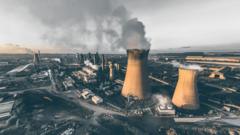
If you stand close enough to a blast furnace, the heat does not just touch your skin. It presses against your chest. It is a heavy, living weight, smelling of sulfur, hot iron, and the damp soil of Lincolnshire. For generations of families in Scunthorpe, this terrifying, magnificent heat was not just a workplace. It was the rhythm of life. It was mortgage payments, Sunday roasts, university tuition, and identity.
But when a furnace goes cold, the silence is worse than the noise. For an alternative view, see: this related article.
For steelworkers like David—a hypothetical third-generation caster whose grandfather helped build these very structures—that silence has been creeping closer for years. To the offices in Whitehall or the boardrooms in Beijing, British Steel is a balance sheet, a chess piece in a geopolitical game, or a line item in a green transition budget. To David, it is the heartbeat of his town.
On Wednesday, July 15, 2026, the British government took its most dramatic step yet to prevent that heartbeat from stopping. The Steel Industry (Nationalisation) Act 2026 received royal assent. In the language of civil servants, the bill has cleared Parliament and is now law, giving ministers the legal power to bring British Steel into public ownership within days. Similar coverage on the subject has been shared by Financial Times.
To some, it is a historic rescue mission. To others, it is an expensive, desperate gamble to save an industry that the modern world is leaving behind. But to understand how we arrived at the brink of nationalization, we have to look past the legislative jargon and look into the fire.
The Saturday We Swallowed Our Pride
A year ago, the future did not look like a legislative victory. It looked like a sudden death.
In April 2025, the Chinese conglomerate Jingye Group, which bought British Steel out of insolvency in 2020, announced plans to shut down the blast furnaces at Scunthorpe. The decision threatened to instantly wipe out thousands of jobs and strip the United Kingdom of its ability to make primary steel from scratch.
The crisis was so acute that Parliament was recalled on a Saturday. Politicians of all stripes scrambled to pass emergency special measures. They took control of how the plant’s assets were managed, essentially telling a foreign private owner how to run its own property. But it was a temporary band-aid.
Think of it as putting a patient on life support while arguing over who pays for the medicine.
The government tried to negotiate a commercial sale. They looked for private buyers. They tried to find a compromise with Jingye over the astronomical costs of updating the plant to meet environmental targets. But the talks hit a brick wall. When the negotiations crumbled, the state was left with two choices: let the fires go out permanently, or buy the hearth.
They chose the hearth.
The Anatomy of a Strategic Anxiety
It is easy to look at the decline of British manufacturing with a sense of nostalgia. But the push to save Scunthorpe is driven by something far colder than sentimentality: national security.
Imagine a country that cannot build its own warships, lay its own railway tracks, or construct its own nuclear power plants without relying on imported metal. During peacetime, global supply chains run smoothly. You click a button, and cheap steel arrives from across the ocean. But we do not live in a peaceful, predictable world.
Consider the numbers. Over the last ten years, domestic steel production in the UK has plummeted by more than half. Today, the nation produces roughly four million tons of steel a year, which covers a mere 30 percent of what it actually consumes. The rest must be imported.
If Scunthorpe's blast furnaces die, the UK becomes the only nation in the G7 unable to produce raw steel from scratch.
This is the invisible thread connecting the sweat-drenched overalls of a worker in Lincolnshire to the strategic defenses of the nation. If the supply chains fracture, a country without domestic steel is a country at the mercy of others.
The Trillion-Pound Question
Public ownership is not a magic wand. It is a massive, complex, and incredibly expensive transition.
The government’s plan is to steer British Steel toward a greener future, replacing the coal-hungry blast furnaces with electric arc furnaces. These modern units melt down recycled scrap metal rather than smelting iron ore from scratch, dramatically reducing carbon emissions. Across the country, Tata Steel UK is already moving in this direction, backed by a £500 million government grant for an electric arc furnace in Port Talbot.
But this shift reveals a painful contradiction.
Electric arc furnaces require far fewer workers to operate. Even if the government successfully nationalizes the company, modernizes the site, and keeps the British Steel brand alive, the community of Scunthorpe is still staring down the barrel of job losses. The transition to green energy is necessary, but for the people who have spent their lives feeding coal into the belly of the beast, the future feels cold.
There are also the immediate financial realities. Jingye is already seeking substantial compensation from the British government for the takeover. Critics in Parliament have raised alarm bells about the potential billions in taxpayer money required to not only purchase the company but to run it, modernize it, and clean up decades of industrial footprint.
We are, quite literally, buying a house that needs a new roof, new plumbing, and a complete rewiring, while the previous landlord demands a premium exit fee.
The Weight of the Metal
For the people who live in the shadow of the cooling towers, the political debates in London can feel a million miles away. They do not care about the fine print of the Steel Industry (Nationalisation) Act. They care about whether their children will have to leave town to find work.
They remember the previous era of nationalization in the late 1960s, a time of massive state-run monopolies that eventually fractured under the weight of inefficiency and strikes. No one wants a return to the bloated, subsidized industries of the past. Yet, leaving the fate of a foundation industry entirely to the whims of global market forces has brought Scunthorpe to the edge of ruin.
This tension is the true heart of the story. It is a conflict between the cold efficiency of global capitalism and the deep human need for stability, security, and pride in one's work.
Nationalization is a desperate, old-fashioned tool being used to solve a modern, futuristic crisis. It is a confession that some things are too important to be left to the market.
As the sun sets over the industrial skyline of North Lincolnshire tonight, the smoke still rises from the giant structures. For now, the fires remain lit. The men and women walking through the gates for the night shift do so with a strange mixture of relief and apprehension. The government has saved their factory, but they have also inherited its future.
David walks onto the casting floor, the familiar heat wrapping around him like an old blanket. He looks at the glowing liquid metal flowing through the troughs, brilliant and dangerous. For the first time in years, he knows the furnace will still be hot tomorrow. But as he looks at the empty spaces where his colleagues used to stand, he knows that the hardest work is yet to come.