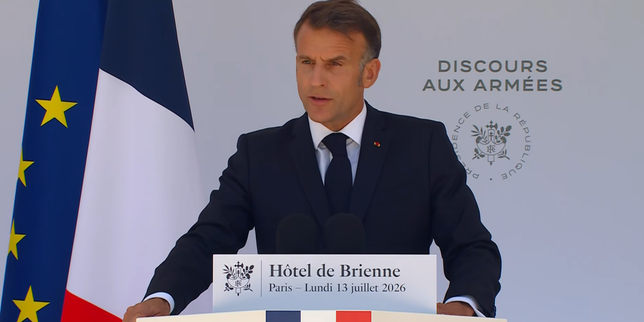
The room smells of aged brass, heavy wool, and the distinct, sharp scent of rain drying on marble. Outside the tall windows of the Hôtel de Brienne, Paris hums with its usual indifference to the machinery of statecraft. But inside, the air feels thick, almost compressed. A man stands near the window, adjusting the cuffs of his shirt, looking out at a courtyard where young men and women stand at rigid attention.
Emmanuel Macron is preparing for his final address to the French armed forces as their president.
To the casual observer, a July speech to the military is a routine piece of political theater. It features standard choreography, predictable applause, and a litany of strategic acronyms. But look closer at the tension in the shoulders of the generals waiting in the hallway. Listen to the uncharacteristic urgency in the draft of the speech resting on the desk. This is not a victory lap. It is a warning flare.
The continent of Europe has spent decades tucked safely beneath an invisible umbrella. We bought our gas from the East, our consumer goods from the Far East, and our security from the West. It was a comfortable arrangement. It allowed for long summers, robust social programs, and a general sense that the brutal history of the twentieth century was a closed book.
That book just blew wide open.
The Illusion of the Long Peace
Imagine a homeowner who hasn't checked the roof in thirty years. Every spring brings a few leaks, but a bucket catches the water, and the sun eventually comes out. The homeowner convinces himself that roofs are inherently permanent structures.
Europe is that homeowner.
When the Berlin Wall crumbled, a collective sigh of relief echoed from Lisbon to Helsinki. Governments rushed to cash in what economists called the "peace dividend." Military budgets were slashed. Regiments were dissolved. Factories that once forged armor were converted to manufacture luxury sedans. We convinced ourselves that economic interdependence meant physical safety. If we traded together, we wouldn't bleed together.
It was a beautiful theory. It was also wrong.
The reality of modern warfare did not vanish; it simply morphed while we weren't looking. While European capitals debated fiscal deficits and green transitions, other powers were quietly reshaping the landscape of coercion. They weren't just building tanks; they were mapping underwater internet cables, stockpiling rare earth minerals, and refining algorithms capable of blinding an enemy's command structure in seconds.
Now, the bill has arrived. And the account is overdrawn.
The French president’s final address to his troops carries the weight of this realization. For years, Macron has beaten a drum that many of his continental neighbors found irritating, if not outright alarmist. He spoke of "European strategic autonomy"—a phrase so dry it could turn wine to dust. But strip away the bureaucratic jargon, and the message was simple: No one is coming to save us if we refuse to save ourselves.
The Fragile Shield
Consider the anatomy of a modern artillery shell. To a civilian, it is a simple chunk of metal filled with explosives. To a logistician, it is a masterpiece of distributed manufacturing. The casing comes from one country, the propellant from another, the specialized fuse from a third.
When a major conflict flared on Europe's doorstep, the continent tried to ramp up production. The results were sobering.
We discovered that the assembly lines no longer existed. The skilled machinists had retired. The raw chemical components were backordered for months, sourced from nations that did not necessarily share our democratic values. It was a stark lesson in the difference between financial wealth and industrial capability. You cannot fire a portfolio of tech stocks out of a howitzer.
This is the core of the crisis that Macron highlighted in his final moments with the military. France possesses one of the most capable armed forces in Europe, complete with a sovereign nuclear deterrent. But France is not an island. In a world defined by continental-sized superpowers, a single nation acting alone is nothing more than a speed bump.
The math is brutal. The United States spends over eight hundred billion dollars annually on defense. China’s budget rises with clockwork regularity every year. Meanwhile, European defense spending remains a fragmented mosaic of twenty-seven different priorities, twenty-seven different procurement systems, and twenty-seven different ideas of who the actual enemy is.
We buy different radios that cannot talk to each other. We maintain a dozen different types of main battle tanks, creating a logistical nightmare for any joint operation. It is a system designed for peacetime vanity, not wartime survival.
The Unseen Digital Trench
The true vulnerability, however, is not found in the mud of Eastern Europe or the waters of the Mediterranean. It is humming quietly in server farms buried beneath mountains, and in the satellites orbiting miles above our heads.
The nature of conflict has shifted from the physical to the cognitive. A modern state can be paralyzed without a single soldier crossing a border. If the power grid fails in mid-winter, if hospital networks go dark, if the financial clearing systems freeze for seventy-two hours, a nation will fracture from within.
During his address, the president didn't just talk about buying more hulls or airframes. He pointed toward the digital frontier. The next generation of defense requires an entirely different breed of warrior—people who fight with keyboards and code rather than rifles and bayonets.
But building that capability requires immense, sustained capital. It requires a scale of investment that no single European nation can sustain on its own. It demands a collective pool of resources, a shared European defense fund that can compete with the tech giants of Silicon Valley and the state-directed laboratories of Beijing.
This is where the political friction lies. For decades, the European project has been about harmonization, regulation, and consumer rights. It has excelled at creating standard dimensions for fruit and lowering roaming charges for mobile phones. It has deliberately avoided the messy, violent business of hard power.
Turning that massive, bureaucratic supertanker around is an agonizingly slow process. And time is the one luxury Europe no longer possesses.
The Empty Chair
The silence in the courtyard grows deeper as the afternoon wanes. The president steps to the podium. His voice carries over the loudspeakers, crisp and measured, reflecting the sobriety of a continent at a crossroads.
The true audience for this speech is not just the soldiers standing in formation. It is the leaders sitting in Berlin, in Brussels, in Rome, and in Warsaw. It is a final, urgent appeal to those who will remain in power long after his term concludes.
The danger of the current moment is not just a lack of equipment; it is a lack of imagination. We find it impossible to believe that the world we built could actually fall apart. We treat peace like the weather—something that happens to us, rather than something that must be actively, fiercely defended.
But history shows that peace is an anomaly. It is a fragile garden carved out of a wilderness that is constantly trying to reclaim it. If you stop weeding, if you stop tending the fences, the wild always returns.
Macron's departure marks the end of an era of French leadership that, whatever its flaws, consistently demanded that Europe look into the mirror and recognize its own vulnerability. As his voice echoes across the stone courtyard, the question hangs in the damp air: Who will pick up the drum when he steps down?
The soldiers stand motionless. Their faces are young, clear, and unlined by the historical traumas that defined their grandparents' lives. They are the ones who will inherit the consequences of the decisions made, or avoided, in the comfortable rooms of state capitals over the next few years.
The president finishes his remarks, steps away from the microphone, and delivers a final, lingering salute. He turns back toward the warmth of the palace, leaving the courtyard to the gathering shadows and the cold, unyielding reality of an uncertain tomorrow.


