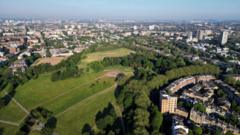
The grass on Primrose Hill usually smells of expensive picnic wine and the faint, lingering scent of hope. It is one of the few places in London where the city feels like a toy, a glowing collection of distant glass and steel that cannot hurt you. People go there to watch the sun dip behind the BT Tower, waiting for that specific moment when the skyline turns a bruised purple. On New Year’s Eve, that hill is a cathedral of anticipation.
But as the clock ticked toward 2024, the grass held a different scent. Iron. Cold. Sharp.
Harry Pitman was twenty-one years old. He didn't climb the hill to become a statistic or a cautionary tale printed in the morning editions of the evening papers. He went because that is what you do when you are young and the year is turning over. You find your friends, you find a vantage point, and you look at the horizon. You imagine that the next twelve months will be the ones where everything finally makes sense.
He never saw the fireworks.
The facts of the night are as clinical as a surgical blade. At approximately 11:40 PM, while thousands of people were laughing and clutching plastic cups of champagne, a confrontation broke out. It was fast. It was chaotic. In the middle of a crowd so dense you could barely move, a blade found its mark. Harry collapsed. By the time the first vibrant streaks of light painted the sky above the Thames to celebrate a new beginning, Harry’s life had already ended.
The Geography of a Tragedy
Primrose Hill isn't just a park; it is a symbol of safety. Nestled in the shadow of Regent’s Park and surrounded by some of the most affluent real estate in the world, it feels insulated. It is a place for celebrity sightings and Sunday morning jogs. When violence erupts in a place like this, it shatters the collective illusion that certain zip codes are immune to the darkness creeping through the city's veins.
The police cordons the next morning were a jagged contrast against the manicured greenery. Officers in high-visibility vests stood where families usually spread checkered blankets. The forensics tent, a stark and lonely white structure, became the only thing to see on a hill famous for its views.
Witnesses described a scene of incomprehensible contrast. On one side, the jubilant roar of a crowd counting down from ten. On the other, the desperate, rhythmic thud of paramedics performing CPR on a boy whose heart had stopped keeping time with the city.
Consider the proximity of these two worlds. A few yards in one direction, someone was kissing a stranger and making a resolution to join a gym. A few yards in the other, a young man was fading into the turf. This is the terrifying reality of urban violence—it does not wait for a dark alley or a quiet street. It is bold. It is immediate. It happens in the light.
The Invisible Stakes of the Blade
We often talk about knife crime in London as if it is a weather pattern—something tragic but seasonal, an inevitable part of the metropolitan atmosphere. We look at the numbers. We see the age of the victim and the age of the suspects—often teenagers themselves—and we shake our heads at the "waste."
But waste is too passive a word.
This is an erosion. Every time a young man like Harry is taken, a hole is punched through a family, a friend group, and a community. These holes don't mend. The "invisible stakes" are the decades of life that vanished in a heartbeat. The wedding Harry won’t have. The children he won’t father. The mundane, beautiful boredom of a Tuesday afternoon ten years from now that he will never experience.
The suspects arrested in the aftermath were sixteen and fifteen years old.
Think about that age. At fifteen, the brain is still a work in progress, a storm of impulses and misplaced bravado. Yet, in our current social climate, that storm is increasingly armed. The transition from a heated argument to a fatal wound has become shorter than ever. The blade has replaced the fist, and in doing so, it has removed the possibility of walking away with nothing but a bruised ego.
The Illusion of the Crowd
There is a psychological phenomenon known as the bystander effect, where the presence of others inhibits our pulse to help. But on Primrose Hill, the crowd wasn't indifferent—it was simply overwhelmed. There were tens of thousands of people. The sheer volume of humanity created a mask.
In a digital age, we are used to seeing the world through a lens. Many people on that hill likely thought the commotion was just another group of revelers getting too rowdy. They were filming the horizon, their screens reflecting the artificial glow of the city, while the most real and raw moment of the night happened just behind their shoulders.
The police later pleaded for mobile phone footage. They knew the murder was likely captured on a hundred different iPhones, hidden in the background of selfies and videos of the London Eye. We live in a world where we are constantly watching, yet we rarely see.
The Aftermath of the Silence
When the sun rose on New Year’s Day, the city was quiet, nursing its collective hangover. But for the Pitman family, the silence was permanent.
The tributes began to pile up at the base of the hill. Flowers, cards, a lone football jersey. These are the artifacts of grief we use to try and ground a soul to a place it left too soon. People walked by, some pausing to offer a silent prayer, others quickening their pace, unable to look at the physical manifestation of their own fears.
Violence in public spaces changes the way we navigate our lives. It plants a seed of suspicion. You start to look at a group of teenagers not as kids, but as potential threats. You choose the long way home. You avoid the hill at sunset. The "hidden cost" of Harry’s death isn't just the loss of his life; it’s the theft of the public’s peace of mind.
The investigation will move through the courts. There will be hearings, evidence bags, and legal arguments about intent and provocation. The justice system will attempt to balance the scales, but the scales of a human life are impossible to level. You cannot trade a prison sentence for a heartbeat.
We are left asking why. Why does a celebration require a weapon? Why does a twenty-one-year-old end up on a mortuary slab because of a disagreement in a park?
There are no easy answers, only the heavy, cold reality of the morning after. The fireworks are long gone, the smoke has cleared, and the city has moved on to its next headline. But on a green slope in North London, where the view is supposed to be beautiful, the earth remembers the weight of a boy who just wanted to see the sky turn purple one more time.
The wind still blows across the ridge, carrying the ghosts of resolutions that will never be kept.