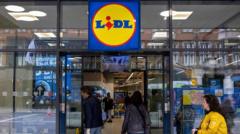
Lidl’s recent structural adjustments to the Lidl Plus loyalty program represent a fundamental shift from aggressive market-share acquisition toward margin preservation. While consumer sentiment focuses on the perceived loss of value, the reality is a calculated recalibration of the "Cost per Loyal Visit." By increasing the spending thresholds required to trigger significant rewards, Lidl is effectively testing the price elasticity of its middle-tier shoppers while attempting to filter out "cherry-pickers" who provide low lifetime value (LTV).
The Mechanics of Reward Dilution
The transition in the Lidl Plus reward structure is not a random austerity measure; it is an optimization of the redemption funnel. Historically, discount retailers used low-threshold rewards to drive app adoption and digitize the customer base. Once a critical mass of first-party data is achieved, the utility of high-frequency, low-spend rewards diminishes. Building on this theme, you can find more in: Bulls Are Bettting Big on American Express Before Earnings.
The core tension lies in the Spend-to-Reward Ratio. When the spending requirement for a top-tier coupon increases—for instance, from £100 to £150 or £200 within a monthly cycle—the retailer achieves two operational goals:
- Break-even Point Extension: The retailer captures a higher gross margin per customer before any margin-eroding discount is applied.
- Basket Size Expansion: Shoppers nearing a threshold are incentivized to add "filler" items to their baskets, often high-margin impulse buys or branded goods that counteract the eventual discount.
This creates a Value Gap. For the budget-conscious shopper, the utility of the app drops as the "effort-to-reward" distance increases. If the marginal cost of reaching the next tier exceeds the perceived value of the coupon, the incentive structure fails. Analysts at Harvard Business Review have also weighed in on this matter.
The Three Pillars of Loyalty Devaluation
The perception of Lidl Plus becoming "less generous" is a byproduct of three distinct strategic levers being pulled simultaneously.
1. Threshold Escalation
By moving the goalposts for "Milestone Coupons," Lidl targets the average transaction value (ATV). If a shopper spends £40 per week, a £100 monthly threshold was easily attainable. Moving that threshold to £150 forces that shopper to either consolidate their spending (shifting spend away from competitors like Aldi or Tesco) or lose the benefit entirely. This is a "winner-takes-all" play for the shopper's total grocery wallet.
2. Coupon Specificity and Inventory Clearing
There is a notable shift from "flat-rate" discounts (e.g., 10% off the total shop) toward "category-specific" coupons (e.g., 15% off select bakery items). From a balance sheet perspective, flat-rate discounts are the most expensive because they apply to high-demand, low-margin staples like milk and eggs. Category-specific coupons allow Lidl to:
- Clear overstock in specific departments.
- Drive trial for high-margin private label (Lidl Own Brand) goods.
- Minimize "deadweight loss" where discounts are given on items the customer would have bought anyway.
3. Temporal Friction
The expiration windows for activated coupons serve as a psychological and operational constraint. Reducing the validity period of a reward from seven days to three days increases the "Redemption Friction." This leads to "Slippage"—a phenomenon where rewards are earned but never redeemed, allowing the retailer to report high "loyalty engagement" while maintaining higher realized margins.
The Discounter’s Dilemma: Brand Equity vs. Yield Management
Lidl operates on a high-volume, low-complexity model. Unlike "Big Four" supermarkets (Tesco, Sainsbury's, Asda, Morrisons), discounters lack the margin cushion to absorb rising supply chain costs without passing them on or cutting promotional spend.
The current strategy suggests that Lidl has moved from the Acquisition Phase of its digital journey to the Monetization Phase. During acquisition, the goal was app installs. Now, the goal is "Return on Ad Spend" (ROAS) within the app itself. However, this strategy carries a significant risk: the "Discounter Identity Crisis."
If a customer chooses Lidl specifically for price leadership, and that leadership is obfuscated by complex, hard-to-reach loyalty tiers, the brand’s core value proposition—simplicity—is compromised. When loyalty schemes become as complex as those of legacy retailers, the cognitive load on the shopper increases. This creates an opening for competitors who maintain a "Everyday Low Price" (EDLP) model without the hurdle of app-based gatekeeping.
Calculating the Hidden Cost of Shopper Defection
The primary risk factor in this recalibration is the Churn Probability of the Value-Seeker. In the discount sector, brand loyalty is often secondary to price-per-unit. By making rewards less accessible, Lidl risks a "Reversion to the Mean," where shoppers no longer feel a sunk-cost incentive to stick with one retailer.
The loss of a customer is not just the loss of their next £40 shop; it is the loss of the data stream they provide. Loyalty apps are fundamentally data-harvesting engines. When a user stops scanning the app because the rewards are out of reach, Lidl loses visibility into:
- Price sensitivity across specific SKUs.
- The effectiveness of cross-merchandising.
- Regional variations in demand.
The degradation of data quality is a hidden cost that may eventually outweigh the immediate margin gains from reduced coupon payouts.
Operational Bottlenecks in Digital-First Loyalty
The "Lidl Plus" friction is also exacerbated by hardware and software bottlenecks. As the app becomes more central to the checkout experience, any technical failure or slow loading time at the Point of Sale (POS) creates physical friction. In a high-speed discount environment, a 30-second delay while a customer tries to load a coupon impacts "Labor Productivity"—one of the most critical metrics for a discounter.
If the reward at the end of that 30-second delay is perceived as negligible, the customer is less likely to tolerate the friction in future visits. This leads to a decline in "Scan Rates," effectively blinding the retailer to the customer's behavior.
The Shift Toward Personalized Pricing Models
The long-term trajectory of Lidl Plus likely moves away from universal milestones toward Segmented Incentives. Data-driven retailers are increasingly using "Propensity Modeling" to offer different rewards to different users.
- High-Churn-Risk Users: May receive aggressive, low-threshold discounts to prevent them from switching to Aldi.
- Sticky/Loyal Users: May see their thresholds increased, as the data suggests they will continue to shop at Lidl regardless of the reward level.
This creates a "Discriminatory Pricing" environment where the "generosity" of the scheme is invisible to the general public because it is tailored to individual spending patterns. The current "less generous" sentiment may simply be the result of Lidl transitioning away from "one-size-fits-all" rewards toward this more clinical, data-optimized approach.
Strategic Pivot: The Required Response
Lidl must recognize that "loyalty" in the discount sector is a functional, not emotional, relationship. To mitigate the backlash while maintaining margin control, the following pivots are necessary:
- Transparency over Gamification: Replace moving monthly targets with a fixed, transparent "Value Back" percentage that remains consistent. This reduces the cognitive load and restores the "price leader" trust.
- Utility-Driven Rewards: Instead of just money-off coupons, integrate rewards that offer "Time Value," such as express checkout lanes or early access to "Middle of Lidl" promotional items.
- Basket-Level Optimization: Shift focus from total monthly spend to "Basket Composition." Incentivize the purchase of high-margin private label items specifically, rather than trying to force a total volume increase that the consumer’s budget cannot sustain in an inflationary environment.
The current dissatisfaction indicates a mismatch between Lidl’s internal margin targets and the external economic reality of their core demographic. If the "Cost of Loyalty" becomes too high for the consumer, the loyalty app ceases to be a tool for retention and becomes a catalyst for comparison shopping.
Retailers observing this shift should prioritize "Reciprocity Efficiency"—ensuring that every unit of data or effort provided by the customer results in a clear, non-negotiable unit of value. Anything less is merely a temporary tax on the customer base that will inevitably lead to a market-share correction.