Stop looking at Netflix for subscription inspiration. If you're running a media company, your churn problem isn't going to be solved by flash sales, cheaper ad tiers, or slicker recommendation algorithms. It gets solved when you make your product so deeply woven into a reader's geographic identity that canceling feels like cutting ties with their own town.
Look at Amedia. The Norwegian publisher was staring down bankruptcy a decade ago. Today, it manages 850,000 subscribers in a country of just 5.5 million people. Its digital revenue makes up 80% of its total subscription intake. They didn't pull this off by chasing pivot-to-video trends or buying into generative text gimmicks. They did it by building a regional monopoly on identity through a single, brutal metric: first-party logged-in data. For an alternative look, read: this related article.
Most publishers treat registration walls like a minor marketing hurdle. Amedia treats registration as the entire business. Right now, 87% of their total pageviews come from users who are actively logged into their proprietary identity system, aID. They have clean, actionable data on 2.8 million people. That's over half the population of Norway.
When you know exactly who is reading, where they live, and what local sports team their kid plays for, you stop guessing what content drives retention. You just build for it. Related reporting on this matter has been provided by Reuters Business.
The Counterintuitive Art of Making Core Audiences Invisible
Every newsroom dashboard in the world encourages journalists to write for the readers they already have. If your biggest audience segment is retired people who love local politics, your analytics will tell you to print more stories about city council zoning laws. It's a textbook retention trap. You optimize yourself straight into a demographic graveyard.
Amedia hit this exact wall. Their data revealed a terrifying reality: they had more subscribers over the age of 80 than under the age of 40.
Instead of launching a generic youth-focused marketing campaign, they did something that sounds completely unhinged. They intentionally hid 90% of their existing subscriber data from their editorial dashboards.
In a series of trials across local newsrooms like Romerikes Blad, the tech teams isolated the metrics for readers under 40 and made the traditional older audience completely invisible to journalists.
The editorial teams stopped writing reactive follow-ups to fill space for the hyper-engaged, elderly base. Instead, they began covering local issues through the lens of young parents, first-time homebuyers, and regional commuters.
The result wasn't just a 30% surge in under-40 subscribers over nine months. The broader revelation was that the older audience didn't leave. The journalism simply became cleaner, more direct, and less bogged down by institutional inertia. Older readers stayed because the paper was alive; younger readers joined because the paper finally spoke to them.
Forget Clickbait and Stream the Third Division Match
We've been told for years that local news is dying because tech platforms stole the ad market. That's a lazy excuse. Local news bled out because it tried to play the scale game against entities with infinite servers. If you're competing for national clicks, you lose.
Amedia shifted from scale to depth by making its local digital subscriptions non-negotiable hard paywalls. To get people to pay up to 25 euros a month for a single local title, they had to offer utility that couldn't be aggregated by a global feed.
They found that utility in low-tier local sports streaming.
Around 2013, every publisher went through a phase of forcing print reporters to stand in front of smartphones to shoot awkward video packages. It failed everywhere. It was expensive, slow, and generated zero subscription conversions.
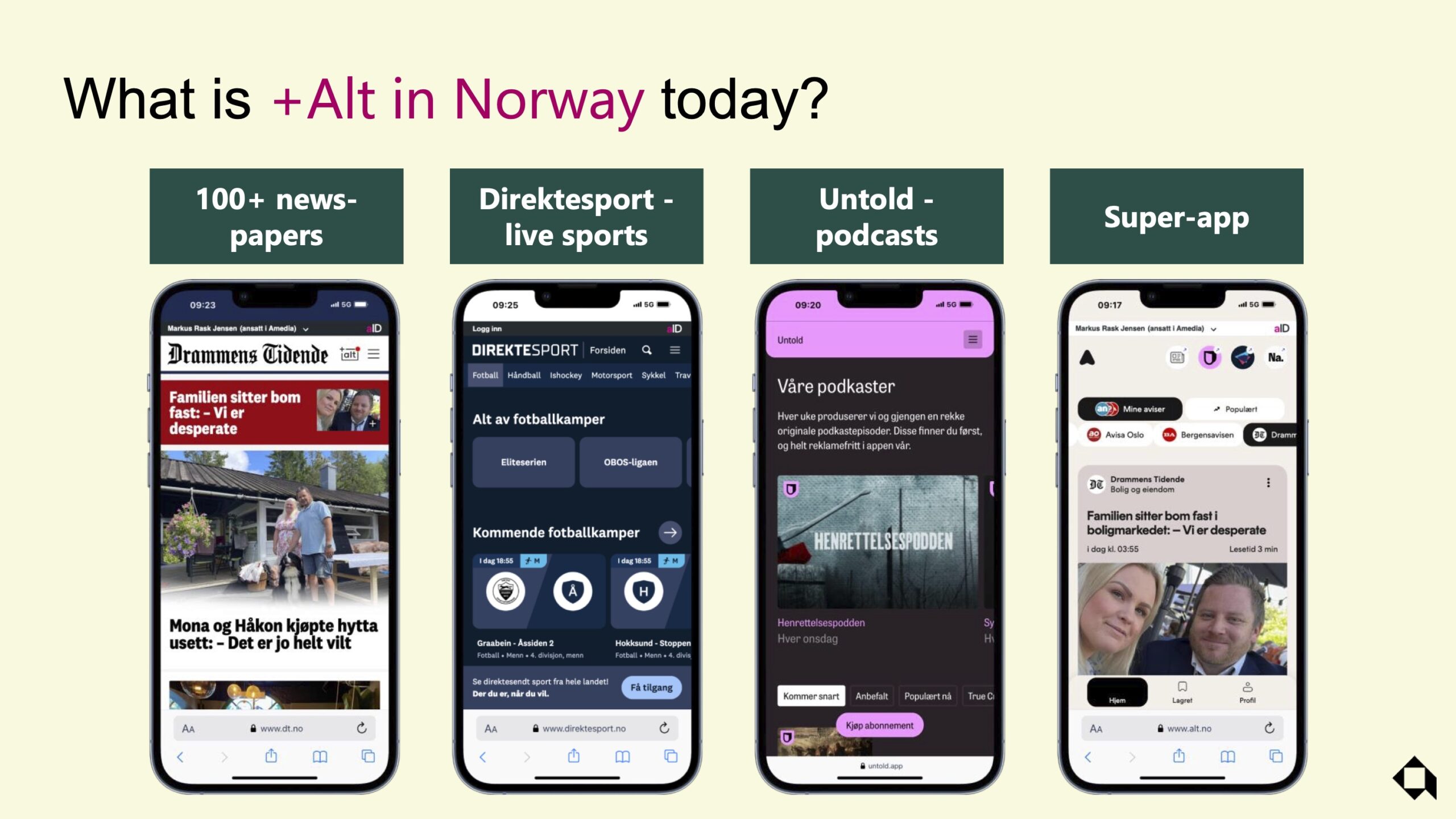
Amedia dropped the news video packages and bought up the broadcast rights for Norwegian football from the second down to the fourth division. They started live-streaming handball games, school tournaments, and local athletic meets.
They didn't hire expensive production crews. They integrated with local sports clubs, using automated cameras and simple setups to stream 6,000 live events a year.
If you want to watch your niece's regional championship game or see your hometown team fight to stay in the third division, you don't go to YouTube. You can't find it on television. You pay for the local paper. Local sports streams turned out to be the single highest driver of raw digital registration and long-term subscriber acquisition in their history.
The Magic of the All Access Regional Bundle
Once you hook a reader on local sports or neighborhood news, how do you insulate your business from summer churn cycles? You bundle horizontally, not vertically.
Instead of offering a discount to keep a subscriber from clicking cancel, Amedia built "+Alt" (Plus Everything). It's a cross-border ecosystem product. For 299 Norwegian crowns (roughly 27 euros) a month, a subscriber doesn't just get their town's digital paper. They get unlocked access to more than 100 newspapers across the entire network.
The initial internal fear was obvious: wouldn't a master bundle cannibalize individual local titles?
The data proved the exact opposite. Readers don't live single-town lives anymore. They live in a suburb, work in a major city, own a cabin in the mountains, and grew up in a completely different province.
The first iteration of the bundle failed because it simply dumped a massive list of 73 separate websites onto the user. Churn didn't budge. The product team went back and rebuilt the framework to separate the experience into two distinct zones: a dedicated "home area" for the reader's primary local titles, and a centralized "discover feed" powered by the user's aID profile.
This personalized feed injects relevant stories from across the entire country based on behavioral patterns, not generic trending algorithms. Week-six reader retention skyrocketed by more than eight times compared to the unbundled model.
Today, 60% of Amedia’s 850,000 subscribers use the +Alt bundle. The strategy is scaling beyond Norway. Following acquisitions and joint ventures, they've exported this identical infrastructure into Sweden through Bonnier News Local, and into Denmark via Berlingske Media. The data patterns are translating across borders perfectly.
How to Apply the Long Game Strategy to Your Operation
If you want to stop chasing fleeting traffic spikes and build an audience model that survives the ongoing decay of platform referral traffic, you need to change your structural priorities immediately.
First, stop optimizing your homepage for anonymous fly-by traffic. Introduce a strict registration wall for premium local utility. If a reader wants to comment, view local data tables, or access specific regional guides, make a logged-in account mandatory. Do not worry about a temporary drop in programmatic ad impressions. Clean, first-party identity data is worth tenfold what an anonymous open-programmatic eyeball pays.
Second, audit your content production against your demographic realities. If your analytics show your active subscriber base is aging out, don't create a separate, superficial youth vertical. Isolate your young demographic data, show your newsroom what that specific cohort reads, and adjust your core editorial coverage to match their practical real-world needs.
Finally, look for your regional blind spots. Find the community events, hyper-local sports leagues, or municipal datasets that large media companies can't scale down to cover. Own those niches completely through live video or definitive tracking. Then, use those entry points to pull readers into a broader regional network.
Stability doesn't come from a viral hit. It comes from becoming a non-negotiable utility in your reader's daily routine.