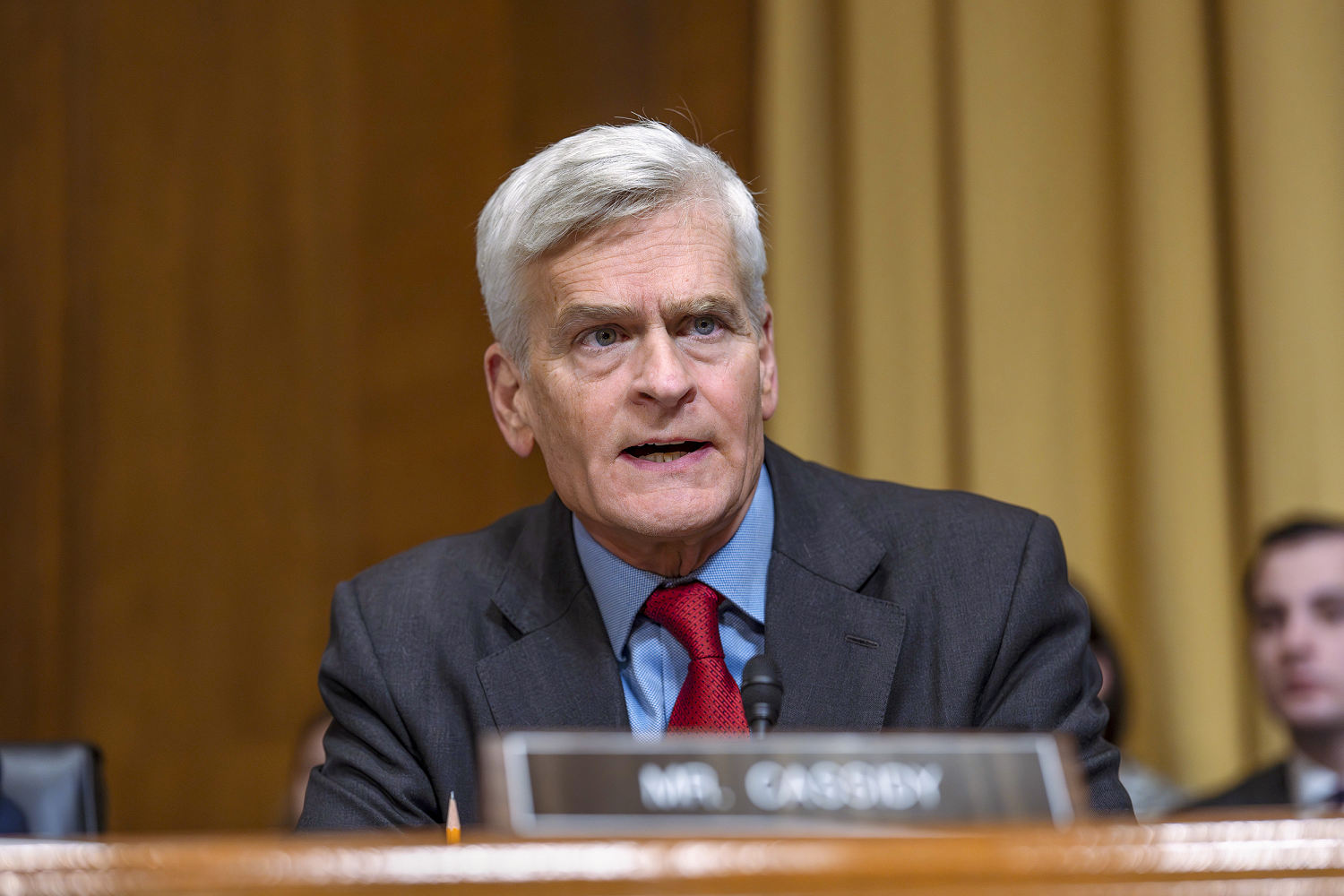
The air in Louisiana smells of damp earth and slow-moving water, a heavy humidity that clings to everything like a memory. In the local diners of Baton Rouge and the fishing docks of the bayou, politics isn't usually a matter of high-minded theory. It’s about who has your back when the storm surge hits. For decades, Bill Cassidy was that man—the doctor who treated the uninsured, the senator who secured the flood maps, the reliable Republican vote.
But a single hand raised in a quiet chamber in Washington D.C. changed the temperature of the air back home.
When Bill Cassidy voted to convict Donald Trump during his second impeachment trial, he wasn't just casting a vote. He was cutting an anchor. In that moment, he became a man standing on an island of his own making, watching the tide rise and the shoreline of his own party recede into the distance. Now, as the 2026 election cycle begins to churn, that island is getting smaller.
The Weight of a Single Word
Imagine walking into a room where everyone used to be your friend, only to find the locks changed and the lights dimmed. That is the reality for a "heretic" in modern American politics. To the MAGA faithful in Louisiana, Cassidy’s vote wasn't an act of conscience; it was a betrayal of the blood. It didn't matter that he had voted with the former president nearly 90 percent of the time. In the theater of modern populism, 90 percent is a failing grade. Loyalty is binary. It is 100, or it is zero.
Cassidy knew this. He is a physician by trade, a man trained to look at data, symptoms, and outcomes with a clinical, sometimes cold, detachment. When he looked at the evidence of January 6th, his internal diagnostic tool told him a line had been crossed. He acted on the diagnosis.
The fallout was instantaneous. The Louisiana Republican Party censured him before the ink on his vote was even dry. They didn't want to hear about constitutional duty or the nuances of executive overreach. They wanted a fighter who would hold the line, regardless of where the line was drawn.
The Third Man in the Room
Politics, like nature, abhors a vacuum. Into the space between Cassidy’s traditional conservatism and the populist fire of the current GOP enters a chaotic variable: Robert F. Kennedy Jr.
Usually, a third-party or independent surge is a headache for the incumbent. In Louisiana, it’s a migraine. RFK Jr. doesn't follow the traditional map of political gravity. He pulls from the edges. He attracts the conspiratorial, the disillusioned, and those who feel the two-party system is a rigged game played with weighted dice.
For Cassidy, this creates a pincer movement. On one side, he is being primaried by the "True Believers"—candidates who wrap themselves in the flag and the Trump endorsement like a suit of armor. On the other side, RFK Jr. siphons off the protest vote, the very people who might have once backed an incumbent just to keep the status quo.
Consider the math of a three-way split in a state where the primary system is a "jungle." In Louisiana, everyone runs on the same ballot. If no one clears 50 percent, the top two move to a runoff. In a fractured field, a moderate-leaning Republican like Cassidy can find himself squeezed into third place by a firebrand challenger and a celebrity independent.
The numbers are cold. The feelings are hot.
The Doctor’s Dilemma
There is a specific kind of loneliness that comes with being right at the wrong time. Cassidy spends his days now trying to talk about things that actually affect the lives of Louisianans: the skyrocketing cost of property insurance, the crumbling infrastructure of the energy corridor, and the looming insolvency of Social Security. He talks like a man who wants to fix a broken limb.
But the crowd wants to talk about the spirit. They want to talk about the soul of the movement.
At a recent town hall, the tension was thick enough to cut. A voter stood up, not to ask about the bipartisan infrastructure bill Cassidy helped craft, but to ask why he turned his back on the leader of the party. Cassidy’s response was measured, academic, and grounded in the law. It was a perfect answer for a law school seminar. It was a terrible answer for a political rally.
The gap between policy and identity has become a canyon. Cassidy is standing on the policy side, shouting across the void, while the voters are gathered on the identity side, listening to the echoes of a different drum.
The Invisible Stakes of Survival
Why does this matter to anyone outside the 225 area code? Because Bill Cassidy is a canary in the coal mine for the American center-right.
If a sitting Senator with a deep record of local accomplishment and a conservative voting record cannot survive a vote of conscience, then the "broad church" of the Republican party has been demolished and replaced by a fortress. The stakes aren't just about one man’s job. They are about whether there is room for dissent within a political movement, or if every member must become a mirror.
If Cassidy falls, it sends a signal to every other moderate or institutionalist in Washington: The price of independence is your career.
A Different Kind of Storm
Louisiana is a state defined by its relationship with disaster. People here know how to rebuild. They know how to scrape the mud out of the drywall and start over. But the political storm Cassidy is facing doesn't leave behind mud; it leaves behind a vacuum.
He is betting his future on the idea that, eventually, the fever will break. He is betting that when the shouting dies down, the voters will want the doctor back. He is banking on the "Quiet Majority"—the people who don't post on social media, who don't wear the hats, and who just want their government to function.
But those people are getting harder to find. They are retreating into their private lives, exhausted by the noise.
Meanwhile, his opponents are energized. They see Cassidy not as a neighbor, but as a ghost of an era they are desperate to bury. They see RFK Jr.’s presence not as a threat, but as a tool to further disrupt the establishment that Cassidy represents.
The Final Diagnosis
There is no easy medicine for the position Bill Cassidy finds himself in. He cannot undo the vote. He cannot out-populist the populists. He is a man of the institution in an anti-institutional age.
As the sun sets over the Mississippi River, the silhouette of the state capitol rises high above the trees. It is a monument to power, but also to the fragility of that power. Inside those walls, deals are made and broken, but the real decisions are made in the hearts of people who feel they have been forgotten by the men in suits.
Cassidy is trying to prove he hasn't forgotten them. He is trying to prove that his vote was an act of protection for the very system that allows them to have a voice.
It is a subtle argument. It is a complex argument. And in the current climate, a complex argument is often a losing one.
The island is still there. The water is still rising. Bill Cassidy is still standing, looking toward the shore, wondering if anyone is left to launch a boat.
The tragedy of the modern statesman is the realization that you can save the ship and still be thrown overboard by the crew.



