The cold in northern Ontario does not just bite. It echoes. Walk out onto the granite expanse of the Canadian Shield in the dead of January, and the silence is so heavy it feels physical. For thousands of kilometers, there is little else but black spruce, frozen muskeg, and the deep, ancient rock that holds the continent together.
But beneath that silence lies a friction that has defined a nation for generations.
Imagine a welder named Marc. He is a hypothetical composite of the thousands of tradespeople who spent their youth working the camps in Fort McMurray, but his reality is concrete. His boots are worn, his lungs have tasted too much grinding dust, and his mortgage in a small town outside Sudbury relies entirely on the movement of heavy molecules. For Marc, and for millions of people who will never see an oil sands mining operation, a pipeline is not an abstract political debate. It is a lifeline made of high-tensile steel.
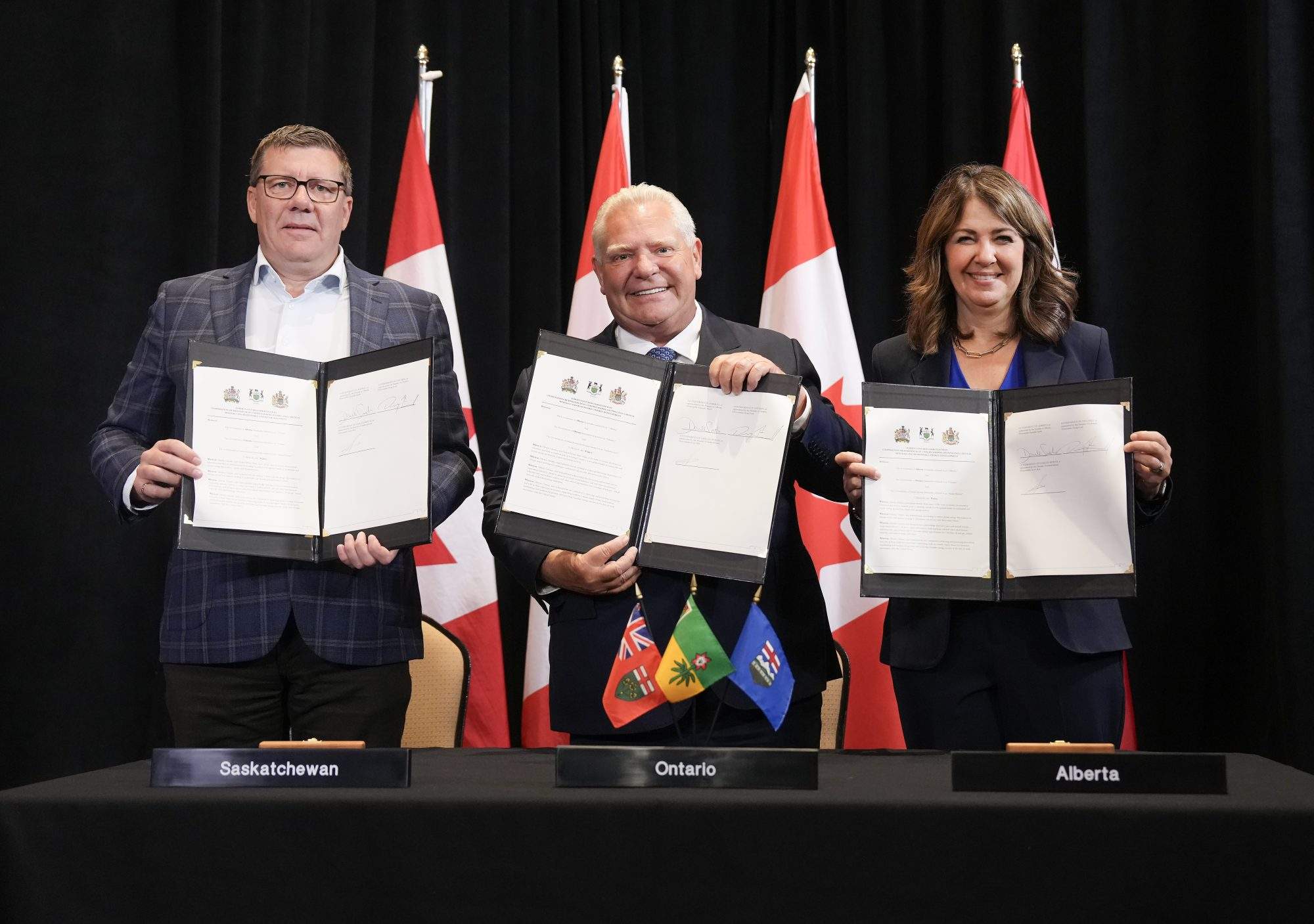
Two provincial capitals, separated by a vast geographic and political gulf, are trying to bridge that silence. Alberta and Ontario are quietly aligning their political weight behind a monumental ambition: a 3,300-kilometer energy corridor designed to slice through the heart of the country, moving western crude directly to eastern refineries.
It is an old dream revived with sudden, desperate urgency.
The Anatomy of a Continental Divide
To understand why a pipeline across three thousand kilometers matters, you have to look at a map of Canada’s vulnerabilities. The country sits on some of the largest oil reserves on Earth, yet its eastern refineries regularly import crude from foreign nations. It is a paradox born of geography and infrastructure inertia. Western oil flows south to Texas; eastern cities look east across the Atlantic or south to the American Midwest.
The proposed corridor aims to smash that loop.
Think of it as an economic bypass surgery for a country suffering from poor circulation. The sheer scale of the project is dizzying. At 3,300 kilometers, the line would stretch roughly the distance from Madrid to Moscow. It requires laying massive steel pipe through some of the most unforgiving terrain on the planet, crossing hundreds of waterways, navigating delicate ecosystems, and cutting through the traditional territories of dozens of Indigenous communities.
The logistical hurdles are terrifying. The political hurdles are worse.
For years, the energy conversation in Canada was defined by paralysis. Projects were proposed, litigated, protested, and ultimately abandoned under the weight of regulatory uncertainty and shifting public sentiment. But the economic tectonic plates have shifted. Inflation pinched hard. Global energy security fractured overnight. Suddenly, the idea of a self-contained, domestic energy ecosystem stopped looking like a corporate wish list and started looking like national survival.
Voices in the Boardrooms and the Bogs
When premiers sit at boardroom tables in Toronto and Edmonton, they speak the language of gross domestic product, sovereign energy security, and interprovincial trade balances. They point to charts showing billions of dollars in potential economic activity and thousands of construction jobs.
But step away from the polished oak tables.
Go to the diners along Highway 11, where the transport trucks idle in the snow, their diesel exhaust plumeing into the crisp air. Talk to the owners of the small manufacturing shops in southwestern Ontario who forge the valves and pump components. Their perspective is stripped of geopolitical grandstanding. They see a country that has stopped building big things, and they are terrified of what happens when the old momentum completely runs out.
"We used to be a nation of builders," an aging machinist in Hamilton recently remarked over a styrofoam cup of black coffee. He wasn't talking about ideology. He was talking about pride. The pride of looking at a massive piece of infrastructure and knowing your hands helped shape it.
Yet, the anxiety on the other side of the ledger is just as real, and just as human.
For a community leader in an Indigenous nation along the proposed route, the pipeline represents an intrusive gamble. They have watched generations of resource development promise prosperity, only to leave behind contaminated tailing ponds and empty promises. The fear of a spill in a pristine watershed is not a theoretical risk calculation calculated by an actuary in a Calgary skyscraper. It is a threat to a way of life that has existed since long before the first surveyor’s stake was driven into the soil.
Trust is the rarest commodity in this entire equation. It cannot be mined, and it cannot be shipped through a pipe.
The Mathematical Weight of Concrete and Steel
The numbers behind an infrastructure project of this magnitude are difficult for the human mind to contextualize without anchor points.
- 3,300 kilometers: Long enough to cross the entire European continent.
- Millions of barrels per day: The capacity required to completely displace foreign imports in eastern refineries.
- Billions in capital expenditure: Private and public investment that would ripple through engineering firms, steel mills, and local hospitality industries for a decade.
Consider what happens next if the project secures its permits. The demand for specialized labor would trigger a domestic migration wave. Thousands of workers would pack their bags, leaving families behind for weeks at a time to live in remote modular camps. The social fabric of small northern towns would stretch and change overnight.
Prices for local housing would spike. Grocers would struggle to keep shelves stocked. It is a boom-and-bust cycle that rural Canada knows intimately, a rhythm of sudden wealth followed by the inevitable, quiet exodus when the construction crews move on to the next sector.
The economic argument put forward by Ontario and Alberta is that this disruption is a necessary price for long-term stability. By linking the resource-rich west with the industrial and refining capacity of the east, they argue Canada can insulate itself from the volatile swings of global energy politics. It is a strategy of building a fortress around the domestic economy.
The Friction of the Future
But a fortress can feel like a prison to those trapped on the outside of its benefits.
The environmental opposition to the pipeline is deeply rooted in a generational shift in how we view progress. For decades, progress was measured in tons of earth moved and barrels produced. Today, for a growing segment of the population, progress is measured in carbon avoided and ecosystems preserved. They look at a new oil pipeline and see an expensive monument to a past era, a multi-billion-dollar anchor dragging a country backward when it should be sprinting toward an electrified future.
This is the core emotional knot that cannot be untied with a simple cost-benefit analysis. It is a clash of two entirely different, deeply held visions for what the country should be. One vision prioritizes immediate economic security, tangible blue-collar jobs, and national self-reliance. The other prioritizes ecological stewardship, global climate commitments, and a rapid transition away from fossil fuels.
Both sides are terrified of losing. Both sides feel their survival is on the line.
The alliance between Ontario and Alberta is an attempt to force a resolution to this deadlock. It represents a calculation that economic anxiety has finally eclipsed environmental hesitation in the minds of the voting public. Whether that calculation is correct remains to be seen, but the push is accelerating with a momentum not seen in a decade.
The paperwork will accumulate. The court challenges will file into the registry system. Analysts will debate shipping tariffs and refinery configurations on cable news channels.
But out on the Canadian Shield, the wind will keep blowing across the granite. The muskeg will freeze and thaw, completely indifferent to the ambitions of politicians and CEOs. And the people whose lives depend on the outcome—the welders, the land defenders, the truckers, and the shop owners—will continue to wait, watching to see if the country will find a way to build something together, or if the divide will simply grow wider.