The rain in Manchester does not just fall; it saturates the red brick, pools in the gaps of the pavement, and hangs in the air like an unresolved argument. Inside a community center muffled against the damp, the atmosphere is heavier still. A room full of people who used to know exactly where they stood are sitting in uncomfortable silence. They are waiting for an admission of guilt.
Politics is often measured in policy papers and parliamentary arithmetic. But its true currency is trust. When that currency collapses, it does not happen in the abstract halls of Westminster. It happens in the living rooms of Cheetham Hill, Rochdale, and Old Trafford, where people watch the news on their phones and wonder if the leaders they elected can see their humanity. Recently making headlines in this space: Why Baltimore Harbor Needs the Pistachio Tide.
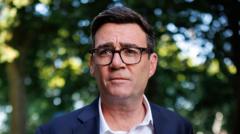
Andy Burnham, the Mayor of Greater Manchester, stood before an audience that had grown cold. He was there to say what many in his party had avoided saying for months. He was there to apologize.
The Sound of Silences
To understand the weight of a political apology, one must understand the anatomy of the betrayal that preceded it. Additional insights regarding the matter are covered by The Guardian.
In the autumn of 2023, as violence erupted across the Middle East, the national leadership of the Labour Party made a choice. In the immediate aftermath of the October 7 attacks, the party’s leadership scrambled to project strength, clarity, and unwavering alignment with traditional geopolitical alliances. In doing so, they stumbled into a communicative catastrophe. During a widely broadcast interview, the leadership appeared to suggest that Israel had the right to cut off water and power to millions of civilians in Gaza.
The words were spoken in a clinical, detached studio environment. But they landed like a physical blow in communities across the United Kingdom.
Imagine a local shopkeeper in Longsight, waking up at dawn to open his newsagent, checking his phone to see images of children pulled from rubble, and then hearing the political party he has canvassed for, voted for, and believed in for thirty years justify the collective punishment of those same children. The disconnect is agonizing. It creates a specific kind of vertigo—the realization that the people who claim to represent you are operating on a entirely different moral frequency.
The national party leadership spent weeks attempting to clarify, qualify, and walk back those early statements. They argued context. They offered legalistic explanations. But in politics, as in life, when you have to explain that you did not mean what everyone clearly heard you say, you have already lost the argument.
The View from the Ground
While the national debate raged in television studios, local leaders were left to manage the fallout.
Greater Manchester is a region built on solidarity. It is a place where working-class identity, immigrant heritage, and a fierce sense of social justice have historically fused to create a formidable Labour stronghold. But that bond is not unconditional. It relies on a shared understanding that human suffering is not a bargaining chip to be traded for electoral safety.
As the weeks dragged on, the silence from the top of the party became deafening. Local councillors resigned in protest. Long-standing party members quietly tore up their membership cards. The anger was not loud or performative; it was quiet, deep, and resentful. It was the anger of someone who has realized they are being taken for granted.
Burnham watched this fracturing happen in real-time. He knew that the standard political playbook—deflect, delay, and wait for the news cycle to move on—would not work here. The damage was too structural. The wound was too deep.
When he finally spoke out, acknowledging that the party’s initial response was deeply wrong, it was not just a tactical maneuver. It was an act of political survival. He admitted that the party had failed to show the necessary empathy, clarity, and speed in condemning the humanitarian catastrophe unfolding before the world's eyes.
The High Price of Caution
Political strategists often suffer from a disease of excessive caution. They believe that by saying as little as possible, they minimize risk. They treat human suffering as a minefield to be navigated rather than a tragedy to be mourned.
But caution has its own hidden costs.
Consider what happens next when a political movement chooses strategic ambiguity over basic human empathy. The collective belief in the democratic process begins to erode. People look at the ballot box and see nothing but an empty choice between different shades of indifference. When a community feels abandoned by the progressive party it helped build, it does not simply vote for someone else. Often, it stops voting entirely. It retreats into alienation.
Burnham’s apology was an attempt to halt that retreat. By explicitly stating that the party's early stance was flawed, he sought to validate the pain of those who felt invisible. He was acknowledging that the anger in the room was not an overreaction; it was a completely rational response to a profound lack of leadership.
An apology from a regional mayor cannot alter international diplomacy. It cannot stop bombs from falling or open border crossings. But it can mend a broken line of communication between a community and those who seek to govern them. It is a small, necessary step toward rebuilding a house that was carelessly burned down for the sake of a few days of favorable headlines in London newspapers.
The damp air outside the community center did not lift when the meeting ended. The skepticism remains, thick and palpable. One speech does not erase months of perceived indifference, and trust is far easier to shatter than it is to rebuild. But as the attendees moved back out into the Manchester drizzle, the silence felt slightly less absolute. A crack had appeared in the wall of political denial, and for the first time in a long time, people felt they had at least been heard.