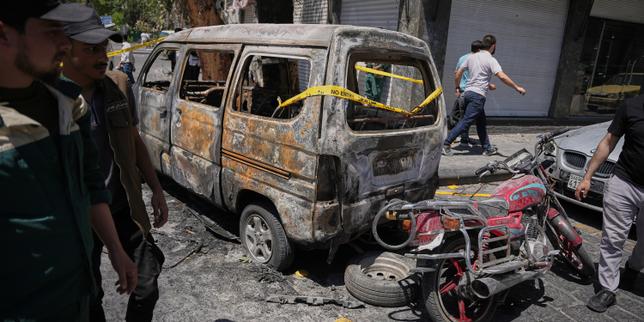
Two crude bombs packed into a trash bin and a parked car don't just shatter windows. They shatter narratives.
When improvised explosive devices tore through central Damascus on July 7, 2026, the timing wasn't accidental. The blasts went off near the luxury Four Seasons Hotel, where French President Emmanuel Macron had just spent the night. While Macron was already 10 kilometers away at the presidential palace meeting his Syrian counterpart, Ahmad al-Chareh, the message from the perpetrators was loud and clear. Damascus is not safe, no matter what the new government says.
The Syrian Health Ministry initially reported 18 injuries, but the definitive toll quickly rose to one dead and 36 wounded. This represents the second major security breach in the capital in less than a week, following a café bombing near the Justice Palace that killed ten people. For a city that had remained relatively insulated since the dramatic ouster of Bashar al-Assad in late 2024, the sudden return of urban terror is a massive reality check.
The Geopolitical Gamble in Plain Sight
Why is Macron risking French diplomatic capital—and his own physical safety—to walk through a minefield?
The French leader has spent over a year spearheading the Western push to normalize relations with Syria's new Islamist coalition government. He hosted Chareh at the Élysée Palace back in May 2025, a move that drew fierce criticism from domestic political opponents who couldn't stomach Paris rolling out the red carpet for a former jihadist leader.
But Macron is playing a longer game. France wants a seat at the table for Syria’s multi-billion-dollar reconstruction. It also wants a stable Mediterranean to curb migration and ensure the permanent containment of ISIS cells.
To prove his commitment, Macron didn't just fly in for a quick photo-op. He stayed overnight. He walked through the Old Damascus market and visited the iconic Umayyad Mosque in his shirtsleeves alongside Chareh. It was a calculated display of normalcy meant to signal to the international business community that Syria is open for business.
Business as Usual Amid the Smoke
The Syrian Interior Ministry was quick to point out that the bombs detonated outside Macron’s strict security perimeter, claiming they never posed a direct threat to the French delegation. Syrian security personnel had reportedly spotted the devices, which exploded during a failed disposal attempt.
Instead of cutting the trip short or panicking, the French delegation doubled down. The meetings continued exactly as planned, resulting in several major bilateral developments:
- Restoring Ambassadors: France and Syria officially agreed to reappoint ambassadors, fully restoring diplomatic ties severed back in 2012.
- Airport Infrastructure: Shipping giant CMA CGM signed a partnership deal to manage air cargo freight handling at Damascus International Airport.
- Financial Assistance: The French Central Bank agreed to provide technical assistance to help stabilize Syria's financial institutions.
- Asset Repatriation: Both nations initiated a process to return roughly $58.3 million in illicit assets seized from Rifaat al-Assad, the uncle of the deposed dictator.
TotalEnergies executives were also on the ground, signaling that French corporate interests are ready to move fast if the security environment holds.
Who Wants to See Damascus Burn
No group immediately claimed responsibility for the tandem blasts, but the suspects belong to a predictable list of spoilers. Residual ISIS cells are still active throughout the desert regions, eager to prove that the new government cannot protect the capital. At the same time, armed factions loyal to the remnants of the Assad regime have every incentive to disrupt Western normalization.
Chareh's coalition has struggled to project absolute authority across a deeply fragmented nation. While the capital has been largely peaceful since the transition, these latest bombings expose the cracks in the state's security apparatus. If the government cannot secure a perimeter around the most heavily guarded hotel in Damascus during a landmark G7 leader's visit, foreign investors will think twice before pouring capital into the country.
Macron remains publicly undeterred. Taking to X shortly after the attacks, he stated that nothing would smother the aspiration of Syrians to live in a sovereign, safe, and united country. He then departed Damascus for Ankara to attend a NATO summit, leaving Chareh with a clear reminder of how fragile his grip on power truly is.
For businesses looking at the Syrian market, the path forward requires extreme caution. Normalization is moving faster at the state level than the security reality on the ground justifies. Companies must invest heavily in localized threat intelligence and independent security infrastructure rather than relying solely on state guarantees. High-profile political backing from Paris looks good on paper, but asphalt and shrapnel don't care about diplomatic breakthroughs.