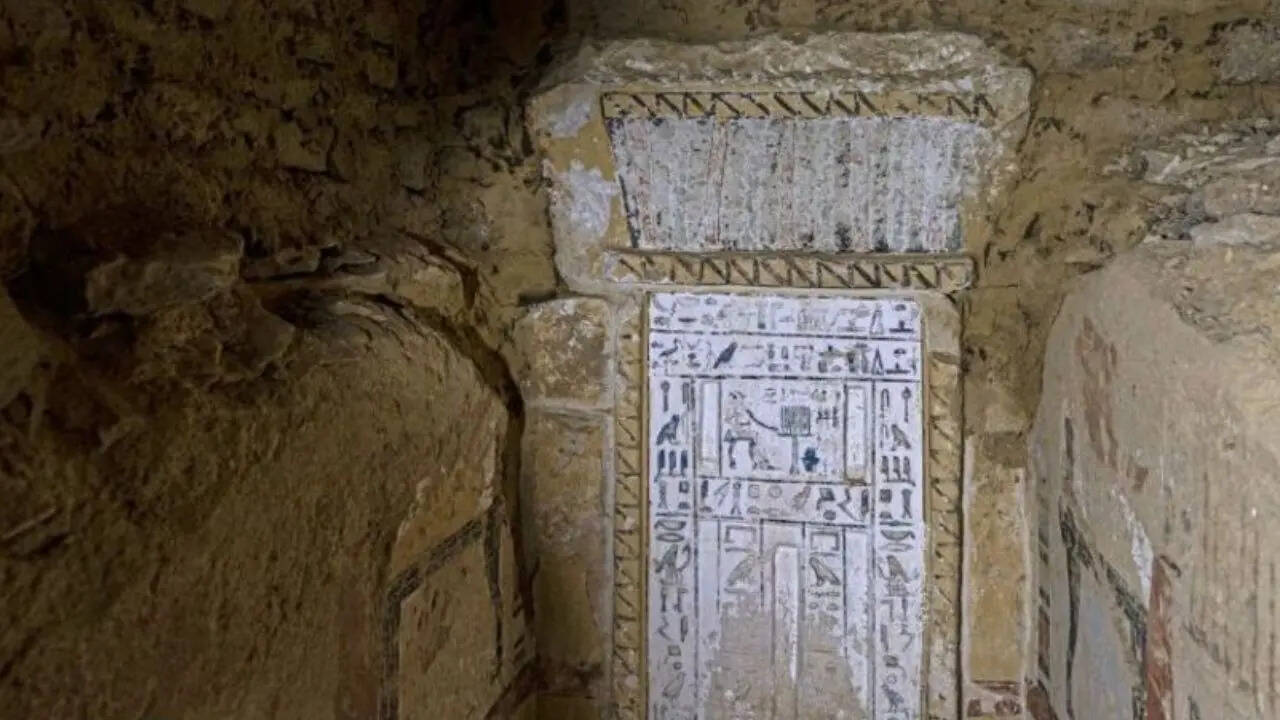
The dust at Saqqara does not just sit on the ground. It hangs in the air like a physical weight, a gritty veil that tastes of salt and ancient limestone. For decades, archaeologists have paced this necropolis, their boots crunching over the debris of dynasties, looking for a door that hadn't already been kicked in by tomb robbers or weathered away by the relentless Egyptian sun. In early 2023, the ground finally gave up a secret it had kept for 4,300 years.
Deep at the bottom of a fifteen-meter shaft—roughly the height of a five-story building—a limestone sarcophagus lay undisturbed. It was sealed with mortar, exactly as it had been left during the Fifth or Sixth Dynasty of the Old Kingdom. When the team finally pried back the lid, they didn't find the usual skeletal remains or the dark, damp decay of a failed preservation. They found a man named Hekashepes. And Hekashepes was shimmering.
He was covered entirely in gold leaf.
The Silence of the Shaft
To understand why this discovery sent a literal tremor through the archaeological community, you have to appreciate the sheer statistical improbability of an unlooted grave. Most tombs are found "disturbed." That is a polite academic term for "ransacked." Throughout history, people have been desperate, and gold is a powerful motivator. Yet, Hekashepes waited in total darkness while empires rose, fell, and turned to sand above his head.
Imagine the last person to touch that mortar. They would have wiped their brow, climbed the rope ladder, and looked out over a landscape where the Great Pyramids were still relatively new, gleaming white in their Tura limestone casing. They expected Hekashepes to remain hidden forever. For once, the universe cooperated.
This wasn't just a burial; it was a high-stakes bid for eternity. In the Old Kingdom, the "Ka" or soul needed a physical vessel to return to. If the body withered or was destroyed, the soul became a homeless wanderer in the afterlife. By encasing Hekashepes in gold, his family wasn't just showing off their wealth. They were trying to manufacture a god. They were attempting to freeze time using the only metal that never tarnishes, never rusts, and never fades.
More Than a Mummy
While Hekashepes is the glittering star of the Saqqara find, he wasn't alone in that stretch of desert. The site acted as a sprawling, multi-layered puzzle of human lives. Near the shaft, researchers found a group of statues carved from limestone. They represented a man, his wife, and several servants.
One statue stood out: a man named Messi. No, not the footballer, though the coincidence provided a brief moment of levity for the excavation team. This Messi was a priest and a keeper of secrets. His statues were found in a nearby tomb, and they offer a startlingly intimate look at the people who populated the royal courts. These weren't just "artifacts." They were portraits.
When you look at a 4,000-year-old statue, you aren't looking at "history." You are looking at a specific man's chin, the way he chose to have his hair depicted, and the desperate hope he had that someone—anyone—would remember his name. In ancient Egypt, speaking a dead person's name was a way to keep them alive. Messi, Hekashepes, and a man named Khnum-djed-ef—a priest in the pyramid complex of Unas—have all been brought back to life in the most literal sense. We are speaking their names again.
The Engineering of the Afterlife
The sheer physical labor required to lower a massive limestone sarcophagus down a narrow, fifteen-meter hole is staggering. There were no hydraulic lifts. There were no steel cables. There was only hemp rope, wooden rollers, and the collective sweat of dozens of laborers.
Consider the logistical nightmare. The shaft is cramped. The air is thin. One slip of a rope and the sarcophagus—and the people at the bottom—would be crushed. The precision required to seal that lid with mortar in a space barely wider than the stone itself speaks to a level of craftsmanship that we often dismiss as "primitive." It wasn't primitive. It was obsessive.
This discovery challenges the notion that the most elaborate burials were reserved solely for pharaohs. Hekashepes wasn't a king. He was a wealthy private citizen, yet his burial rivaled the splendor of royalty. It suggests a society where the "dream of gold" was attainable for the elite, a middle-class aspiration for divinity that fueled an entire economy of embalmers, stonecutters, and goldsmiths.
The Tastes of the Dead
Beyond the gold and the stone, the find included a wealth of daily items. Pottery, jars, and tools were tucked into the corners of the tombs. These are the items that break your heart if you look at them long enough. They are the equivalent of a favorite coffee mug or a cherished set of dinner plates.
Archaeologists found vessels that likely held oils, beer, and grain. The Egyptians believed the afterlife was a mirror of this one, only better. You would still get hungry. You would still want to drink with your friends. By placing these items in the tomb, they were packing a suitcase for a journey they knew was one-way.
The find at Saqqara is a reminder that our fear of being forgotten is the oldest human emotion. We build digital archives and cloud storage; they built limestone shafts and gold-wrapped bodies. The medium has changed, but the panic remains the same. We want to be known. We want to last.
The Moment of Contact
There is a specific kind of silence that occurs when a seal is broken after four millennia. It is the sound of the past rushing into the present. For the lead archaeologist, Zahi Hawass, and his team, the moment the lid moved was the culmination of months of back-breaking work in the dust.
They weren't looking at a museum display. They were looking at a person.
Hekashepes lay there, his gold skin reflecting the modern LED flashlights of the intruders. He looked back with eyes that hadn't seen light since the building of the pyramids. The gold wasn't just a decoration; it was a mask of defiance against the inevitable rot of time.
It is easy to get lost in the "shocks archaeologists" headlines. We like the drama. We like the idea of "cursed" tombs or hidden treasures. But the real story is much quieter and much more profound. It is the story of a man who was loved enough, or feared enough, or respected enough, to be granted the most expensive armor ever devised: a second skin of gold.
He was a man who lived, breathed, ate, and likely worried about his taxes or the rising of the Nile. Then he died, and his community rallied to ensure he would never truly disappear. They succeeded. He survived the collapse of the Old Kingdom, the Greek and Roman occupations, the rise of modern religions, and the industrial revolution. He sat in total stillness while the world above him moved from chariots to SpaceX rockets.
Now, he is a data point. He is a series of photographs and a subject for chemical analysis. But for a brief moment when that lid first creaked open, he was just a man sleeping in the dark.
The gold leaf is still there, thin and fragile as a butterfly's wing. It clings to his wrappings, a shimmering testament to a civilization that refused to accept that "goodbye" was permanent. We didn't just find a mummy. We found a message. It says: I was here. Do not forget me.
The desert wind continues to blow over Saqqara, shifting the dunes and burying the work of today’s explorers. Somewhere nearby, another shaft likely waits. Another name is hidden in the dark, waiting for a flashlight to find it. We keep digging because we are looking for ourselves in the debris. We are looking for proof that even if we are eventually covered by the sand, someone might one day bother to look for us.
Hekashepes is finally awake. The world he woke up to is louder, faster, and stranger than the one he left behind, but he still wears the sun on his skin.