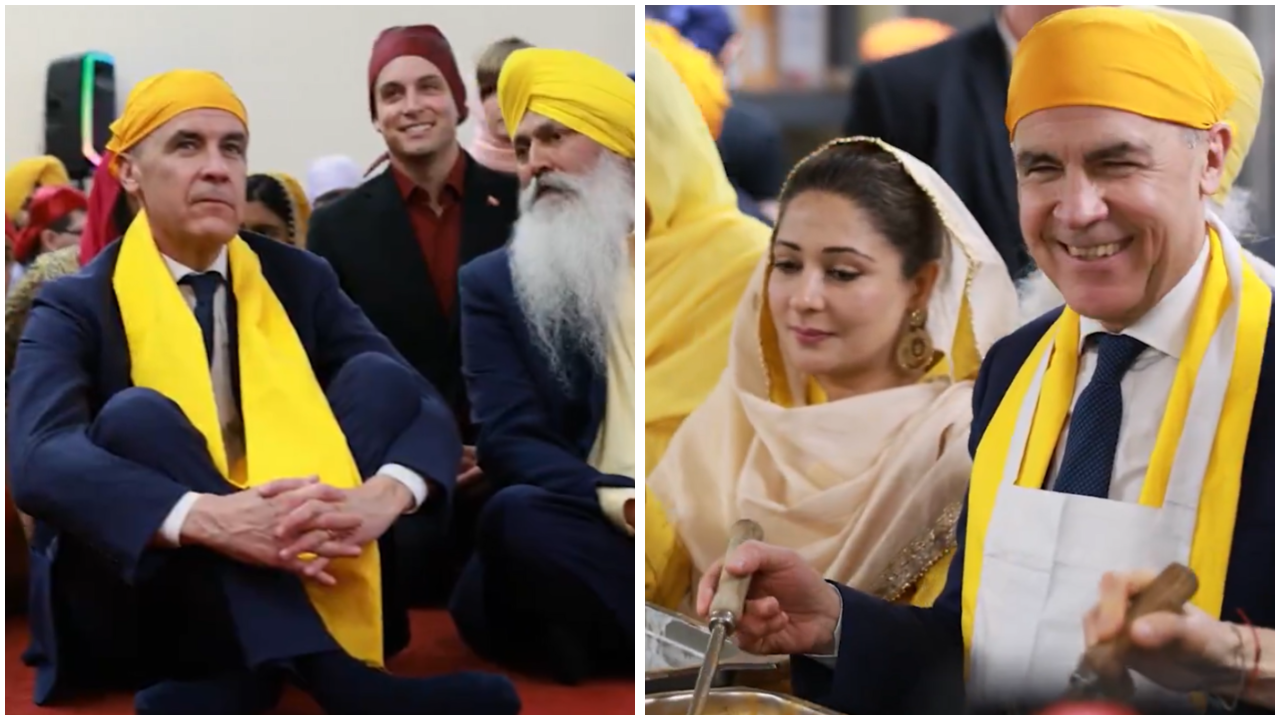
Mark Carney spent decades navigating the cold, data-driven corridors of central banking, but his recent appearance at Gurdwara Sahib Ottawa proves he has finally mastered the warmer, more volatile art of Canadian retail politics. By joining community service for Sikh Heritage Month, the Prime Minister isn't just checking a box on a multicultural calendar. He is attempting to stabilize a Liberal base that has spent years oscillating between fervent support and deep-seated skepticism. In a room filled with the scent of langar and the weight of ancestral history, Carney’s presence serves as a calculated signal that his administration intends to move beyond the technocratic labels that have defined his career.
The optics were precise. On Saturday, Carney stepped away from the geopolitical friction of the Strait of Hormuz and the looming trade shadow of Donald Trump to wash dishes and serve food. This wasn't merely a photo opportunity; it was an exercise in Seva—selfless service—designed to bridge the gap between his "rock star central banker" persona and the everyday realities of the second-largest Sikh community in the world.
The Strategy Behind the Service
Carney’s transition from the Bank of England to the Prime Minister’s Office has been scrutinized for its perceived lack of "common touch." Skeptics often portray him as a man of the Davos elite, more comfortable discussing carbon pricing than community grievances. His active participation in Sikh Heritage Month is a direct rebuttal to that narrative. By emphasizing the "generations of Canadian Sikh women and men who have contributed to our shared prosperity," Carney is leaning into a brand of economic patriotism that binds his financial expertise to the cultural fabric of the nation.
The timing is far from accidental. April 2026 marks a period of consolidation for the Liberal government. Having recently secured a slim parliamentary majority through by-election victories and floor-crossings, Carney is now in a position where he must prove he can lead a nation, not just manage an economy. The Sikh vote is not a monolith, but it is a powerhouse in key ridings across Ontario and British Columbia. Winning over these communities requires more than just policy papers; it requires physical presence.
Beyond the Photo Op
While the headlines focus on the Prime Minister’s participation in the langar, the underlying subtext is one of intense diplomatic and domestic balancing. The Canadian Sikh diaspora exists at the intersection of a complex relationship between Ottawa and New Delhi. For Carney, celebrating Sikh Heritage Month is a delicate walk on a tightrope. He must affirm the identity and contributions of Canadian Sikhs without further inflaming the diplomatic tensions that have simmered since the Trudeau era.
His rhetoric at the Gurdwara focused heavily on "Halemi Raj," a vision of fair and ethical rule. This choice of language is significant. It suggests an administration trying to find a moral vocabulary that resonates with religious values while maintaining a secular, democratic framework. For a man who built a career on the "tragedy of the horizon," invoking ethical rule is a way to frame his long-term economic goals as a form of social justice.
The Reality of the Majority
Carney’s Liberal party currently holds 172 seats, a position of strength that gives him the breathing room to engage in these cultural dialogues without the immediate threat of a non-confidence vote. However, this majority is fragile. It was built on the premise that Carney is the "wartime leader" Canada needs to navigate a trade-heavy, Trump-dominated global environment.
The danger for Carney is the perception of performative politics. If the community service at the Gurdwara isn't backed by progress on issues like immigration processing times, housing affordability, and rising hate crimes, the goodwill generated during Sikh Heritage Month will evaporate. The community leaders watching Carney serve food are the same leaders who will hold him accountable for the 2025 Budget’s promises of "generational investments."
The Economic Integration Argument
Carney is uniquely positioned to frame multiculturalism through an economic lens. In his remarks, he didn't just talk about culture; he talked about "shared prosperity." This is the Carney specialty. He views the Sikh community not just as a cultural group, but as a vital engine of the Canadian economy—from healthcare professionals to small business owners and farmers.
This approach attempts to depoliticize identity by turning it into a metric of national success. If the Sikh community thrives, Canada thrives. It is a pragmatic, perhaps slightly cold, way of looking at diversity, but it is one that aligns with Carney’s broader mission to "reinvent cooperation" in a fractured world.
A New Type of Leadership
We are seeing a version of Mark Carney that many didn't think existed. The man who once obsessed over interest rates is now obsessing over retail politics. He is learning that in Canada, the way to a voter's heart is often through the community kitchen, not the boardroom.
The challenge remains. Can a leader who is essentially an "outsider" to traditional party politics maintain this level of authenticity? The Sikh community has a long memory. They have seen Prime Ministers come and go, many offering the same platitudes every April. What they are looking for from Carney is a departure from the "sunny ways" of his predecessor and a move toward the "hard-hitting reality" he promised during his leadership campaign.
Carney’s visit to Gurdwara Sahib Ottawa was a successful exercise in brand management, but the real test lies in the months ahead. As the 2029 election cycle slowly begins its long orbit, every gesture of service will be weighed against the tangible results of his majority government. For now, the Prime Minister has shown he can handle the heat of the kitchen. Whether he can handle the heat of a divided country remains the defining question of his premiership.
Action is the only currency that matters in Ottawa. While the images of Carney in the Gurdwara are a strong start for the 2026 season, the Sikh community, and indeed all Canadians, will be looking for the legislative follow-through that proves this wasn't just a brief stop on a long political road trip.