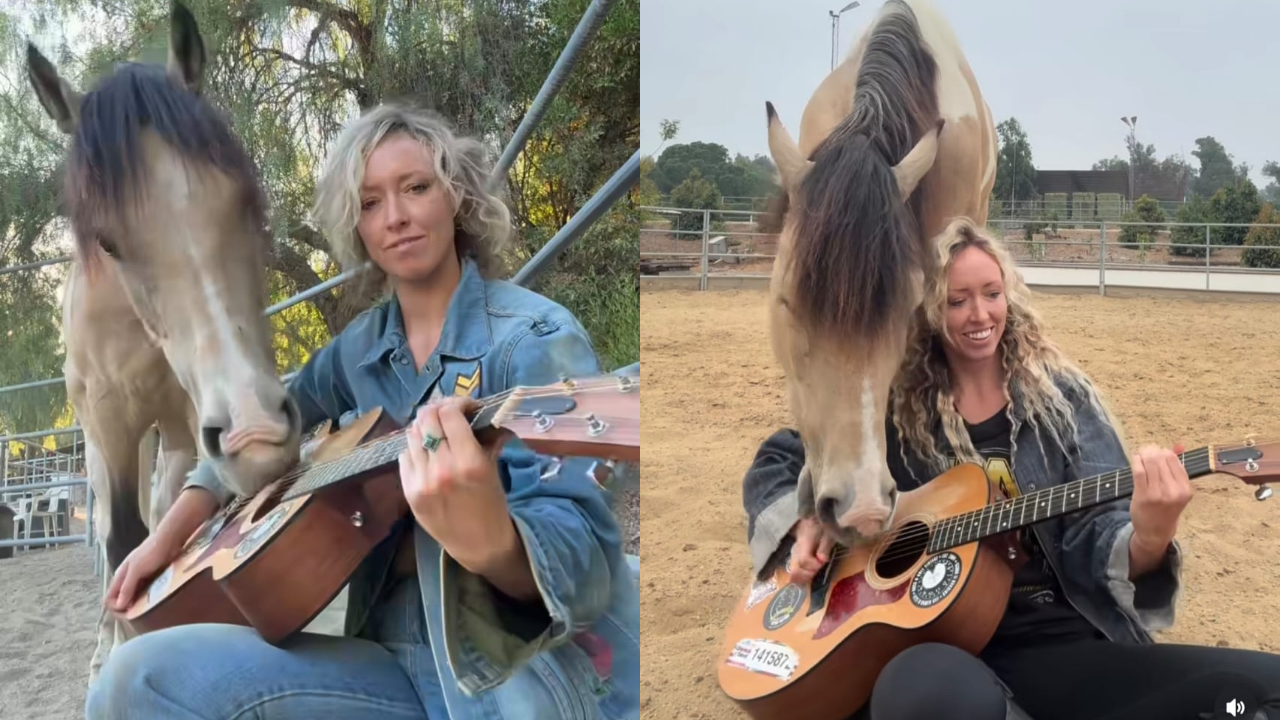
Inter-species behavioral modification operates under strict operant and classical conditioning frameworks. When an individual conditions an animal to perform tasks outside its evolutionary baseline—such as a horse manipulating a guitar or harp—the process requires a granular understanding of reinforcement schedules, sensory adaptation, and motor output capabilities.
Popular media accounts frequently frame such anomalies as spontaneous creativity or intuitive animal communication. A rigorous examination reveals a different reality: a structured application of behavioral psychology, anatomical adaptation, and systematic shaping. Evaluating the mechanics behind this phenomenon clarifies how complex motor programs are installed in non-human subjects.
The Behavioral Architecture of Shaping
Shaping complex motor behaviors in animals with low baseline propensity for the task demands a matrix of incremental approximations. A horse does not naturally strum strings or press frets; its primary motor repertoire involves locomotion, grazing, and herd dynamics.
To bridge this behavioral gap, trainers rely on secondary reinforcement, specifically clicker training, paired with primary reinforcers like food rewards. The process breaks down into distinct operational phases:
- Target Acquisition: The animal learns to touch a specific object, such as a rubber pad or a modified stick, using its muzzle or hoof. This establishes agency and predictability in the learning loop.
- Proximity Conditioning: The target is placed adjacent to or upon the instrument. The animal must redirect its previously established target-touching behavior toward the functional zones of the guitar or harp.
- Force Calibration: Equine hooves and lips possess distinct tactile feedback mechanisms. The animal must modulate pressure: too little force yields no sound, while excessive force damages the instrument or triggers a startle response.
- Sequential Chaining: Individual actions—approaching, lifting a limb, executing a controlled strike or pluck, and returning to a neutral stance—are linked into a continuous behavioral chain.
The primary constraint in this architecture is the animal's cognitive fatigue threshold. Equine attention spans during novel task acquisition are short, necessitating micro-sessions lasting between five and fifteen minutes to prevent habituation decay or stress-induced stereotypies.
Anatomical and Ergonomic Constraints
Physical execution depends entirely on structural modification of the interface. Equus caballus possesses a skeletal and muscular framework optimized for weight-bearing and stride efficiency, not fine motor manipulation.
A standard acoustic guitar or concert harp cannot be operated by an unmodified animal. Ergonomic adaptations are mandatory to bridge the gap between human-designed instruments and equine physiology.
The Interface Problem
The hoof wall is keratinized and lacks tactile nerve endings in the same manner as human fingertips. Consequently, the animal cannot feel string tension, string spacing, or fret placement.
Successful execution relies instead on proprioception and visual cues. The instrument must be secured at an elevation and angle that matches the natural arc of the equine limb or muzzle movement.
- Guitar Modification: Standard guitars require horizontal placement on a stable stand, elevated to chest or knee height. Plectrums or modified extensions are frequently attached to the hoof or integrated into a custom boot to allow clean string contact without dulling the sound through direct hoof-to-wood or hoof-to-steel friction.
- Harp Modification: Harps present a vertical plane of parallel strings. Because a horse's primary flexible manipulator is its upper lip and prehensile muzzle rather than its forelegs, harp interaction typically involves plucking individual strings with the lips or specialized mechanical actuators triggered by a muzzle press.
These structural modifications alter the physics of sound production. The resulting acoustic output is rarely a clean chord progression in the human sense; rather, it represents a pattern of percussive strikes and accidental harmonics governed by the animal's spatial movements.
Cognitive Processing and Operant Economics
Analyzing the cognitive load of the animal reveals an economic calculation of effort versus reward. In operant conditioning, the animal evaluates the energy expenditure required to produce a sound against the predictability of the reward schedule.
Continuous reinforcement rapidly establishes the behavior, but variable ratio schedules maintain it over longer durations. However, if the behavioral requirements become too complex without intermediate bridging signals, extinction bursts occur. The animal exhibits frustration behaviors, such as pawing, head-tossing, or walking away from the setup.
Sensory Integration Challenges
Horses are prey animals with panoramic monocular vision and a narrow binocular blind spot directly in front of their muzzle. When interacting with an instrument positioned immediately in front of them, they rely heavily on tactile and auditory feedback rather than sight.
- Auditory Feedback Loop: The sudden acoustic output of a guitar string can act as an unintentional punisher if the sound is too loud or sharp. Desensitization to the instrument's resonance is a mandatory precursor phase.
- Vibrational Awareness: The resonance traveling through the body of the guitar or harp provides somatosensory feedback that reinforces the physical action, anchoring the behavior in the animal's physical memory.
Operational Assessment and Limitations
Attributing human artistic intent to these demonstrations misunderstands behavioral science. The animal is not composing music or appreciating harmonic structures; it is executing a conditioned motor sequence to secure a primary reinforcer.
The value of such demonstrations lies not in the musical output, but in the diagnostic window they provide regarding the animal's learning capacity, emotional regulation, and cognitive flexibility. When executed correctly, the methodology demonstrates high-resolution communication between species, utilizing precise timing and environmental control.
To scale or replicate such training protocols, handlers must account for individual temperament, baseline anxiety levels, and physical soundness. Animals with chronic joint discomfort in the knees or pasterns cannot sustain the repetitive flexion required for instrument manipulation, making physical assessment a mandatory gatekeeper before behavioral shaping begins.
Establish a baseline measurement of the animal's voluntary movement patterns before introducing any novel props. Map out the exact micro-steps of reinforcement, ensuring that each behavioral increment is fully consolidated before raising the criteria for reward.