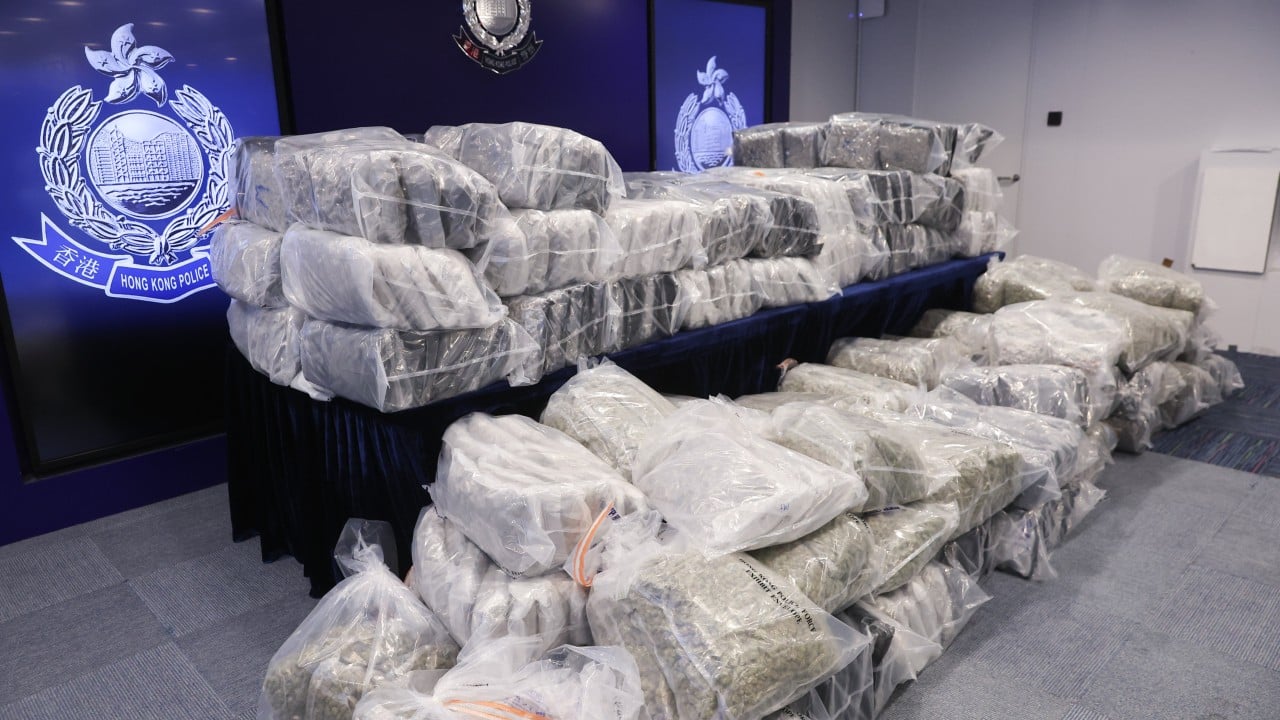
The recent seizure of HK$100 million in cannabis buds during a beach raid in Hong Kong represents a significant operational success in maritime interdiction, yet it simultaneously exposes the evolving logistics of illicit supply chains. To understand the impact of this event, one must look beyond the sticker price of the haul. This operation reveals a calculated shift in the "Risk-to-Reward Ratio" governing regional trafficking. Law enforcement intelligence indicates that the 500 kilograms of narcotics were intercepted at a critical node—the transition point between maritime transport and terrestrial distribution.
The Triad of Maritime Logistics Vulnerability
Traffickers operate under a specific set of constraints defined by geography, surveillance density, and payload volume. The Hong Kong coastline, characterized by its jagged topography and numerous secluded inlets, presents a high-friction environment for law enforcement and a high-opportunity environment for smugglers. The success of this raid can be attributed to the disruption of three specific logistical pillars.
1. The Shoreline Transfer Bottleneck
Maritime smuggling relies on the speed of the "ship-to-shore" transition. In this instance, the use of a speedboat—a vessel chosen for its high power-to-weight ratio—minimizes the time spent in open water where radar detection is most likely. However, the moment the vessel hits the beach, the operation enters a phase of maximum vulnerability. The transition from a singular, high-capacity maritime unit to multiple, lower-capacity terrestrial units (vans or trucks) creates a temporal bottleneck. Police timing suggests they exploited this exact window of physical congestion.
2. Payload Concentration Risk
By aggregating HK$100 million worth of product into a single delivery, the syndicate optimized for transportation efficiency but failed at risk diversification. In supply chain theory, this is a "single point of failure." The decision to move 500kg in one shipment implies a high level of confidence in the corruption or evasion of local sensor networks. The seizure confirms that the "detection probability" ($P_d$) was higher than the syndicate’s internal estimates, leading to a total loss of the capital investment.
3. The Resource Cost of High-Grade Product
Unlike "resin" or "oil," cannabis buds are high-volume, low-density cargo. They require climate-controlled storage and careful handling to maintain their market value. The seizure of buds suggests the target market is a premium consumer segment willing to pay for quality, which in turn necessitates more complex, and therefore more detectable, logistical arrangements compared to compressed narcotics.
Quantifying the Economic Impact on Syndicate Operations
A HK$100 million seizure does not merely represent a loss of potential revenue; it represents a massive "sunk cost" in procurement and logistics. To analyze the true damage to the criminal organization, we must apply a basic cost function:
$$Total Loss = (Procurement Cost) + (Logistics Overhead) + (Opportunity Cost of Capital)$$
Capital Attrition
The procurement of 500kg of high-grade cannabis buds involves significant upfront capital. When law enforcement removes this volume from the market, the syndicate faces an immediate liquidity crisis. They have paid their suppliers and their transporters, but they have zero inventory to convert back into cash. This creates a "Credit Crunch" within the criminal underworld, often leading to internal friction or violent debt restructuring.
Market Price Volatility
A sudden removal of HK$100 million in supply creates a localized supply shock. In the short term, the retail price of cannabis in Hong Kong is expected to spike as the remaining distributors adjust for the scarcity. However, this price increase also signals to competing syndicates that there is a vacuum to be filled, potentially leading to an influx of new, smaller-scale smuggling attempts that are harder to track than a single massive shipment.
The Intelligence-Led Interdiction Framework
The arrest of three individuals during the raid is a tactical victory, but the operational data suggests a deeper strategic shift in how the Hong Kong Police Force (HKPF) utilizes "Signals Intelligence" (SIGINT) and "Human Intelligence" (HUMINT).
Predictive Analytics in Coastal Patrolling
The HKPF does not patrol 733 kilometers of coastline at random. The location of the raid suggests the use of predictive modeling based on previous seizure data, weather patterns, and maritime traffic density. By identifying "high-probability landing zones," the authorities can concentrate their limited tactical units at the most likely points of entry. This is an application of the Pareto Principle: 80% of smuggling occurs through 20% of the available coastline.
The Role of Tactical Surprise
The use of a "beach raid" indicates that the police successfully maintained operational security (OPSEC). Traffickers often use lookouts equipped with thermal imaging or encrypted communications to monitor police movements. Overcoming these countermeasures requires a high degree of tactical discipline, likely involving silent approach maneuvers and the use of night-vision technologies to neutralize the smugglers' advantage of darkness.
Structural Weaknesses in Modern Smuggling Tactics
The failure of this HK$100 million operation highlights several structural flaws in current smuggling methodologies. These flaws are inherent to the scale of the operation.
- Communication Breakdown: Large-scale operations require coordination between the boat crew, the shore team, and the transport drivers. Each link in this communication chain is a point where electronic eavesdropping can occur.
- Vessel Non-Anonymity: High-powered speedboats are conspicuous. Their engine signatures and hull profiles are often known to maritime authorities. Using such vessels is a calculated risk that failed in this instance.
- Physical Fatigue: Smuggling operations often take place in the early hours of the morning. Human error due to fatigue during the high-stress "offloading" phase frequently leads to delays that allow law enforcement to close the distance.
The Strategic Shift Toward Decentralization
As a direct result of massive seizures like this one, criminal organizations are likely to pivot toward a "Decentralized Distribution Model." Instead of one HK$100 million shipment, they may move toward twenty HK$5 million shipments. This "mosquito fleet" strategy presents a significant challenge for law enforcement. While a single large seizure makes for a compelling headline, the persistent flow of smaller quantities can be more damaging to social health and more difficult to intercept.
The maritime authorities must now transition from a "Target-Centric" approach—where they look for the big haul—to a "Network-Centric" approach—where they disrupt the smaller, more frequent pathways. This requires increased investment in autonomous underwater vehicles (AUVs) and drone-based coastal surveillance to provide 24/7 coverage of the littoral zones.
The seizure of HK$100 million in cannabis buds is a clear indicator of the scale of the challenge. It confirms that despite rigorous enforcement, the demand for illicit substances in regional hubs remains high enough to justify extreme financial risks. The tactical success of the raid provides a temporary reprieve, but the long-term solution lies in the continuous adaptation of surveillance technology and the relentless pursuit of the financial infrastructure that underpins these massive capital outlays.
The immediate strategic priority for regional security forces is the "Financial Follow-up." By tracing the HK$100 million capital trail, investigators can identify the shell companies and money laundering nodes that funded the 500kg purchase. Disrupting the money is the only way to ensure the logistics do not simply reset for a second attempt.
:max_bytes(150000):strip_icc():focal(819x186:821x188)/Murdaugh-Family-e90854a716884d608fb6fd925e18d840.jpg)
