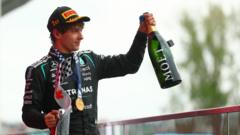
The 2026 Canadian Grand Prix was not decided by raw aerodynamic efficiency, but by a cascading series of operational miscalculations and mechanical thresholds. While standard race commentary focuses heavily on the emotional fallout of George Russell’s lap 30 power unit failure, an objective analysis reveals that the event was dictated by three core variables: tire thermodynamics under fluctuating track conditions, the optimization of aerodynamic tow at the Circuit Gilles Villeneuve, and the structural volatility of unrestricted intra-team competition.
Kimi Antonelli’s fourth consecutive grand prix victory expanded his championship lead over Russell to 43 points. This outcome was catalyzed by strategic failures elsewhere on the grid—most notably at McLaren—and a critical reliability bottleneck that halted a high-stakes tactical stalemate between the two Mercedes drivers.
The Strategic Asymmetry of Tire Phase Changes
The competitive order at Montreal was structurally altered before the green light due to a fundamental misunderstanding of track surface thermodynamics by the McLaren pit wall. A light pre-race drizzle induced a classic decision-making trap regarding tire selection.
The Intermediates vs. Slicks Trade-Off
The Circuit Gilles Villeneuve features a highly abrasive asphalt profile that sheds standing water rapidly via mechanical dispersion from racing cars, especially when ambient temperatures are low and wind speeds are elevated. Two additional formation laps—precipitated by Arvid Lindblad’s stranded Racing Bulls chassis on the grid—extended the track-drying window by approximately four minutes.
McLaren opted to start both Lando Norris and Oscar Piastri on Green-banded Intermediate tires, anticipating a damp track surface. The decision failed because it ignored the micro-climate data:
- Thermal Degradation: Intermediate tires require a water film to prevent the tread blocks from overheating. On a rapidly drying track, the friction coefficients generate excessive internal carcass temperatures.
- The Blistering Threshold: As tread blocks flex on dry asphalt, hysteresis losses cause the rubber compound to vulcanize rapidly, destroying mechanical grip within two laps.
While Norris leveraged the brief initial wet-grip advantage to surge from third to first at the launch, the operational cost was catastrophic. Piastri was forced to pit at the end of lap 1, and Norris followed on lap 2.
[Initial Track Phase: Damp] ➔ [2 Extra Formation Laps: Accelerated Thermal Drying]
                                       │
                ┌──────────────────────┴──────────────────────┐
                ▼                                             ▼
     [McLaren: Intermediates]                      [Mercedes: Slick Compounds]
  - Overheating of tread blocks                 - Optimal carcass temperature
  - Hysteresis/Mechanical degradation           - Immediate positioning advantage
  - Forced pit stops (Laps 1 & 2)               - Sustained stint longevity
This strategic misstep effectively removed Mercedes' closest pace threat from the equation, isolating Antonelli and Russell at the front of the field and converting a multi-team race into a pure intra-team zero-sum game.
The Aerodynamic Tow and Braking Instability
With the McLarens relegated to the midfield, the race devolved into a mechanical chess match between Russell and Antonelli. The Circuit Gilles Villeneuve is characterized by long straightaways punctuated by heavy braking zones, making it a high-sensitivity circuit for aerodynamic drag and energy recovery systems (ERS).
The Final Chicane Friction
Between laps 6 and 24, the lead exchanged hands multiple times due to a predictable feedback loop involving the Drag Reduction System (DRS) and tire degradation. The driver trailing entering the back straight consistently commanded a significant velocity differential via the aerodynamic tow.
This mechanical advantage created extreme instability at the entry points of major braking zones, specifically the Turn 10 hairpin and the Turn 13/14 final chicane.
- The Lap 6 Out-Braking Maneuver: Russell utilized the ERS overtake mode and DRS to pull alongside Antonelli on the back straight. Antonelli, defending the inside line, experienced a loss of aerodynamic downforce on the front axle due to the turbulent wake of Russell's car. This reduced the front-tire vertical load, leading to a severe front-axle lock-up. Antonelli was forced to bypass the chicane entirely, relinquishing the position to prevent flat-spotting his tires.
- The Lap 24 Wheel-to-Wheel Contact: The geometric limits of the track were breached when Antonelli attempted a counter-attack into the final chicane. Operating on the absolute limit of mechanical adhesion, the two cars rubbed Pirelli sidewall paint. Antonelli drifted off-track to complete the pass, forcing race control to intervene and order him to return the position due to an illegal advantage gained outside track boundaries.
This intense cycling of overtaking and defending subjected both power units to extreme thermal spikes. Running continuously in dirty air forces the trailing car's cooling ducts to ingest high-temperature exhaust wake, raising internal internal combustion engine (ICE) and MGU-K temperatures far above baseline operating parameters.
The Cost Function of Mechanical Reliability
The defining inflection point occurred on lap 30, when Russell’s Mercedes suffered a terminal power unit failure while leading the grand prix.
Power Unit Thermal Modeling
While specific telemetry data remains proprietary, the mechanical failure can be understood through structural stress variables. Formula 1 power units operate on a narrow thermal margin. The constant cycling between maximum energy deployment on the straights and heavy harvesting under braking generates massive kinetic and thermal loads.
[Continuous Close-Proximity Racing] ➔ [Ingestion of High-Temperature Exhaust Wake]
                                              │
                                              ▼
                               [Elevated Internal Carcass & PU Temps]
                                              │
                                              ▼
                               [Lap 30 MGU-K / Component Failure]
When two identical cars race in close proximity for 30 consecutive laps, the lead car must defend aggressively—utilizing maximum engine modes—while the trailing car suffers from reduced cooling efficiency. The failure of Russell’s power unit at Turn 9 suggests a thermal or electrical breakdown within the energy store or the MGU-K, likely exacerbated by the high-frequency vibrations from the curb-riding required at the final chicane.
Midfield Cascades and Strategic Isolation
Russell’s retirement fundamentally altered the tactical landscape for the remaining 38 laps. Freed from the aerodynamic wake of his teammate, Antonelli entered a clean-air operational window, allowing him to manage his tire degradation curves and engine modes conservatively.
Midfield Complications and Podiums
The secondary effects of the early-race tire miscalculations and subsequent mechanical retirements reshaped the remaining point-paying positions.
| Driver | Team | Starting Grid | Finishing Position | Tactical Driver |
|---|---|---|---|---|
| Kimi Antonelli | Mercedes | 2 | 1 | Controlled clean-air management post-Lap 30. |
| Lewis Hamilton | Ferrari | 5 | 2 | Late-stint tire offset; exploited Verstappen's warm-up issues. |
| Max Verstappen | Red Bull | 6 | 3 | Suffered from poor tire warm-up on Medium compound. |
| Charles Leclerc | Ferrari | 8 | 4 | Maximized a standard one-stop strategy under VSC. |
The race shifted to a one-stop strategy for the front-runners on lap 40, when Lando Norris suffered a terminal gearbox failure at the hairpin, triggering a Virtual Safety Car (VSC). This window allowed the leading cars to shed their worn slick compounds and transition to the Medium compound for the final stint.
The final podium positions were determined by a stark thermodynamic contrast on lap 62. Max Verstappen, operating the Red Bull chassis, struggled with slow tire warm-up characteristics inherent to the RB22's suspension geometry when running the Medium compound in cold, windy conditions.
Lewis Hamilton, capitalizing on a significant tire-temperature offset, executed a clinical pass around the outside of Turn 1. This move highlighted a critical performance bottleneck in the Red Bull car's ability to generate immediate tire carcass heat after safety car periods or pit transitions under low ambient temperatures.
Mercedes Championship Governance
The outcome in Montreal establishes a clear operational mandate for the Mercedes team management. With Antonelli holding a 43-point lead over Russell after just five rounds of the 22-race calendar, the intra-team dynamic has transitioned from a healthy rivalry to a high-risk liability.
The data from the first five races indicates that the Mercedes W17 chassis possesses a clear performance delta over the field, but its internal reliability is fragile when pushed to maximum operational limits by its own drivers.
The primary risk factor to Mercedes securing the Constructors' Championship is no longer the development rate of Ferrari or Red Bull, but rather the structural damage inflicted by its own drivers competing for the same piece of asphalt. Management must now introduce strict rules of engagement regarding DRS usage and defensive positioning when its cars lock out the front row, or risk squandering a dominant technical advantage through mechanical attrition.