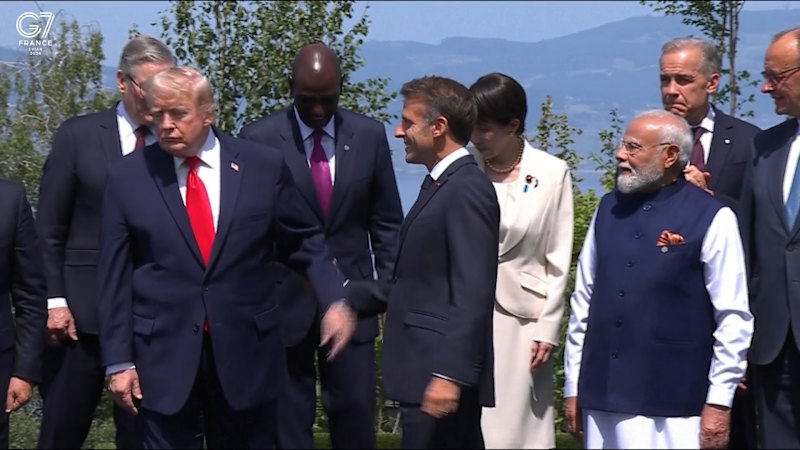
Legacy media outlets loves a cheap visual gag. When a video clip circulated of Donald Trump stepping away from a group of world leaders at a G7 summit, the editorial rooms didn't hesitate. They ran with a predictable, hyper-partisan narrative: a leader detached, wandering aimlessly, losing his grip on the international stage.
It is lazy journalism at its absolute finest.
While commentators spent 48 hours hyper-analyzing camera angles and body language, they completely ignored the actual mechanics of what was happening on the ground. The "wandering leader" trope is a smoke screen. It allows pundits to avoid discussing the brutal, transactional reality of modern international relations, choosing instead to focus on superficial optics.
I have spent over a decade analyzing international summits from the inside, watching how these events are staged, managed, and spun. Here is the uncomfortable truth: every single movement at a G7 summit is choreographed, and when a leader breaks script, it is rarely an accident. It is usually a deliberate rejection of the sterile, performative consensus that these summits try to force down the public's throat.
The Mirage of G7 Multilateralism
The mainstream consensus insists that the G7 is a unified front of democratic nations working in perfect harmony. Any deviation from the group photo is treated as a crisis of diplomacy.
This is fundamentally wrong. The G7 is not a harmonious club; it is a battleground of competing national interests wrapped in a flag of convenience.
When a leader steps away from the pack—whether to speak directly to a parachutist, greet a staff member, or simply signal a refusal to participate in a staged photo-op—it disrupts the manufactured optics. The media panics because their pre-written narrative of global unity is interrupted. They substitute geopolitical analysis with cheap psychological speculation.
Imagine a scenario where a corporate CEO walks out of a highly scripted PR press conference to talk directly to the engineers on the ground. The press would call it a brilliant, populist move. But when a populist politician does the exact same thing at an international summit, the establishment labels it as disorientation.
The Precision of Strategic Non-Compliance
To understand what actually happens at these summits, you have to understand the concept of strategic non-compliance. International summits are designed to force leaders into consensus statements that often harm their domestic agendas. Traditional politicians play along. They smile, sign the communique, and deal with the fallout later.
Populist leadership operates on an entirely different playbook. The goal is to explicitly signal to the domestic base that the leader does not answer to a globalist committee.
- The Scripted Event: Leaders stand in a semicircle, facing the cameras, projecting a unified front.
- The Disruption: A leader intentionally breaks the formation, forcing the cameras to follow them and breaking the symmetry of the shot.
- The Result: The manufactured image of total consensus is broken. The individual leader dominates the news cycle, while the actual, often empty, policy announcements of the summit are pushed to the back page.
By focusing entirely on whether a leader looked "focused" or "wandering," the media plays right into this hand. They generate millions of clicks on a non-story while failing to report on the shifting trade alliances and defense spending arguments happening behind closed doors.
What the Pundits Missed While Chasing Clips
While the internet was busy debating a ten-second video clip, the real tectonic shifts of the summit went completely unaddressed. The true story of recent G7 meetings isn't the physical positioning of the American president; it is the collapsing authority of Western European nations within the alliance.
For decades, Washington dictated terms, Europe fell in line, and the summit ended with a boilerplate statement on global cooperation. Today, European leaders are facing historic domestic unpopularity and economic stagnation. They need the G7 to validate their status on the world stage. An American leader who treats the summit as a casual, transactional pit stop instead of a sacred institution completely deflates their leverage.
The elite media cannot admit that the traditional structures of global governance are failing to produce results. It is far easier to write 1,000 words on a leader walking toward a skydiver than it is to explain why the G7 can no longer effectively enforce global trade norms or manage escalating regional conflicts.
The Cost of Optic-Driven Journalism
There is a distinct downside to this contrarian view: it requires abandoning the comfort of a simple, partisan narrative. It forces you to look at data, trade balances, and defense commitments rather than viral videos.
If you view international politics through the lens of a high school popularity contest, you will always be blindsided by real-world outcomes. The voters who decide elections do not care if a leader stands two feet to the left of the French President during a photo-op. They care about bilateral tariffs, energy independence, and manufacturing jobs.
Stop consuming political coverage that treats world history like a reality television show. The next time a headline tells you a leader "wandered off" or "snubbed" an ally, ignore the commentary. Look at the policy concessions made in the shadow of that distraction. That is where the real power lies.