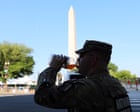
The asphalt on Constitution Avenue doesn’t just get hot in July. It breathes. If you stand on it long enough in the thick of a Washington D.C. summer, the heat radiating through the soles of your shoes feels less like weather and more like a physical confrontation.
For months, seventeen-year-old Marcus had been practicing the complex, syncopated snare drum rolls for the biggest performance of his life. He wasn’t thinking about the thermodynamics of asphalt. He was thinking about his uniform. It was a heavy, wool-blend, high-collared tribute to tradition, complete with a vinyl-brimmed shako hat that trapped sweat like a greenhouse. His high school marching band had raised eleven thousand dollars to bus from Ohio to the nation's capital. They were supposed to lead the National Independence Day Parade.
Instead, Marcus spent the morning of the Fourth of July sitting on the floor of an air-conditioned hotel lobby, staring at a pair of pristinely polished black marching shoes that would never touch the pavement.
The announcement came with the sudden, sharp sting of a snapped drumhead. Cancelled. Not delayed, not rerouted, but completely scrubbed from the calendar. The official press releases from city officials and safety coordinators spoke in the sterile language of municipal risk management. They cited "unprecedented heat indices," "pavement temperatures exceeding safe thresholds," and "the compounding risk to public safety personnel."
But metrics and municipal statements do a poor job of capturing the quiet heartbreak of a canceled tradition. They don't show you the concession vendors looking at thousands of dollars of melting ice and unused hot dog buns. They don’t capture the look on a grandfather's face who had traveled three states to see his granddaughter march past the National Archives, only to end up eating a lukewarm turkey sandwich in a crowded metro station just to escape the sun.
To understand why a city would pull the plug on its own birthday party, you have to look past the thermometer and examine the invisible breaking point of the human body.
Imagine a standard thermometer reading ninety-eight degrees Fahrenheit. In the swampy, low-lying basin of the District of Columbia, that number is a deception. Humidity acts as a thick, wet blanket, trapping moisture against the skin. The human body cools itself through evaporation; when the air is already saturated with water, that system failures. The sweat stays. The core temperature rises.
When a marching band moves down a parade route under these conditions, they aren’t just walking. They are performing strenuous cardiovascular exercise while carrying heavy brass, wood, and fiberglass instruments. A sousaphone can weigh upwards of thirty pounds. Carrying that weight while blowing forced air through a metal tube in a wool uniform creates a microclimate of extreme danger. Within twenty minutes, a performer's internal temperature can spike to levels that trigger heat exhaustion or, worse, exertional heat stroke.
The decision-makers in Washington weren't just looking at the weather report that morning; they were looking at a mathematical certainty of crisis.
Consider the logistics of a major metropolitan parade. Hundreds of thousands of spectators line the streets, packed shoulder-to-shoulder with minimal access to shade. If ten percent of those people begin to suffer from heat-related distress simultaneously, the infrastructure collapses. Ambulances cannot navigate closed parade routes. Emergency rooms become bottlenecked. The celebration transforms into a mass-casualty event managed not by parade marshals, but by triage nurses.
It is easy to blame climate trends or point fingers at overly cautious city planners. We live in an era where risk aversion often dictates public life. Yet, anyone who has ever watched a fellow performer or a family member collapse from heat prostration knows the terrifying speed with which a celebration turns into a medical emergency. One moment a teenager is keeping time with the bass drum; the next, their eyes roll back, their skin turns grey and clammy, and they hit the pavement with a sickening, unprotected thud.
The cancellation in Washington is part of a larger, quieter shift happening across global events. For decades, the calendar was an unshakeable framework. The parade happened on the Fourth of July. The marathon happened in October. The county fair happened in August.
But the friction between human biology and shifting seasonal realities is grinding those certainties away. We are forcing ourselves to redefine what is possible, or even permissible, in the open air. Festivals are quietly shifting their dates into the shoulder seasons of spring and autumn. Athletic events are pushing start times to the pre-dawn hours, forcing runners to race against the sunrise rather than each other.
The real loss isn't the spectacle itself. A parade is just people walking in a line, wearing bright clothes, and waving at strangers. The loss is the collective punctuation mark on our year. Traditions function as anchors in a chaotic world. They tell us who we are, where we belong, and what day it is. When the heat steals those anchors, we are left adrift in a continuous, blurry summer that feels less like a season of joy and more like an endurance test.
By mid-afternoon on the Fourth, the National Mall was strangely quiet. A few resilient tourists wandered past the monuments, darting from the shadow of one elm tree to the next like soldiers navigating a battlefield. The wide, white steps of the Lincoln Memorial, usually swarming with thousands of flag-waving visitors, looked bleached and deserted under the white-hot glare of the sun.
In the hotel parking lot, Marcus and his bandmates gathered in a shaded corner beneath a concrete awning. It wasn't the performance they had spent nine months preparing for. There were no cheering crowds, no television cameras, and no historic backdrops.
But someone found a portable speaker. Someone else unpacked a trumpet. Marcus unlatched his snare drum case, tightened the lugs, and strapped the harness over his plain grey t-shirt.
Without a word from their director, the brass section lined up against the brick wall. Marcus gave the traditional four-click introduction on the rim of his drum. The sound exploded inside the concrete garage, echoing off the parked cars and the low ceiling, loud and sharp enough to make your chest vibrate. They played the entire national medley from memory, sweat dripping down their faces onto the oil-stained concrete floor.
A few hotel maids stopped to watch, holding stacks of clean towels. A family from Texas, stranded by the same cancellation, stood by the elevators and clapped along. It wasn't a parade. It was a defiance.
As the final chord resonated and faded into the humid afternoon air, Marcus unstrapped his drum and wiped his forehead with the back of his hand. The heat hadn't gone anywhere. The black asphalt out on Constitution Avenue was still empty, baking silently in the sun, a long, shimmering river of tar that had managed to do what history and politics could not: silence the music of the nation's capital on its own holiday.