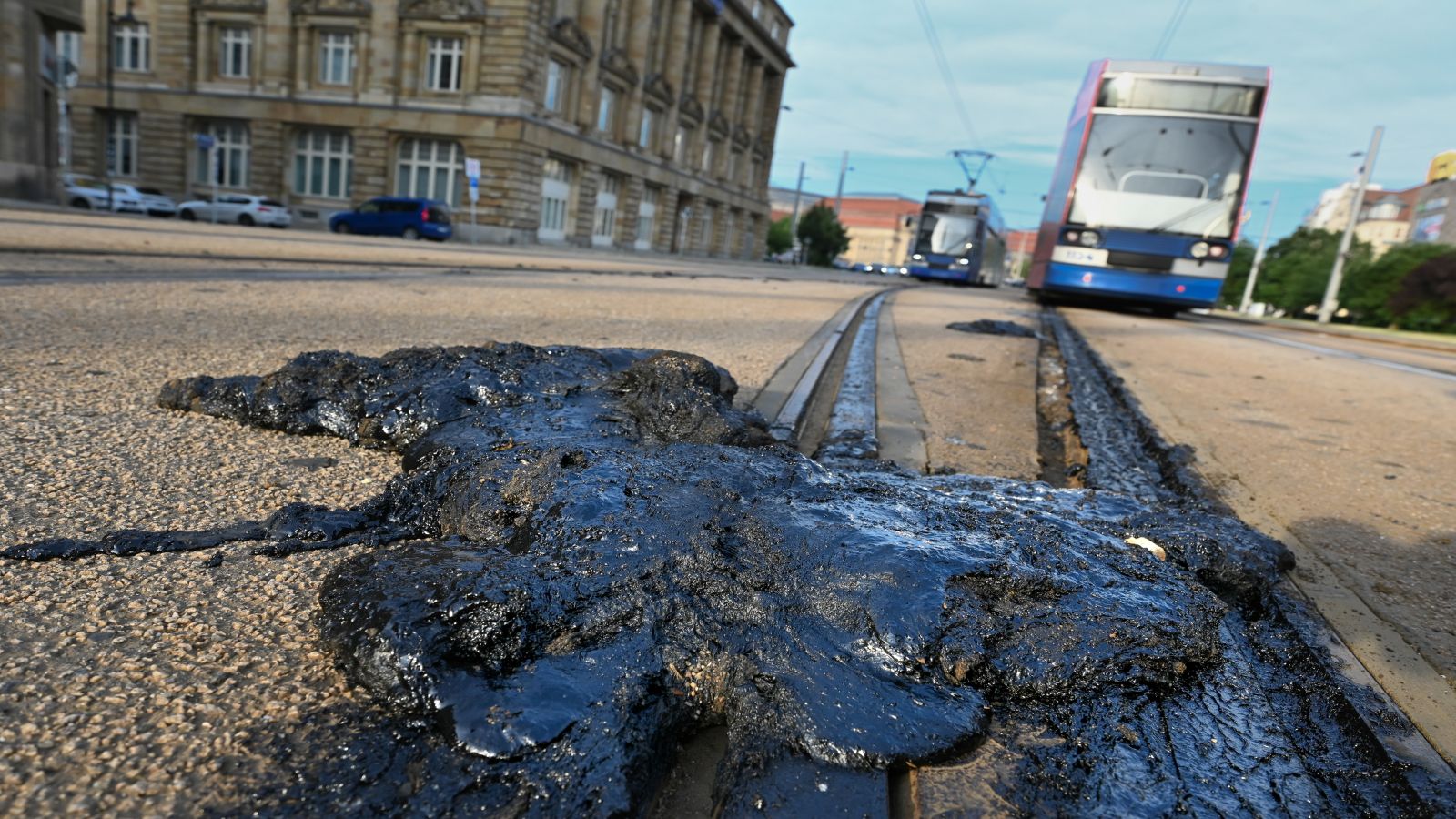
Every summer, the media unrolls the exact same script.
Images of warped rail tracks, dripping traffic lights, and soft asphalt are plastered across timelines to trigger immediate, collective panic. The narrative is always identical: European infrastructure is fundamentally broken, hopelessly outdated, and collapsing under the weight of unprecedented climate shifts.
It is a compelling story. It is also entirely wrong.
The sensationalized coverage of melting roads and buckled tracks mistakes a standard engineering trade-off for a systemic catastrophe. Having spent years analyzing logistics networks and industrial supply chains, I can tell you that what the public calls "infrastructure failure" is actually the math of predictable resource allocation playing out exactly as designed.
The crisis isn't that our materials are failing. The crisis is that we are demanding trillions of euros be spent to solve a statistical outlier.
The Thermal Physics Journalists Ignore
Let’s dismantle the "melting" traffic light and buckling rail hysteria with basic engineering reality.
Steel rail tracks do not buckle because the air temperature hits 38°C (100°F). They buckle because solar radiation forces the rail temperature to soar up to 20 degrees higher than the ambient air. When steel heats up, it expands. If the track is constrained, that thermal expansion converts into lateral mechanical stress.
Thermal Stress Formula: S = E * a * dT
Where:
E = Young's Modulus of Steel
a = Coefficient of Thermal Expansion
dT = Temperature Differential
Engineers across the continent do not need to be told this. They design tracks for a specific Stress-Free Temperature (SFT). In the UK, that SFT is typically set around 27°C. In Southern Italy, it is set much higher.
If you raise the SFT to withstand a rare 43°C spike in London, you create a massive, catastrophic vulnerability in the winter. When the temperature drops to -5°C, the steel will contract violently, building up immense tensile stress that causes the rails to snap cleanly in half.
A snapped rail in January causes a high-speed derailment. A buckled rail in July causes a slow-moving delay.
Choosing the lower SFT is not a failure of vision. It is a deliberate, calculated decision to prioritize human lives in the winter over commuter convenience in the summer.
The same logic applies to asphalt. Roads are paved using specific bitumen grades binder-optimized for local historical climates. To pave the entirety of Northern Europe with the heavy, high-temperature bitumen polymers used in Dubai would require hundreds of billions of euros. The result? Roads that crack to pieces during the first standard winter freeze.
The True Cost of Zero Tolerance
The public demands absolute resilience. "Fix the tracks," they shout. "Cool the schools."
But in infrastructure, absolute resilience is a financial illusion.
Imagine a scenario where a European nation decides to completely overhaul its rail network to be entirely impervious to a 45°C heatwave. They replace thousands of kilometers of track, install heavy-duty concrete sleepers, and implement active hydraulic tensioning systems.
The cost would be staggering. It would drain the public coffers of funds desperately needed for healthcare, education, and actual green transition initiatives. And for what? To prevent a total of four days of speed restrictions per year.
I have seen public transport agencies blow through their entire annual contingency budgets in three months trying to retroactively fit heavy air-conditioning units onto subway lines built in the 19th century. The geometry of the tunnels leaves nowhere for the waste heat to go, resulting in hotter tunnels and stalled trains.
We have fostered an intellectual environment where admitting a downside is seen as a defeat. The downside to our current infrastructure is that for a few days a year, things will run slowly. The downside to the alternative is structural insolvency. We must learn to accept occasional operational friction as the price of fiscal sanity.
Dismantling the Premium Fallacy
People always ask: Why can't we just use cutting-edge composite materials that don't expand or contract?
The premise of the question is fundamentally flawed because it assumes infrastructure scaling works like consumer electronics. You cannot swap out millions of tons of structural aggregate and structural steel for experimental carbon-fiber composites. The manufacturing capacity does not exist on this planet, and the carbon footprint of producing those advanced materials at scale would completely negate any environmental benefit.
Another common question: Why don't schools just install central air conditioning across the board?
The brutal reality is that most Northern European school buildings are architectural relics designed exclusively to retain heat. Installing commercial HVAC systems across tens of thousands of historic buildings would require tearing down structural walls, installing massive electrical sub-stations to handle the peak load, and increasing municipal energy demands precisely when the grid is under maximum strain.
It is an incredibly inefficient use of capital. It makes far more sense to adjust the academic calendar or introduce mandatory remote learning days during extreme peaks than to fundamentally rebuild the physical estate for a microscopic percentage of the school year.
Shift the Strategy From Mass Concrete to Data
Stop trying to pave over the weather. The solution to extreme climate anomalies is not more concrete, heavier steel, or endless air conditioning units. The solution is dynamic operational flexibility.
A truly resilient system does not try to stand rigid against a storm; it bends. Instead of wasting capital on material over-engineering, investment must flow into two specific areas:
- Predictive Thermal Modeling: Utilizing real-time fiber-optic temperature sensors along rail lines to precisely locate high-stress points, allowing operators to slow down trains only where absolutely necessary, rather than halting an entire network.
- Decentralized Power Grids: Enhancing localized solar and battery storage so that when peak cooling demand hits, the entire regional grid doesn't collapse under the weight of sudden, uncoordinated power draws.
We must stop treating every hot summer as an unexpected apocalyptic event that exposes our societal incompetence. The infrastructure isn't failing you. Your refusal to understand the basic laws of thermal dynamics and economic trade-offs is.
Accept the friction, slow down the trains, shut the doors for a few days, and save the capital for problems that actually matter.