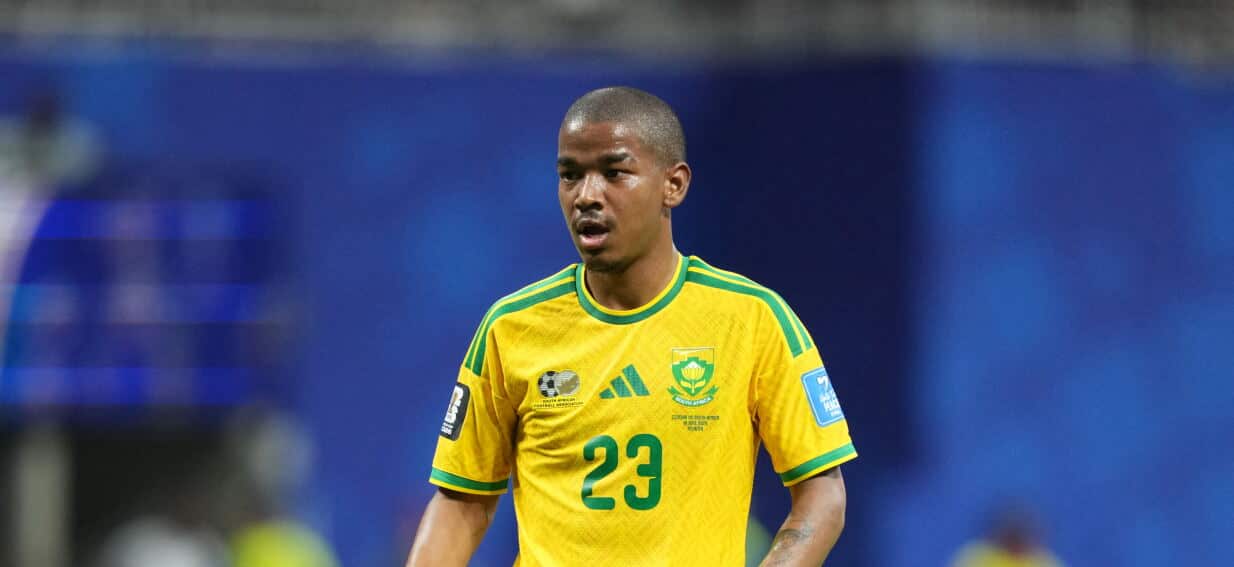
Elite professional football clubs view academy prospects as appreciating human capital assets, yet the structural mechanisms designed to protect these investments frequently fail to account for non-linear psychological stress and rapid asset relocation. The sudden passing of South African international midfielder Jayden Adams at age 25, less than three weeks after competing in the 2026 FIFA World Cup, exposes a critical operational blind spot in sport science: the interaction between acute bereavement, rapid competitive progression, and the institutional management of young athletic talent.
Analyzing the trajectory of Adams requires decomposing his final 18 months into operational phases. The data reveals an intense compounding of professional expectations, commercial scaling, and severe personal trauma that tested the limits of his athletic infrastructure.
The Dual-Stress Framework: Compounding Emotional and Physical Loads
Elite athletic performance models isolate metabolic output, high-intensity running distances, and neuromuscular fatigue. They routinely under-index for acute emotional trauma. The timeline of Adams’ participation in the 2026 FIFA World Cup establishes a distinct structural bottleneck where psychological trauma collided with maximum physical demand.
- Phase 1: High-Intensity Tournament Exposure. Adams started for South Africa 🇿🇦 in Group A fixtures against Mexico and Czechia, while serving as an impact substitute in the 1–0 tactical victory over South Korea. This period demanded peak cardiovascular output and precise cognitive execution under global scrutiny.
- Phase 2: Acute Psychological Bereavement. Hours before kicking off against Czechia in Atlanta, Adams received confirmation of the death of his maternal grandmother, Marianna Adams.
- Phase 3: Administrative Separation. Due to logistical constraints, tournament stakes, and personal choice, Adams remained in North America to fulfill national team duties rather than immediate decompression within his primary support system in the Western Cape.
When an athlete experiences severe emotional shock, the sympathetic nervous system triggers a sustained cortisol and adrenaline surge. In standard environments, a recovery protocol dictates immediate load reduction. In a World Cup environment, this chemical baseline is forced to coexist with extreme physical exertion. The physiological cost function of this overlapping strain is rarely captured on standard GPS tracking vests, which measure mechanical workload rather than systemic autonomic exhaustion.
Asset Valuation and the Institutional Transition Chasm
The commercial architecture surrounding Adams highlights the friction that occurs when a domestic asset transitions rapidly into a global commodity. His career progression presents a clear study in escalating market pressure:
- Academy Production to Professional Validation: Graduating as the first professional signee from the Stellenbosch FC academy in August 2020, Adams established a baseline domestic value.
- Domestic Capital Concentration: His January 2025 transfer to Mamelodi Sundowns—the dominant financial entity in South African football—escalated his domestic earnings to approximately R190,000 per month ($10,700 USD) under a contract extending to 2028.
- Continental Title Leveraging: Assisting Sundowns in capturing the CAF Champions League title against Moroccan side AS FAR drove his projected international market valuation to €1.8 million.
- Global Endorsement Activation: A multi-year commercial alignment with Nike valued at approximately R3.5 million signaled his transition from a regional athlete into a corporate marketing vector.
This rapid appreciation creates an institutional chasm. When a player's valuation increases by multiples within a short horizon, the internal pressures of family dependency, national expectation, and commercial accountability compound. Western Cape police have opened an inquest docket following the discovery of Adams' body at a property in Schotsche Kloof, Cape Town. The absence of an immediate official cause of death has led to unverified public conjecture regarding food poisoning or acute depressive episodes, highlighting the urgent need for sporting organizations to formalize comprehensive post-tournament decompression protocols.
Structural Blind Spots in Post-Tournament Re-entry
The period immediately following a major international tournament represents the highest risk window for elite athlete burnout and systemic failure. When a national team is eliminated—as South Africa was by Canada in the Round of 32 on June 28—players are abruptly decoupled from high-scrutiny national squad bubbles and returned to domestic life or club tracking.
During this transition, three operational failures typically occur:
The first limitation rests in the severance of immediate medical oversight. National team medical staffs manage players with precise daily monitoring during tournaments, but this data pipeline dissolves the moment a player enters post-tournament leave. The home club assumes the athlete is in a state of passive rest, creating an information vacuum.
This creates a bottleneck in psychological risk assessment. An athlete who has suppressed personal grief to perform on a global stage experiences a profound neurochemical crash when the external stimuli of crowds, media, and match adrenaline vanish. The sudden drop in dopamine and cortisol, coupled with unaddressed grief, leaves the individual highly vulnerable to severe psychological decompensation without immediate, proactive clinical intervention.
The final system failure is the reliance on self-reporting. Elite athletes are socially conditioned to mask vulnerability to protect their squad selection, commercial contracts, and public perception. Expecting a 25-year-old player to voluntarily signal acute distress to an institutional employer is an operational flaw. Clubs must transition from a reactive model—waiting for an athlete to flag an issue—to a predictive, mandatory wellness framework.
Clubs must implement automated post-major-tournament protocols that require a mandatory minimum of 14 days of total isolation from club and commercial obligations, paired with independent, non-affiliated psychological evaluations. These evaluations must be cleared prior to any physical re-testing or return to the training ground. Furthermore, professional player unions must standardize cross-border grief counseling networks that operate outside the direct purview of team management, ensuring athletes can access confidential psychological services without fearing a negative impact on their transfer market value or contract security. Only by decoupling mental health governance from the financial asset management of football clubs can the industry safeguard its human capital from structural failure.