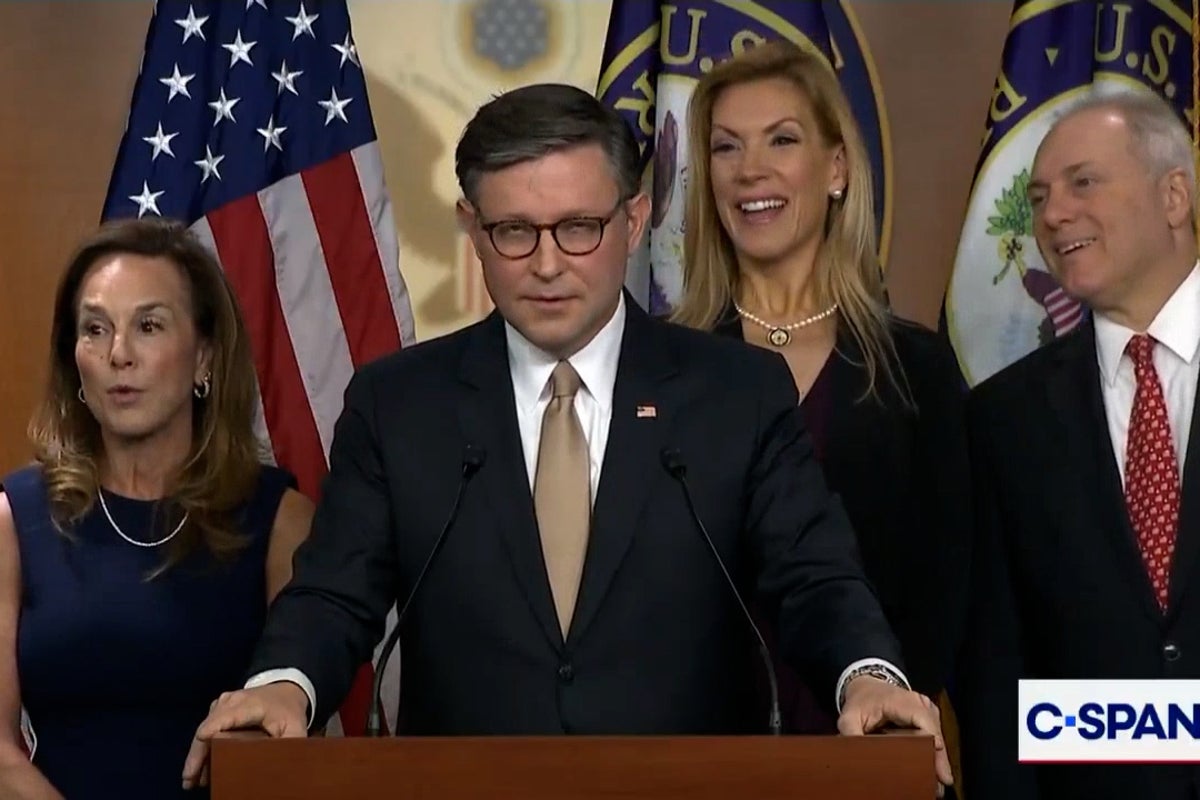
The Supreme Court just dealt a massive blow to the administration's hardline immigration agenda, but the defining image of the day didn't come from the steps of the nation's highest court. It happened in a crowded Capitol briefing room. House Speaker Mike Johnson was at the podium, firing off standard talking points, when reporters read him the live breaking news. The justices had just struck down the executive order attempting to end birthright citizenship.
Johnson didn't offer a polished, media-trained response. Instead, he let out a sharp "Oh dear" and rolled his eyes so hard it almost looked painful.
The press pack chuckled. The internet immediately seized on the video. It's a raw, unvarnished moment that perfectly encapsulates the deep frustration brewing within the Republican establishment. They thought they had a conservative supermajority ready to rewrite decades of legal understanding. Instead, they got a stark reminder of constitutional limits.
This isn't just about a funny face captured on camera. It reveals a fractured strategy on immigration and a growing disconnect between executive ambition and judicial reality.
The Press Room Breakdown
Watching the footage shows exactly how caught off guard the Republican leadership was. Johnson was in the middle of a standard press conference when the 6-3 decision in Trump v. Barbara dropped. He was speaking to reporters who were refreshing their feeds in real time. When a reporter broke the news about the 14th Amendment ruling, Johnson's immediate facial expression spoke volumes before he even opened his mouth.
After the initial eye roll and the collective chuckle from the press corps, Johnson tried to steady the ship. He called the current interpretation of birthright citizenship something that has been grossly abused in recent years. He claimed the original intent of the 14th Amendment was noble but has since been thwarted and overused.
His disappointment was completely transparent. For an administration that spent its first day in office drafting Executive Order 14160 to target the children of undocumented immigrants, this ruling is a definitive stop sign. The fact that the Speaker of the House learned about it mid-sentence, reacting with pure exasperation, shows how much the GOP was banking on a different outcome.
The Legal Reality Behind the Frustration
To understand why Johnson looked like he wanted to sink into the floor, you have to look at what the Supreme Court actually decided. The administration tried to use an executive order to redefine who is subject to the jurisdiction of the United States. They argued that if parents are in the country unlawfully, their children don't qualify for automatic citizenship under the 14th Amendment.
Chief Justice John Roberts didn't buy it. Writing for the 6-3 majority, Roberts made it clear that the executive branch can't simply scribble out a century and a half of constitutional precedent with the stroke of a pen. The historical context of the Citizenship Clause is settled. The court looked back at the common law principle of jus soli, or right of the soil, which has governed American law since the founding.
Even Justice Brett Kavanaugh, while offering a slightly different angle, suggested that any change to this policy would have to come from Congress, not a unilateral dictate from the Oval Office.
Donald Trump quickly took to social media to downplay the loss. He spun the ruling as a roadmap, telling his followers that the court simply pointed the finger at Congress. He claimed lawmakers can easily fix the issue through standard legislation without needing a long and unwieldy constitutional amendment.
But Johnson knows the math. He knows the legislative reality. That's exactly why he rolled his eyes.
The Legislative Gridlock Trump Ignores
Trump's optimistic take that Congress can just pass a law to end birthright citizenship is a fantasy, and Johnson knows it. The Speaker has to manage a razor-thin majority in the House. He faces a Senate where a 60-vote threshold makes controversial immigration overhauls nearly impossible to pass.
Suggesting that Congress can easily pass legislation to strip citizenship rights from children born on American soil ignores basic Washington arithmetic. Even if Republicans held a unified government with wider margins, passing a law that directly challenges the text of the 14th Amendment would spark a fierce internal battle. Moderate Republicans in swing districts aren't eager to vote on radical immigration bills that face certain death in the courts later anyway.
So when Trump says it's an easy fix for Congress, he is shifting the burden to a legislative body that can barely pass standard budget bills without staring down a government shutdown. Johnson's reaction was the look of a manager who was just told by his boss to build a skyscraper with a box of plastic blocks.
A History of Failed Shortcuts
This entire legal battle stems from a desire for shortcuts. For years, conservative activists have argued that the traditional interpretation of United States v. Wong Kim Ark, the 1898 case that solidified birthright citizenship for resident aliens, was wrong. They insisted that a strong president could bypass the difficult process of amending the Constitution by using executive power instead.
We saw the limits of that strategy clear as day. The Supreme Court might have a conservative majority, but institutionalists like Roberts still care about precedent and the separation of powers. They aren't going to hand the imperial presidency a tool that lets any administration redefine constitutional text on a whim.
If the executive branch could redefine "subject to the jurisdiction" for immigration, a future administration could redefine constitutional terms to suit their own political agendas. The court protected its own turf and the integrity of the document it interprets.
The Ghost of the 14th Amendment
The debate over the 14th Amendment always brings out bad historical takes. The clause was passed after the Civil War to ensure that newly freed enslaved people were recognized as full citizens, correcting the horrific legacy of the Dred Scott decision.
Critics of birthright citizenship love to argue that the authors of the amendment never envisioned millions of undocumented immigrants crossing the southern border. They claim the word jurisdiction was meant to exclude people who owe allegiance to a foreign power.
Roberts blew up that argument by looking at the actual text and the historical application of the law. The exceptions have always been tiny and specific: children of foreign diplomats, or invaders during war. Everyone else walking the soil is subject to American laws. If you break a law here, you get arrested by American police and tried in American courts. That means you are under the jurisdiction of the United States. You can't argue that someone is subject to our laws for punishment but completely outside our jurisdiction for citizenship.
It's a logical contradiction that conservative legal scholars have struggled to square for decades. The court refused to play along with the mental gymnastics.
The Strategy Going Forward
Now that the executive order route is officially dead, the immigration debate shifts back to Capitol Hill, whether Mike Johnson likes it or not. The administration will continue to push for hardline border policies, but the grand prize of ending birthright citizenship is off the table for the foreseeable future.
Republicans have to decide how much political capital they want to waste on symbolic bills that have zero chance of passing the Senate. Pushing for birthright citizenship bans makes for great campaign rhetoric. It fires up the base. It fills the campaign fundraising coffers. But as an actual governing strategy, it's a dead end.
Johnson has to balance the demands of his far-right flank, who want immediate legislative warfare, with the reality of maintaining a functional House. Every hour spent debating an unconstitutional immigration bill is an hour not spent on the actual mechanics of government.
Actual Steps for Navigating the Fall Out
If lawmakers actually want to address border security instead of chasing constitutional ghosts, they need to focus on things they can control. The real issues aren't found in legal redefinitions of babies born in American hospitals.
First, fund the immigration courts. The backlog of asylum cases stretches out for years. That delay is the primary driver of the current chaos, creating an incentive for people to cross and wait out a broken system.
Second, update visa programs. The American economy relies heavily on foreign labor, particularly in agriculture, construction, and hospitality. Providing legal, heavily monitored pathways for temporary workers reduces the pressure on the border.
Third, invest in technology at ports of entry. The vast majority of illegal narcotics and human smuggling operations move through official checkpoints, not open deserts. Modernizing scanning systems yields immediate results.
That is the work that needs doing. It's unglamorous, it requires compromise, and it doesn't fit neatly onto a bumper sticker. But it avoids the embarrassment of a 6-3 Supreme Court smackdown and saves the Speaker from having to roll his eyes on national television again.


