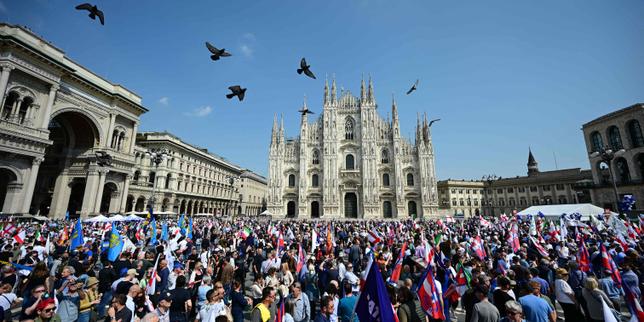
The mainstream press loves a boogeyman. They see a gathering in Milan and immediately start drafting obituaries for the European Union. They talk about a "change of era" and "identity fundamentals" as if these parties are a monolithic gears-and-cogs machine ready to steamroll Brussels. It is a lazy narrative built on surface-level aesthetics and a fundamental misunderstanding of how power actually works in the 21st century.
I have spent years watching these movements from the inside and the fringes. The "unity" displayed on stages in Milan is a marketing product, not a political reality. While journalists fret over the optics of a shared platform, they miss the structural rot and the inherent contradictions that make a truly unified European "extreme right" a mathematical impossibility. For an alternative look, consider: this related article.
The Sovereignist Paradox
The biggest lie being sold is that these parties are allies. By definition, a nationalist party puts its own nation first. You cannot have a "Pan-European Nationalist" movement without eventually hitting a wall of conflicting interests.
When Matteo Salvini talks about Italian interests, and Viktor Orbán talks about Hungarian interests, they are eventually going to disagree on the budget, migration quotas, and agricultural subsidies. The competitor's article suggests a cohesive shift toward a new era. In reality, it is a temporary marriage of convenience between groups that would gladly throw each other under the bus for five points in a local poll. Related coverage on the subject has been published by The Washington Post.
We see this play out in the European Parliament. The "Patriots for Europe" and the "European Conservatives and Reformists" (ECR) are not two branches of the same tree; they are rival firms competing for the same market share. Giorgia Meloni’s strategic pivot toward the center-right mainstream is not a "betrayal" of her roots; it is a cold, hard recognition that you cannot govern a G7 nation while acting like a protest movement.
The Identity Fetish vs. Economic Reality
The media obsesses over "identity fundamentals." They focus on the flags, the rhetoric about "roots," and the traditionalist posturing. It makes for great television and scary headlines. But identity does not pay the bills, and these movements are currently hitting a ceiling because they have no coherent economic answer to a globalized world.
The Milan gathering was high on vibes and low on spreadsheets. You can talk about "defending borders" all day, but if your country’s debt-to-GDP ratio is spiraling and your workforce is shrinking, your "identity" is a luxury you can barely afford. The "lazy consensus" says these parties are winning because people are becoming more radical. The truth? These parties are winning because the center-left and center-right have become indistinguishable, leaving a vacuum.
However, the "radical" solution is often just a collection of protectionist fantasies that would collapse within six months of actual implementation. I have seen political consultants lose their minds trying to turn these slogans into viable policy. It usually ends in a quiet retreat to the very neoliberal structures they spent years attacking.
Why the "Extreme" Label is Obsolete
Stop using the term "extreme right" to describe a group that controls or influences governments in half a dozen European capitals. It is a linguistic security blanket for people who don't want to admit the political center has shifted.
When a movement represents 30% or 40% of the electorate, it isn't "extreme"; it is the new baseline. By clinging to outdated labels, the media fails to interrogate the actual policies these groups propose. They treat them like a temporary fever that will break, rather than a permanent feature of the democratic environment.
The real danger isn't a return to the 1930s. That’s a campfire story. The real danger is a fragmented, paralyzed Europe where national leaders are so busy posturing for their base that they lose the ability to compete with China or the United States. Milan wasn't a launchpad for a new empire; it was a theater of fragmentation.
The Meloni-Le Pen Friction
Look at the power struggle between Rome and Paris. Marine Le Pen needs to look "presidential" to win the Elysee. Meloni needs to look "reliable" to keep the European Central Bank happy. Their interests are diametrically opposed.
If Le Pen takes a hardline stance that threatens the stability of the Euro, Meloni’s Italy—with its massive debt—is the first to suffer. The competitor's article treats these leaders as peers in a shared crusade. They are actually competitors in a zero-sum game.
Every gain for Le Pen’s "Patriots" group is a potential headache for Meloni’s ECR. They are fighting for the soul of the European right, and only one vision can survive. One wants to burn the house down to rebuild it; the other wants to own the house and collect the rent. You cannot do both at the same time.
Stop Asking the Wrong Questions
People keep asking: "Will the far-right take over Europe?"
That is a flawed question. They are already here. The better question is: "Can a movement built on national ego actually manage a continental union?"
The answer is a resounding no. The Milan summit was a display of tactical alignment, not strategic unity. They agree on what they hate—Brussels bureaucracy, current migration trends, green energy mandates—but they have zero consensus on what to build in its place.
Building a political identity on "No" is easy. It requires zero intellectual heavy lifting. The moment they have to say "Yes" to a shared budget or a collective defense strategy, the facade of unity will shatter.
The Demographic Trap
The "identitarian" base is aging. While the Milan stage was filled with talk of the future, the voting data shows these movements often rely on older cohorts who are nostalgic for a version of the past that never actually existed.
Meanwhile, the younger generation of these movements is increasingly fragmented. Some are hyper-libertarian; others are eco-nationalist. The idea that there is a single "youth wave" carrying these parties to power is a myth fueled by a few viral TikTok videos.
If you want to understand the future of Europe, don't look at a stage in Milan. Look at the bond markets. Look at the birth rates. Look at the energy grid. Those are the forces that dictate the "era," not a group of politicians sharing a microphone on a Saturday afternoon.
The Hard Truth
The Milan summit wasn't a "change of era." It was a high-budget press conference for a group of leaders who are terrified of their own limitations. They know that winning an election is the easy part. Governing without collapsing the economy or alienating every neighbor is the real challenge, and so far, none of them have proven they can do it at scale.
The media needs to stop being horrified and start being clinical. Analyze the math. Follow the money. Ignore the flags. When you strip away the identity politics, you're left with a group of people who are just as confused about the future as the "elites" they claim to despise.
The "insurgent" is now the establishment. And the establishment is notoriously bad at keeping its promises.
Buy the ticket, watch the show, but don't for a second believe the script.