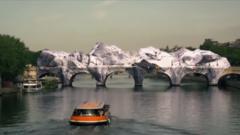
The media is currently swooning over a viral timelapse video showing a massive, inflatable "giant cave" expanding across a historic bridge in Paris. Outlets are calling it a triumph of urban design, a breathtaking marriage of historical architecture and modern creative expression.
They are wrong. It is an expensive, logistical nightmare masquerading as cultural enrichment.
For decades, city planners and municipal art boards have fallen into the trap of believing that scale equals significance. If you inflate a massive PVC structure in the middle of a thoroughfare, you have not created art. You have created an obstacle course. I have spent fifteen years consulting on urban design and public installations, and I have seen cities waste millions on these fleeting spectacles while their actual cultural infrastructure rots.
The lazy consensus loves a timelapse. Fast-forwarded video makes the disruptive look magical. In reality, these installations represent the commodification of public spaces for the sake of a fleeting digital footprint.
The Flawed Premise of Scale and Inflatables
The primary defense of these massive inflatable installations is that they democratize space. The argument goes that by placing a disruptive, avant-garde structure in a highly trafficked area like a Parisian bridge, you force commuters to engage with their environment in a new way.
Let us break down the physical reality of a giant inflatable cave on a bridge.
- Pedestrian Chokepoints: Bridges are vital arteries. Reducing their throughput for a visual stunt creates immediate safety risks and logistical headaches.
- Environmental Costs: Manufacturing, transporting, and constantly powering the high-output blowers required to keep a synthetic cavern inflated for weeks is an ecological net-negative.
- The "Gawker" Effect: These installations do not invite deep cultural contemplation; they invite foot traffic stagnation. People stop to take a photo for social media and immediately move on.
When you look at the mechanics of urban movement, a bridge serves a specific geometric and functional purpose: transit. Forcing a massive, bulbous structure onto a historic stone layout is not a dialogue between the old and the new. It is a spatial monologue where the installation drowns out the city.
The True Cost of Temporary Spectacles
Cities love temporary installations because they offer a quick PR win without long-term maintenance commitments. A permanent sculpture requires structural engineering assessments, ongoing conservation budgets, and years of community consultation. An inflatable cave requires an extension cord and a team of media managers.
Consider the financial disparity. A major European city might allocate €500,000 for a three-week temporary installation. That money originates from cultural grants, corporate sponsorships, and municipal taxes. When the air is let out of the cave, what remains? A storage facility filled with toxic synthetic material and a spike in a tourism board’s social media mentions.
Imagine a scenario where that same €500,000 is decentralized. It could fund ten permanent, neighborhood-level murals, subsidize studio spaces for local working artists for five years, or restore crumbling historical plaques that actually teach citizens about their urban heritage. The contrarian truth is clear: temporary hyper-scale art is a wealth transfer from sustainable local culture to short-term tourism marketing.
Dismantling the Urban Design Myths
The public discussion surrounding these viral installations usually centers on a few flawed questions. Let us address those arguments directly.
Do massive public installations improve the livability of a city?
No. Livability is determined by predictable transit, accessible green spaces, clean infrastructure, and functional public amenities. A massive obstruction on a bridge does not make a city more livable; it temporarily reduces the efficiency of the built environment to create a backdrop for tourists.
Does pop-up art foster genuine community engagement?
The premise here is broken. True community engagement is built through repetition and ownership. A neighborhood park where residents gather daily builds community. A massive, corporate-sponsored inflatable that appears for a month and vanishes creates spectators, not a community. It treats the citizens of a city as an audience rather than participants.
Is historical architecture enhanced by modern juxtaposition?
Rarely. The architecture of a bridge like those in Paris relies on symmetry, sightlines, and historical continuity. Enclosing that space in a giant synthetic bubble completely obliterates the intended view of the river and the surrounding cityscape. It replaces a timeless aesthetic with a temporary gimmick.
The Alternative: True Architectural Integration
If we want public art that challenges minds without fracturing cities, we must abandon the obsession with the temporary and the inflated. True disruption in urban design looks entirely different.
Instead of fighting the existing architecture, successful public art integrates with it permanently or subverts it subtly. Think of the work of artists who use light projection to recontextualize buildings at night without blocking a single pedestrian during the day. Think of structural interventions that repair broken infrastructure with artistic elements, such as creative tiling on damaged steps or functional, beautifully sculpted public seating.
The downside to this approach is obvious to any politician: it lacks the instant gratification of a timelapse video. It does not inflate in sixty seconds. It takes time, genuine craftsmanship, and institutional patience. But it creates a legacy.
Stop cheering for the giant plastic cave. Demand public art that respects the engineering of our cities, respects the intelligence of the public, and stays around long enough to matter.