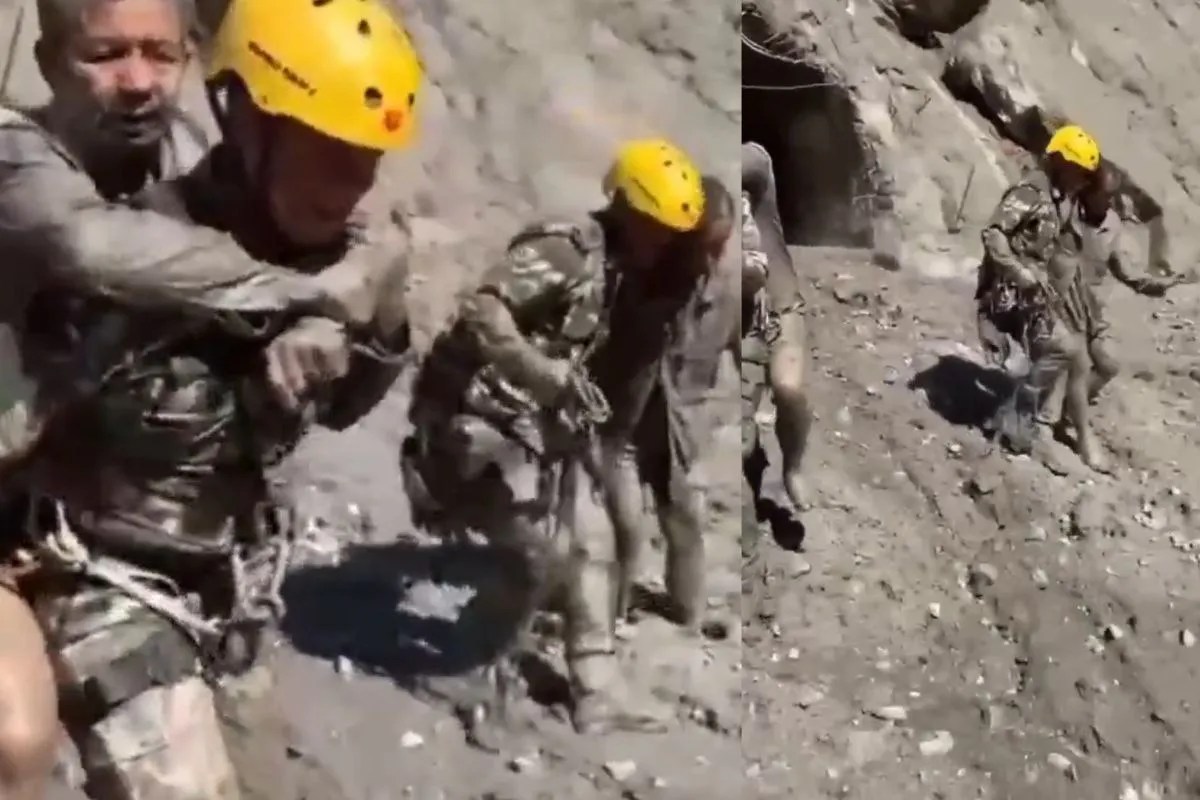
The air inside the mountain tasted of stale diesel, wet cement, and the metallic tang of fear.
Ramesh adjusted the strap of his plastic hard hat, the plastic biting into a forehead slick with sweat and grit. Around him, the Himalayan earth did not feel like dirt; it felt like a sleeping beast with a very light sleep. Heavy excavators thrummed against the bedrock, sending low-frequency vibrations straight up through the soles of his rubber boots. It was deafening, relentless, and completely normal. Until it wasn't.
In construction zones carved deep into fragile tectonic plates, safety is often treated as an expensive suggestion. The project was a massive tunnel initiative, funded by foreign capital, engineered on spreadsheets miles away from the damp reality of the site, and built with the muscle of local laborers who traded their breath for a monthly wage. At the head of the shift stood the supervisor, a man whose identity was tied entirely to his clipboard, his high-visibility vest, and a language barrier that rendered every safety warning a blunt command rather than a shared understanding.
Speed was the only metric that mattered. Every extra meter dug was a victory for the balance sheets back home. Every minute lost to reinforcing unstable shale was viewed as an inefficiency.
Then came the sound.
It was not a sudden explosion. Mountains do not break like glass; they groan like old timber under an unbearable weight. It started as a deep, subterranean sigh, a shift of tectonic muscle that rattled the steel ribs lining the tunnel walls. The bolts screamed as they took the strain. Dust billowed down from the crown of the arch, thick and choking, blotting out the harsh glare of the halogen string lights.
Panic does not arrive as a thought. It arrives as a physical punch to the chest.
Ramesh froze for a fraction of a second, his instincts warring with the routine of a thousand shifts. Beside him, a younger worker dropped his shovel, the metal clanging sharply against the rocky floor. Shouts erupted, bouncing off the damp concrete walls into a chaotic wall of sound.
And then, the supervisor moved.
There was no sweeping gesture of authority. There was no shouted coordination, no cool-headed evacuation protocol executed by the man paid to lead them. The clipboard hit the mud. The supervisor turned on his heel, his boots splashing through the puddles of muddy runoff, and sprinted toward the mouth of the tunnel with a single-minded terror. He did not look back to see who was behind him. He did not check if the younger men, the ones with families waiting in distant villages across the hills, understood where to run. He simply vanished into the growing gloom of the dust storm, leaving behind a wake of abandoned responsibility.
As a hypothetical composite of the dozens of stories that trickle out of high-risk infrastructure corridors every year, Ramesh’s reaction is etched in the collective memory of mountain laborers. You do not chase a coward. You run for your life.
The lights flickered and died. Total darkness swallowed the tunnel, a blackness so absolute it felt like being buried alive before the earth had even settled. Screams echoed off the rock face, multiplying, bouncing, turning into a disorienting chorus of desperation. The air grew thick with pulverized stone, clogging throats and stinging eyes.
In that pitch-black chaos, the true nature of vulnerability was laid bare. Mega-projects bring promises of modernization, employment, and regional connectivity. They promise asphalt highways that cut travel times in half and hydroelectric grids that light up cities hundreds of miles away. But those grand visions are built on a hidden ledger. The currency paid on that ledger is the safety of workers who possess no bargaining power, no insurance policies worth the paper they are printed on, and no voice when corners are cut to meet impossible deadlines.
Ramesh did not think about the geopolitics of foreign investment or the economic metrics of the project. He thought about his daughter’s laugh. He thought about the small courtyard behind his rented room where his boots sat drying in the sun. Those mundane, fragile details became the anchor that kept him from collapsing into the mud.
Crawling on hands and knees, feeling the jagged edges of fallen debris with raw palms, he moved against the vacuum of the wind rushing toward the collapse. Others joined him in the dark, grabbing shoulders, pulling strangers forward, forming an unspoken chain of survival where authority had utterly failed. They did not have a supervisor to guide them. They had only each other, guided by the faint glimmer of daylight filtering through the dust choked mouth of the tunnel far ahead.
When Ramesh finally burst out into the blinding afternoon sun, coughing up gray sludge and trembling in the open air, the scale of the betrayal hit him harder than the mountain air. Outside, standing at a safe distance from the portal, was the supervisor. He was already on his phone, wiping dust from his pristine vest, looking more annoyed by the disruption to his schedule than shaken by the narrow brush with death.
There were no apologies. There were no explanations. There was only the corporate machinery shifting instantly into damage control mode, treating human lives as variables in an equation that could be smoothed over with temporary payouts and non disclosure agreements.
The mountain stands still now, scarred by concrete and ambition. Down in the valley, politicians cut ribbons and celebrate progress, pointing to the dark mouth in the hillside as a monument to human ingenuity. But inside those hollowed out peaks, the shadows hold a different story. They whisper of a system built on haste, where the men who move the earth are treated as disposable, and where the first sign of danger turns leadership into a frantic, solitary race for the exit.
The dust outside the tunnel eventually settled, carried away by the indifferent mountain wind. But the echoes of those screams do not fade so easily, lingering in the quiet spaces between the rock, waiting for the next shift to begin.

:max_bytes(150000):strip_icc()/line-app-logo-ccdacd0f7c344b3d9d4847edcb90733d.jpg)

