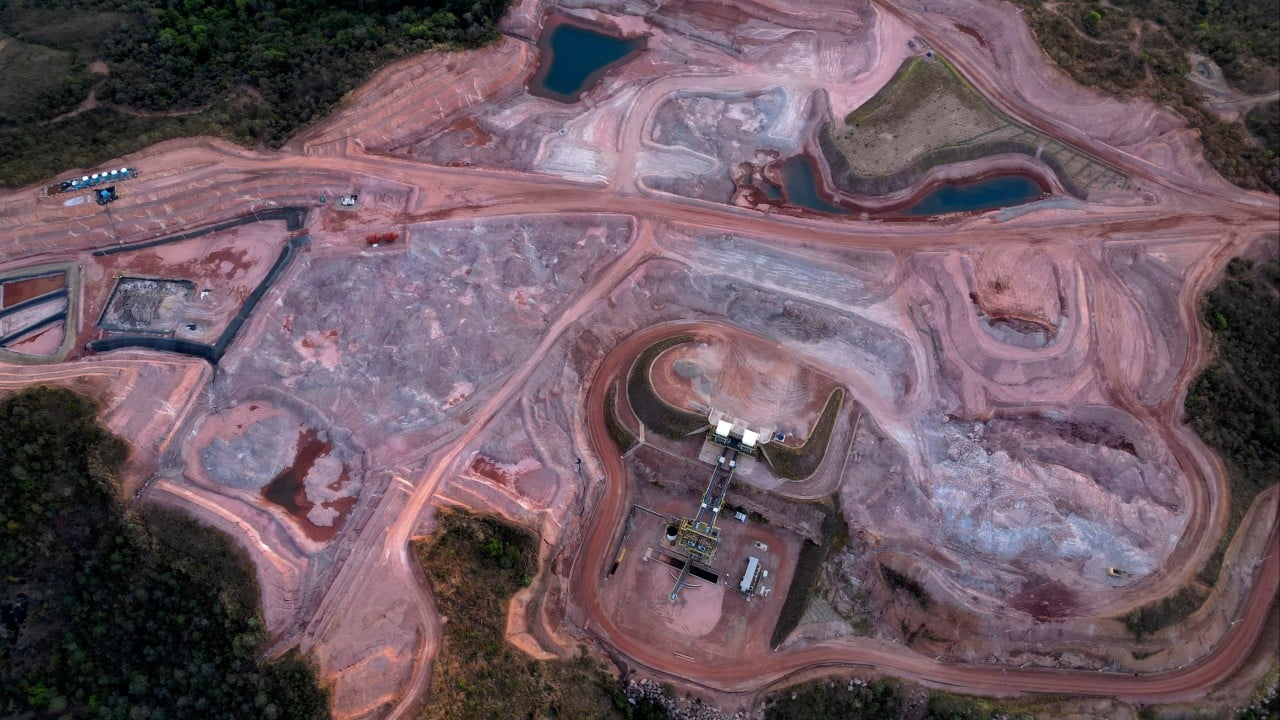
Walk into any boardroom in Washington or Brussels discussing critical mineral supply chains, and you will hear a comforting geographical fantasy. Brazil holds the world's second-largest reserves of rare earth elements, sitting on roughly twenty-one million metric tons of potential salvation. The narrative writes itself: Latin America's largest economy will soon dig up these vital components, supply the Western electric vehicle and defense industrial bases, and neatly shatter Beijing's near-monopoly on permanent magnets.
It is a clean story. It is also fundamentally detached from industrial reality. You might also find this connected story insightful: The Anatomy of Autumn Real Estate Liquidity Shifting From Friction to Velocity.
Owning the dirt is not the same as owning the supply chain. While researchers point out that Brazil cannot loosen China's grip on the rare earth magnet market anytime soon, the conventional analysis stops at the surface. The true bottleneck is not a lack of political will, nor is it a shortage of raw geological deposits. The crisis lies in an unbridgeable chasm of chemical engineering, environmental permitting realities, and intellectual property hoarding that decades of Western neglect cannot solve by simply throwing capital at the problem.
Consider what actually happens after a mining company pulls ore from the ground. In places like Minaçu, where operations like Serra Verde extract ionic clays, the material must first be converted into a mixed rare earth carbonate. For every single ton of finished permanent magnet required by a modern wind turbine or guidance system, roughly two tons of this carbonate must be chemically produced. That is a baseline mass-balance requirement that catches many investors off guard. As reported in recent articles by CNBC, the effects are widespread.
Yet carbonate is merely the starting line. The seventeen rare earth elements chemically bind together in atomic matrimony, sharing nearly identical physical properties. Tearing them apart requires hundreds of sequential solvent extraction stages using toxic acids and precision liquid-liquid handling. China spent fifty years perfecting this solvent chemistry, operating with laxer historical environmental standards and an unflinching state-directed strategy that treated economic losses as the cost of absolute market dominance.
Beijing does not publish blueprints for these separation circuits. Western mining developers attempting to build similar facilities in Brazil or elsewhere find themselves reinventing a very complex wheel. Every deposit has a distinct mineralogical fingerprint. A solvent formula that isolates neodymium in a Chinese hard-rock deposit will fail when applied to an ionic clay profile in South America. Adjusting those chemical baths takes years of trial, error, and multimillion-dollar pilot testing.
Even if a Brazilian facility successfully separates high-purity oxides, the journey toward a functional magnet hits another wall: metallization and powder metallurgy. Stripping oxygen from neodymium oxide to create pure metal requires high-temperature electrolysis or calciothermic reduction—processes fraught with technical hazards and massive energy demands. Once the metal exists, it must be alloyed with iron and boron, milled into ultrafine powders, aligned in a magnetic field, and sintered under immense pressure without oxidizing.
A single mistake in the oxygen-control environment turns a high-performance magnet into brittle scrap metal. Brazil currently hosts promising research initiatives, such as the MagBras project and specialized laboratories in Minas Gerais and São Paulo attempting to master this full cycle. These domestic centers are making admirable strides, but transitioning from a controlled academic laboratory bench to a commercial factory churning out thousands of tons of consistent, spec-compliant material is an industrial marathon.
The financial climate offers no comfort to these domestic pioneers. A brutal slump in global rare earth prices over recent years has scared away traditional commercial lenders. Mining developers cannot secure debt when the end-product pricing is dictated by a dominant competitor capable of absorbing short-term losses to crush emerging foreign rivals. While the Brazilian government has stepped up with strategic financing funds, public capital alone cannot substitute for the invisible infrastructure of an established industrial ecosystem.
An ecosystem requires machine tool builders, chemical reagent suppliers, specialized welding technicians, and waste management facilities designed specifically for low-level radioactive thorium that routinely accompanies rare earth ores. China built that entire support network over half a century. Brazil is attempting to construct it from scratch while global automakers and defense contractors demand immediate, low-cost delivery.
Western policymakers hoping for a quick geographical swap—trading dependence on Beijing for dependence on Brasília—misunderstand the timeline of heavy industry. Capital can be deployed overnight; specialized engineering talent cannot. It takes a decade to train the chemical metallurgists who understand how to tweak a multi-stage solvent circuit when impurity levels shift by fractions of a percent.
Until Western governments are willing to implement permanent price floors, direct supply-chain off-takes, and multi-decade commitments that insulate domestic producers from market manipulation, the immense wealth locked in Brazilian clay will remain largely conceptual. The rocks are there. The chemistry, the engineering, and the systemic capacity are not.
China's magnet grip remains secure not because it owns all the earth, but because it owns the entire process of turning earth into technology.
Understanding Brazil's rare earths industry
This investigative report breaks down the complex economic and technical barriers facing Brazil's rare earth sector as it attempts to challenge foreign supply chain dominance.