The United States has explicitly revived the Monroe Doctrine to secure the world's fastest-growing oil patch in Guyana, but the official narrative of regional stabilization hides a far more aggressive, corporate-driven strategy of resource dominance. Under the newly christened Trump Corollary—popularly known as the Donroe Doctrine—Washington is using naval blockades, targeted sanctions relief, and explicit military posturing to turn Georgetown into its ultimate energy fortress. Yet, while policy papers frame this as a defensive shield against Venezuelan aggression and Chinese encirclement, a closer look at the mechanics of the Stabroek Block and the sudden removal of Nicolás Maduro reveals that Washington is not protecting a vulnerable ally. It is policing a corporate fiefdom.
The stakes could not be higher. Bolstered by soaring global oil prices driven by the conflict between Israel and Iran, Guyana is currently seeing its weekly oil revenues surge past $600 million. A country of barely 840,000 people has seen its per capita GDP skyrocket from $5,640 in 2015 to nearly $30,000. It is an economic explosion unprecedented in modern history, and every drop of it is tethered to American capital.
The Mechanics of the New Hemispheric Policing
To understand how the Donroe Doctrine operates, one must look past the high-minded rhetoric of the International Court of Justice in The Hague, where Guyana and Venezuela continue to trade legal briefs over the disputed, resource-rich Essequibo region. The real enforcement is happening at sea.
Through Operation Southern Spear, the United States military has effectively weaponized maritime law in the Caribbean. The December 2025 seizure of the Skipper, a massive oil tanker intercepted off the Venezuelan coast, signaled a transition from economic pressure to kinetic enforcement. Officially justified by the administration as an extension of the war on drugs and anti-cartel operations, the naval blockade serves a dual purpose. It chokes off the remaining unauthorized lifelines of the Venezuelan state while guaranteeing that Guyana’s offshore platforms remain unmolested.
[U.S. Maritime Interdiction / Operation Southern Spear]
                       │
        ┌──────────────┴──────────────┐
        ▼                             ▼
Choking Venezuela            Protecting Guyana
(Tanker Seizures)            (Stabroek Monopolization)
This is the Roosevelt Corollary updated for the twenty-first century. Where Theodore Roosevelt once claimed the right to exercise an "international police power" to keep European empires out of the Caribbean, the current administration is using naval power to dictate exactly who can extract, ship, and profit from South American crude.
The Exxon Fiefdom and the Illusion of Sovereign Wealth
The narrative peddled by Washington think tanks suggests that American intervention is saving Guyana from a predatory neighbor. The reality on the ground in Georgetown looks less like a sovereign partnership and more like a corporate extraction mechanism.
The heart of the entire geopolitical tussle is the Stabroek Block, a 6.6-million-acre offshore goldmine operated by ExxonMobil, which holds a 45 percent interest alongside partners Hess and CNOOC. The block is currently pumping over 900,000 barrels per day. But the contractual architecture underpinning this production is remarkably lopsided.
Under the production-sharing agreement signed in 2016, the Exxon-led consortium is permitted to claw back up to 75 percent of the oil produced each month to recover its exploration and investment costs. The remaining 25 percent is designated as profit, which is split 50/50 with the Guyanese government. This leaves Guyana with a meager 12.5 percent profit share, plus a 2 percent royalty.
While hundreds of millions of dollars are flowing into the country's central bank every week due to high oil prices, the systemic infrastructure of Guyana remains fragile. The local economy is suffering from severe Dutch Disease, where a sudden influx of foreign currency distorts local prices, drives up the cost of living, and starves non-oil sectors of talent and capital. The wealth is real, but its distribution is heavily skewed toward Houston and Wall Street.
The Dual Track Diplomacy of Carrots and Blockades
The true investigative angle behind the Donroe Doctrine lies in its hypocrisy. While Washington uses Guyana as a geopolitical cudgel against Caracas, it is simultaneously rewriting the rules for Venezuela's vast, state-controlled oil reserves following the ouster of Maduro.
In early 2026, the United States Treasury Department issued a series of sweeping General Licenses that painted a starkly different picture from the hardline rhetoric of the naval blockade.
- General License 48 authorized American citizens and corporations to provide the goods, software, and engineering services necessary to repair and maintain Venezuela's decaying energy infrastructure.
- General License 52 went even further, explicitly allowing U.S. firms to enter into new investment contracts for upstream oil and gas exploration with Petróleos de Venezuela (PdVSA).
The strategic play is transparent. Secretary of State Marco Rubio made the administration’s strategy clear during a Senate Foreign Relations Committee hearing, issuing an ultimatum to the transitional authorities in Caracas: reform the internal investment framework to protect American capital, or watch those billions flow directly into the Stabroek Block next door.
Washington is running a classic regional shell game. It uses the threat of total economic strangulation via the Guyana defense umbrella to force Venezuela's new leadership into a neocolonial capitulation, while using the threat of a rehabilitated Venezuelan oil sector to keep the Guyanese government compliant and dependent on U.S. military protection.
The Essequibo Illusion
For all the nationalist theater coming from both Caracas and Georgetown, the territorial dispute over the Essequibo—which makes up two-thirds of Guyana's landmass—is an engineered crisis that serves the interests of leaders in both capitals, as well as their handlers in Washington.
For the acting Venezuelan government, keeping the Essequibo claim alive is a potent tool for domestic mobilization, a way to drum up patriotic fervor during a chaotic political transition. For Georgetown, the constant threat of a Venezuelan cross-border incursion is the ultimate leverage to ensure the U.S. Navy keeps its destroyers stationed in the Caribbean Sea.
But a permanent resolution to the dispute is the last thing the corporate actors want. The ambiguity creates a risk premium that justifies the lopsided terms of the Stabroek contract. It provides the geopolitical pretext for an ongoing American military presence in northern South America, effectively establishing a permanent command post right on the doorstep of the Amazon.
A Sphere of Explicit Influence
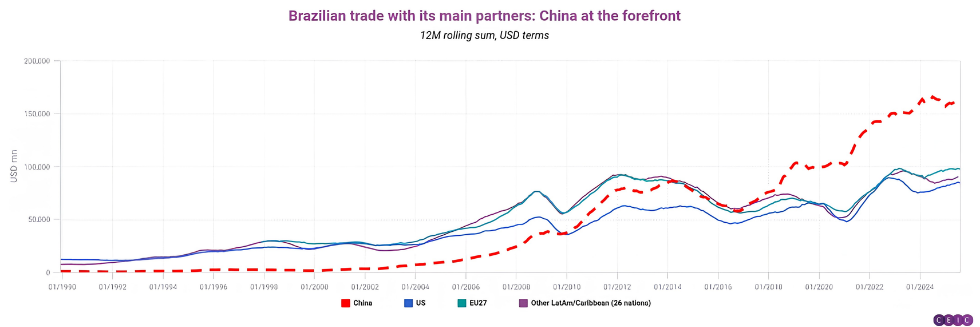
The Donroe Doctrine is not a localized policy designed for a small Caribbean nation. It is a sweeping reassertion of American imperial hegemony over the entire Western Hemisphere, designed to lock out Chinese infrastructure investments and secure critical mineral and energy supply chains through raw coercive power.
By enlisting right-wing regional governments through political maneuvers and outright electoral interference over the past two years, Washington has built a coalition of the willing that acts as a logistical staging ground for maritime interdictions. It is an integrated military and economic zone where national sovereignty is secondary to corporate supply chain security.
The strategy carries immense risks. By relying on naval blockades and unilateral tanker seizures, the administration is testing the absolute limits of international maritime law. It is an approach that mirrors the gunboat diplomacy of the nineteenth century, executed with twenty-first-century military technology.
Guyana has found itself at the absolute center of this grand strategy. The country is not an independent actor navigating a complex geopolitical landscape; it is a golden goose locked in an iron cage. The billions of barrels of oil sitting off its coast have bought the nation unprecedented wealth, but they have also cost the country its strategic autonomy. The U.S. military is back in Latin America with a vengeance, and it has no intention of leaving until the last drop of crude is pumped, refined, and sold under the American flag.