Evolution is a master engineer. Over millions of years, it has designed creatures capable of thriving in environments that would instantly kill a human. We are talking about frogs that live without open water in scorching deserts, and blind snails thriving next to deep-ocean vents that spew boiling, toxic chemicals.
But the latest data from the International Union for Conservation of Nature (IUCN) Red List reveals a grim reality. Extreme evolutionary adaptations are no match for industrial machinery. The global tally now sits at 175,909 species assessed, and a staggering 49,505 of them are threatened with extinction. That means more than a quarter of evaluated life on Earth is sliding toward the brink.
We aren't just losing fragile species. We are wiping out the most resilient, ingeniously adapted organisms on the planet. The problem isn't their inability to adapt to nature. The problem is that they cannot adapt to us.
The Crushing Reality of Deep Sea Mining
Consider the hydrothermal vents at the bottom of our oceans. These volcanic geysers jet out mineral-rich water at temperatures reaching 450°C (842°F). The pressure is immense, the darkness is absolute, and the chemical soup is toxic to almost everything else. Yet, a vibrant ecosystem of molluscs, limpets, and clams calls these vents home.
The new Red List update shows that two-thirds of the hundreds of mollusc species found exclusively on these deep-sea vents are now threatened with extinction. The culprit isn't a change in volcanic activity. It is the imminent threat of deep-sea mining.
Companies want the precious metals packed into the rocks around these vents. As mining exploration ramps up, especially in the Indian Ocean, machines stir up massive plumes of sediment. This underwater dust storm smothers the vents and chokes out the specialized life forms living there. Take Lirapex felix, a tiny snail that survived the crushing depths of the ocean for eons. It is now officially classified as critically endangered because humans want to dig up the seabed for minerals.
When we destroy a hydrothermal vent, we destroy a completely isolated evolutionary laboratory. These creatures can't just move to a different reef. They have nowhere else to go.
Mining the Desert Sand
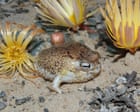
The destruction isn't limited to the ocean floor. Look at the coastal dunes of southern Africa. Here, you find the desert rain frog. Most amphibians need constant moisture or a nearby pond to keep their skin wet and lay their eggs. This bulbous little frog decided it didn't need any of that.
It spends the blistering day buried deep in the cool, damp sand, emerging only at night to hunt for insects. It absorbs moisture directly from the sand grains. It is a spectacular example of evolutionary rule-breaking.
Yet, diamond mining operations are tearing up these exact coastal dunes. Stripping the sand to find gems destroys the fragile subterranean layer where these frogs hide from the sun. Evolution spent millennia teaching a frog how to live in a desert, but it couldn't teach it how to survive a bulldozer.
The Brutal Colonial Footprint of Invasive Species
If industrial extraction is a direct assault, our historical baggage is a slow poison. Australia serves as the ultimate case study for how human-introduced threats break ancient survival systems.
For millions of years, small marsupials filled the ecological niches of rodents and small carnivores across the Australian outback. They developed unique survival tactics. Some burrowed, some jumped, and some relied on sharp nocturnal senses. Then, European settlers arrived, bringing red foxes and feral cats.
The native wildlife had absolutely no evolutionary defense against these highly efficient, placental predators. The new Red List update formally confirms what scientists feared. Five more small Australian marsupials are now officially listed as extinct, not having been spotted for at least 60 years.
- The crest-tailed mulgara
- The southern mulgara
- The northern mulgara
- The little mulgara
- The little bettong
The mulgaras were fierce, rat-sized carnivores that hunted insects and small vertebrates in the arid interior. The little bettong was a rabbit-sized hopping marsupial built for speed. None of those traits mattered when feral cats and foxes swept through their habitats. Australia has now recorded more than 40 modern mammal extinctions, a horrific track record driven mostly by introduced predators.
The Cost of Living in the Trees and Ice
The crisis extends into every layer of the biosphere. Earlier updates and ongoing tracking show that human expansion leaves no sanctuary untouched.
In West Africa, primates like the Roloway monkey are being pushed into tiny fragments of remaining canopy due to relentless logging and the bushmeat trade. Only about 2,000 of these monkeys remain in Côte d'Ivoire and Ghana. Their large body size and beautiful fur make them easy targets for hunters.
Even the frozen ends of the earth offer no escape. The melting sea ice driven by carbon emissions has created a crisis for emperor penguins. Mass drownings of chicks occur when the ice breaks up too early in the season, before the young birds develop waterproof feathers. An animal built to withstand the coldest temperatures on the planet is drowning because the planet is warming too fast.
Proof That Conservation Shifts the Balance
It is easy to look at these numbers and give up hope. But the IUCN data contains a massive silver lining that proves human effort can reverse the damage.
The numbat is a small, stripy Australian marsupial that eats up to 20,000 termites a day using a long, sticky tongue. Like its extinct cousins, the numbat was driven to the absolute edge by feral cats and foxes. It was almost gone.
Instead of watching it vanish, conservationists fought back. They used large-scale feral predator control, including targeted baiting and massive predator-proof fencing. They started intensive captive breeding programs at the Perth Zoo and carefully moved healthy groups into protected wild zones.
Because of this targeted, long-term intervention, the numbat population has rebounded enough to establish at least five new self-sustaining wild populations. It is a massive win.
But even this success story comes with a warning label. The numbat currently occupies a measly 0.04% of its original historic range across southern Australia. If we stop the predator management programs for even a single season, the foxes and cats will return, and the numbat will slide right back toward extinction. Conservation isn't a one-time project. It is a permanent commitment.
Moving Past Vague Awareness to Real Policy Change
We don't need more awareness campaigns. We need strict, legally binding protections and systemic changes to how we conduct global business.
If you want to actually make a difference beyond just reading the sad news, here is where the pressure needs to be applied.
Enforce Global Mining Moratoriums
The International Seabed Authority meets frequently to discuss the rules for deep-sea mining. The IUCN voted for a moratorium on deep-sea mining years ago, but commercial pressure is mounting. Governments must formalize a complete ban on mining around hydrothermal vents and sensitive deep-sea ecosystems. The minerals in those rocks are not worth the total erasure of unique biological lineages.
Fund Transnational Predator Control
The success of the numbat proves that invasive species management works. Governments in biodiversity hotspots need aggressive funding for predator-proof sanctuaries, indigenous-led land management, and island eradication programs to clear out introduced pests.
Rethink Supply Chains
Diamond mining in Africa and logging in West Africa are driven by global consumer demand. Companies must be held accountable for the biological destruction in their supply chains. Look for certified responsibly sourced materials, and demand that corporations provide verifiable data on the habitat impact of their extraction sites.
We like to think of nature as an infinite, adaptive force. It is incredibly creative, but it moves at the speed of genetic mutation over generations. Human destruction moves at the speed of an industrial supply chain. If we don't slow down our consumption and expand our protected zones, the next Red List update will simply be an obituary for the rest of Earth's most brilliant survivalists.